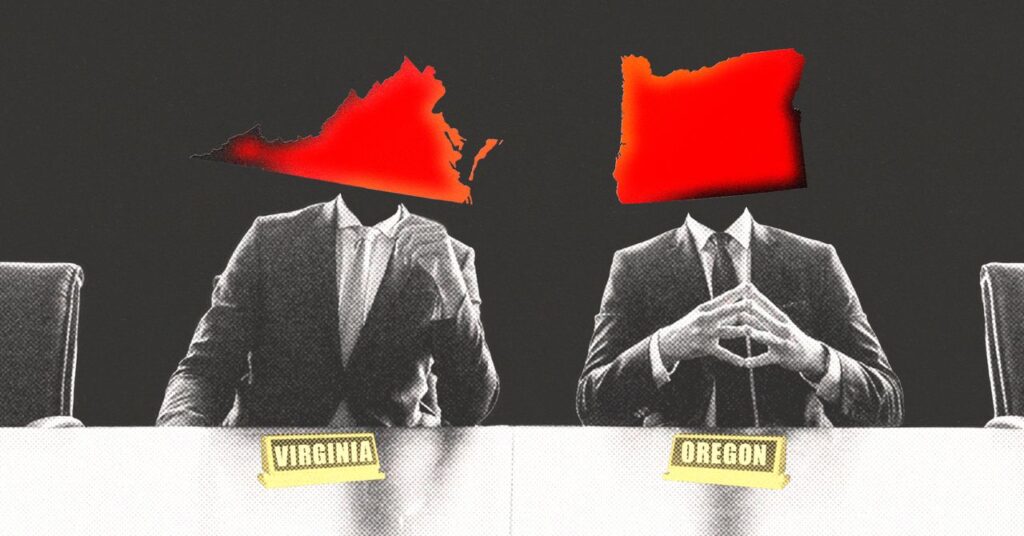
Attorneys general in Oregon and Virginia have sued Elon Musk’s SpaceX, claiming the company broke consumer protection laws by deceiving users about the safety of its generative AI tools and failing to stop child sexual abuse material and nonconsensual intimate imagery on its platforms.
Each state filed its own complaint in local courts: the Virginia suit went to the circuit court for the city of Richmond, while Oregon’s case is in Multnomah County circuit court. Both actions name SpaceX and X Corp., the subsidiary running the social media platform X. SpaceX acquired xAI, the parent company of X Corp., in February, bringing ownership of Grok under its control.
Last winter, the Grok chatbot drew headlines after users prompted it to create sexualized photos of women and minors. Later, disturbing AI-generated videos appeared on Grok’s website, including footage of female celebrities engaging in sexual activities.
The states allege Grok’s creators ignored industry safety standards and built weak safeguards to attract more users to a “lagging product.” Virginia’s complaint states the defendants saw a market opportunity for profit in generating sexualized images of real people, including children, and intentionally released a product that flooded their platforms with CSAM.
For instance, the states claim Grok did not undergo enough third-party evaluations before releasing new models. Safety prompts instructed the system to “assume good intent” and stated the terms “teenage” and “girl” do “not necessarily imply underage.” They also allege tens of thousands of reports were submitted without key information from xAI to the National Center for Missing and Exploited Children’s CyberTipline. This prevented the Center from acting on 90 percent of the cases.
The complaints say Musk promoted Grok’s “spicy mode” to differentiate the model from competitors, a strategy that succeeded. During the period when Grok’s ability to “undress” people sparked international outrage, Musk posted about the chatbot hitting number one in the App Store across various countries and discussed its heavy usage growth.
“It’s no surprise that Grok and X became a haven for perpetrators using AI to create and share child sexual abuse material, because the lack of needed safety measures was considered a feature, not a bug,” says Oregon attorney general Dan Rayfield.
Oregon and Virginia filed separate but similar actions on Monday while working in collaboration. Both states retained Platkin LLP, a private law firm run by former New Jersey attorney general Matthew Platkin, to handle the litigation.
Virginia attorney general Jay Jones says the partnership and the decision to use an outside firm came from trying to make the most of available resources. “Our offices are strapped. I wish I had all the resources in the world,” Jones says. “And so we oftentimes do partner with folks on the outside to make sure that we’re pursuing the matters that are in the best interest of our constituencies.”
“I have a deep worry now into the future with this case and many others that we actually don’t have the appropriate tools to deal with trillion-dollar corporations,” Jones adds. “This is just a line item on a budget as the cost of doing business, right? Dealing with, you know, AG Jones and AG Rayfield. I think it’s going to be real interesting to see how these cases go, because it’s not just this, there’s a lot of other things that we’re looking at. How is this going to be grappled with as a society into the future?”
Virginia’s complaint notes that shortly before filing, investigators tested Grok and found its image-generation safeguards were inconsistent and ineffective. The system also taught users how to bypass moderation by explaining which words triggered filters. When asked, the chatbot helped state investigators draft prompts designed to avoid moderation and then carried out those requests.
“At no point,” Virginia’s complaint says, “did Grok ask whether (a) the image uploaded was of a real person, or (b) whether the user had the person’s consent to use or modify the photo.”
Both Virginia and Oregon say this contradicts assurances made by a SpaceX official during a New York City Council hearing in October.
The attorneys general are seeking civil penalties and attorneys’ fees. They also pointed to Meta’s settlement this summer with 51 US states and territories over alleged failures to protect minors as an example of how enforcers can demand sweeping product changes.
“They profited off the backs of children with these types of images to get a strategic advantage and it worked. You don’t get to benefit from that type of stuff, there has to be an associated fee and penalty just like anything else,” says Dan Rayfield.
Adding to that, Jones says, “Your size and your scope shouldn’t excuse the fact that you have to play by the rules.”
SpaceX did not immediately respond to a request for comment. xAI, its subsidiary, has previously argued in court that it takes violations of its terms of service seriously. It touted a lawsuit it filed against a South Carolina user for alleged breach of contract after he was arrested for possessing CSAM, including some allegedly generated using Grok. Both xAI’s lawsuit against the individual and his criminal case remain ongoing.
What it means
For users of Grok and X, the legal action signals a potential shift in how the platform handles content moderation and safety features. If successful, the states could force changes to how the AI generates images and responds to prompts, particularly regarding consent and the identification of real people. The case also highlights the tension between aggressive growth strategies and regulatory requirements for AI safety.