A giant shark vertebrae lost in 1989 has been found, suggesting the extinct Otodus megalodon could have reached 80 feet. New research into human ancestors on Flores suggests they scavenged rather than hunted. Astronomers warn that satellite networks will ruin night sky observations. A special issue of Science examines 250 years of American scientific history.
Scavengers, not hunters
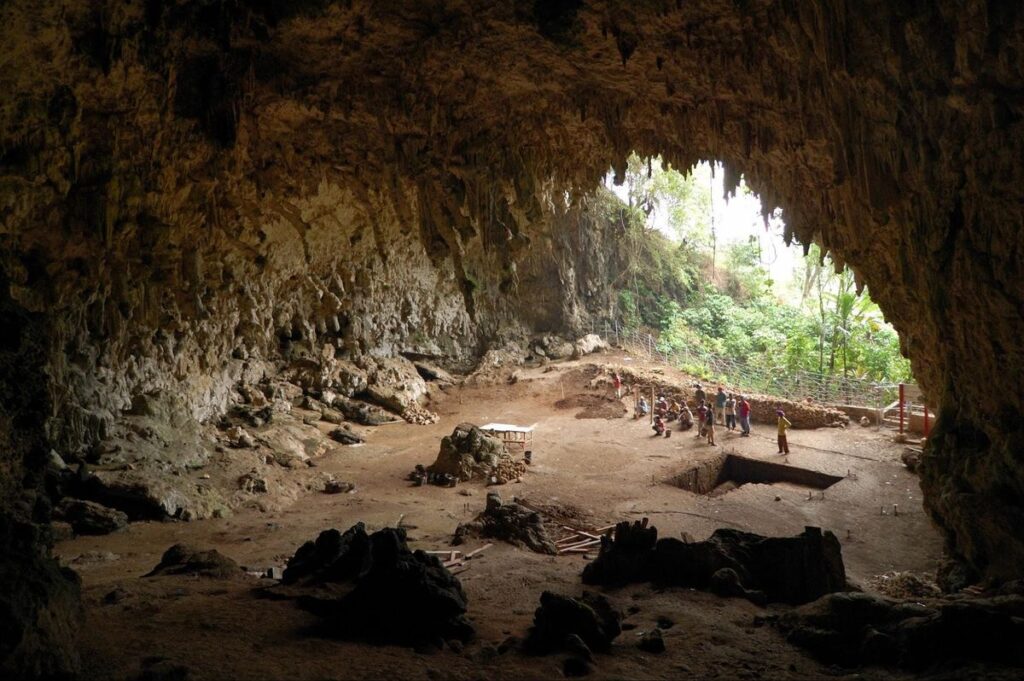
Researchers at the Smithsonian Institution have updated the picture of Homo floresiensis. These small hominins lived on the Indonesian island of Flores for over a million years. They disappeared around the same time modern humans arrived, roughly 50,000 years ago.
Previous findings at the Liang Bua cave showed charred bones and cut marks on Stegodon remains. This led to debates about whether the hobbits made fire or hunted large game. The new study argues they did neither.
E. Grace Veatch and her team believe the Stegodon carcasses were killed by Komodo dragons. The hobbits likely scavenged the leftovers. They consumed the meat raw. The charred remains found earlier were probably left by modern humans who arrived later.
“Komodo dragons likely had primary access to these remains leaving behind only low-utility elements for H. floresiensis to scavenge,” Veatch said.
The study notes the hobbits’ body proportions made running and throwing difficult. This suggests they never developed the skills needed to hunt large prey in the traditional sense. The discovery of grieving elephants in the cave adds to the strange mix of species that once shared the island.
The missing shark is found
A long-lost fossil of a Megalodon has resurfaced. Kenshu Shimada of DePaul University led the team that identified the specimen. It was missing from the National History Museum of Denmark since 1989.
Collection manager Mette Elstrup found a small portion of the vertebrae. It is now cataloged as NHMD 157890.
The fossil is nine inches across. It is the largest shark vertebral specimen known to date. It may also be the largest non-tetrapod vertebrae ever recorded.
This confirms the shark could have grown to 80 feet, perhaps even larger. The animal lived nearly 11 million years ago during the Upper Miocene period.
Satellites block the stars
Astronomers are concerned about the impact of massive satellite networks. A new study warns that plans to launch up to 1.7 million satellites will damage astronomical observations.
O. R. Hainaut from the European Southern Observatory says these satellites create light pollution and radio interference. They also block images of the night sky.
Particular worry exists for large orbital data centers proposed by SpaceX and mirror-like satellites from Reflect Orbital. The latter aims to provide sunlight to Earth at night.
“Reflect Orbital would produce more than 100 Venus-bright satellites by 2030 and over 1,000 by 2035,” Hainaut said. In areas with light pollution, people might only see artificial satellites at night.
These networks also risk orbital crowding and space debris. They interfere with traditional skywatching, a practice that has lasted for tens of thousands of years. Without regulation, the natural night sky could vanish within our lifetimes.
American science at 250
A special issue of Science looks back at 250 years of American scientific history. The collection covers six major moments, including the Manhattan Project, the rise of Silicon Valley, and the space program.
Valerie Thompson, books and culture editor of Science, said the scholars do not shy away from difficult topics. They examine the unrecognized contributions of enslaved people to early agricultural knowledge and the eugenics movement.
The issue invites readers to consider the past and future of the US scientific enterprise. It also raises questions about democracy, representation, and state support for research.