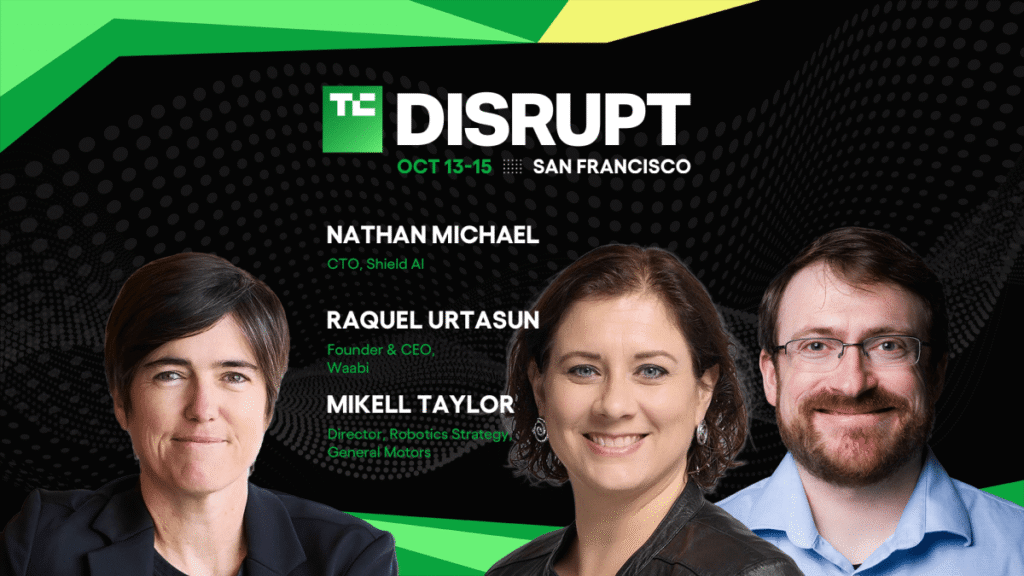
A mistake in an AI chatbot is a nuisance. A mistake in a system controlling an aircraft or autonomous truck can cause a crash. That difference defines the core challenge for the session “Building AI Systems When Failure Is Not an Option” at TechCrunch Disrupt 2026. Shield AI CTO Nathan Michael, Waabi founder and CEO Raquel Urtasun, and General Motors Director of Robotics Strategy Mikell Taylor will address the topic on the Real World AI Stage.
The discussion covers safety culture, validation testing, regulatory compliance, and building trust. The event runs October 13–15 at Moscone West in San Francisco. Tickets cost up to $200 less if secured by 11:59 p.m. PT on September 25.
Nathan Michael
Nathan Michael directs Shield AI’s Hivemind, a platform-agnostic mission autonomy software suite. He previously directed the Resilient Intelligent Systems Lab at Carnegie Mellon University’s Robotics Institute.
His work focuses on environments where performance must be matched by assurance. In February, the U.S. Air Force selected Hivemind as an autonomy provider for its Collaborative Combat Aircraft drone prototype program. Shield AI subsequently announced $1.5 billion in Series G funding, valuing the company at $12.7 billion.
Raquel Urtasun
Raquel Urtasun has spent 25 years in AI and autonomous vehicles. She served as chief scientist and head of R&D at Uber ATG. She is a professor of computer science at the University of Toronto and co-founded the Vector Institute for AI. Her publication record includes more than 200 AI papers.
Waabi raised $1 billion in January and announced a partnership with Uber to support the deployment of 25,000 or more Waabi Driver-powered robotaxis. The company uses its Waabi World simulator to train, test, and stress-test the Waabi Driver in a virtual environment. Urtasun has stated that autonomous trucks require full validation before driverless deployment.
This approach addresses the central question of her session: determining when an AI system is ready to operate without a human behind the wheel.
Mikell Taylor
Mikell Taylor leads robotics strategy for General Motors’ Autonomous Robotics Center. She previously led the Amazon Robotics team that developed Proteus, Amazon’s first autonomous mobile robot.
Her career began building a robotic senior prom date. She has since worked on autonomous underwater vehicles and industrial robotic systems. Her focus remains on machines that are practical, reliable, and able to work effectively around people.
Taylor emphasises that user experience and adoption must be considered from the start of product design and deployment planning. That human element matters when AI-powered machines leave controlled demonstrations and enter workplaces where people depend on them.
When failure isn’t an option
Aircraft, autonomous vehicles, and industrial robots present the same problem. When the consequences of failure are real, what does it take to deploy with confidence?
The session allows leaders in defense, autonomous driving, and industrial robotics to compare their approaches to the decisions that stand between a promising system and one ready for the real world.
Almost ready is not enough. Tickets are available until 11:59 p.m. PT on September 25. Buyers can also get a second pass for 50% off select ticket types.