
Scientists Gave ‘Aggressive’ Fish Psychedelic Drugs. A Breakthrough Came Next
Move over, coked-up salmon. Fish dosed with psilocybin, the psychoactive component found in magic mushrooms, showed less aggression toward peers compared to their normal behavior in laboratory experiments, according to a study published on Thursday in Frontiers in Behavioral Neuroscience.

Becky Ferreira
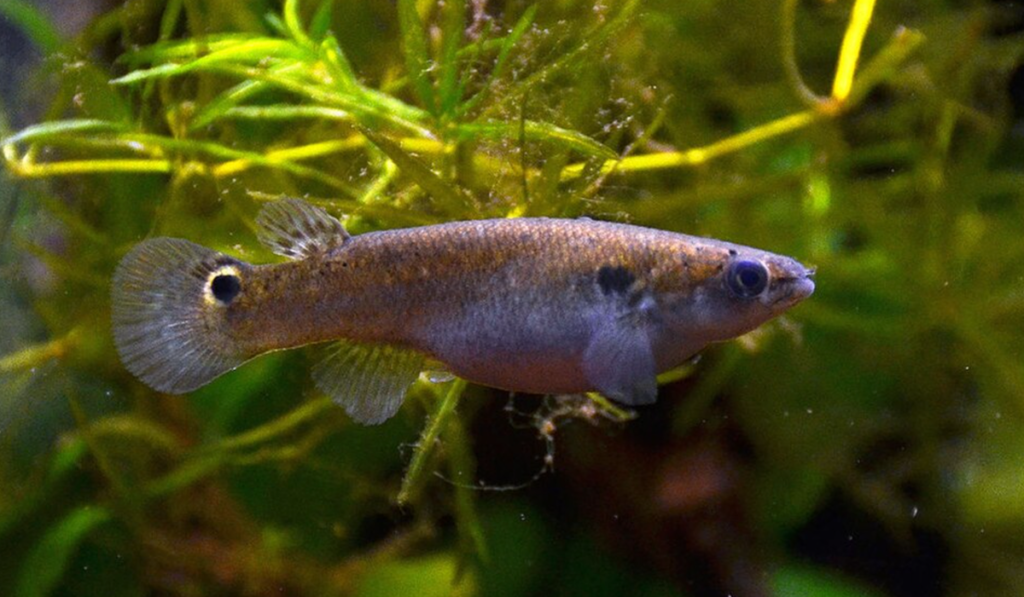
The mangrove rivulus fish (Kryptolebias marmoratus) is particularly intriguing as a highly aggressive fish with remarkable adaptations, including the ability to survive out of water for months at a time. It is also a rare hermaphroditic species that reproduces mainly through self-fertilization, removing genetic variation as a factor in experiments.
“Each lineage that we have is essentially genetically identical, and between lineages, they are genetically distinct,” said Dayna Forsyth, a research associate at Acadia University in Nova Scotia who led the study, in a call with 404 Media. “So, we eliminate the genetic factor, and just focus on the behavioral effect.”
To determine how psilocybin influences behavior in these fish, Forsyth and her colleagues placed two undosed fish on opposite sides of a tank with a fiberglass mesh barrier that allowed the fish to see and smell each other but prevented physical interactions. Then, the “focal fish” was removed and exposed to a low psilocybin dose in a separate tank for 20 minutes before being transferred back to the partitioned tank where its responses to the undosed “stimulus fish” were observed.
“We really had no idea what we were getting ourselves into,” Forsyth said. “We didn't have much to go off of before. My research question throughout was just: ‘does psilocybin affect fish behavior?’ We had no idea when we first started this, because there weren't too many papers out there on fish.”
As it turned out, psilocybin had a noticeable impact on the behavior of these fish. Mangrove rivulus fish express aggression by suddenly darting at peers in swimming bursts, but these charges were noticeably reduced in the psilocybin-treated fish. However, the fish still interacted in less overtly hostile ways—such as performing lateral and head-on displays meant to size up peers—regardless of whether they had been dosed.
“We definitely predicted that all aggressive behaviors, including those lateral and head-on displays, would be decreased,” Forsyth said. “We really did not expect it to just target that highly aggressive and more energetically costly behavior, rather than the low-energy behaviors. That was definitely a surprise.”
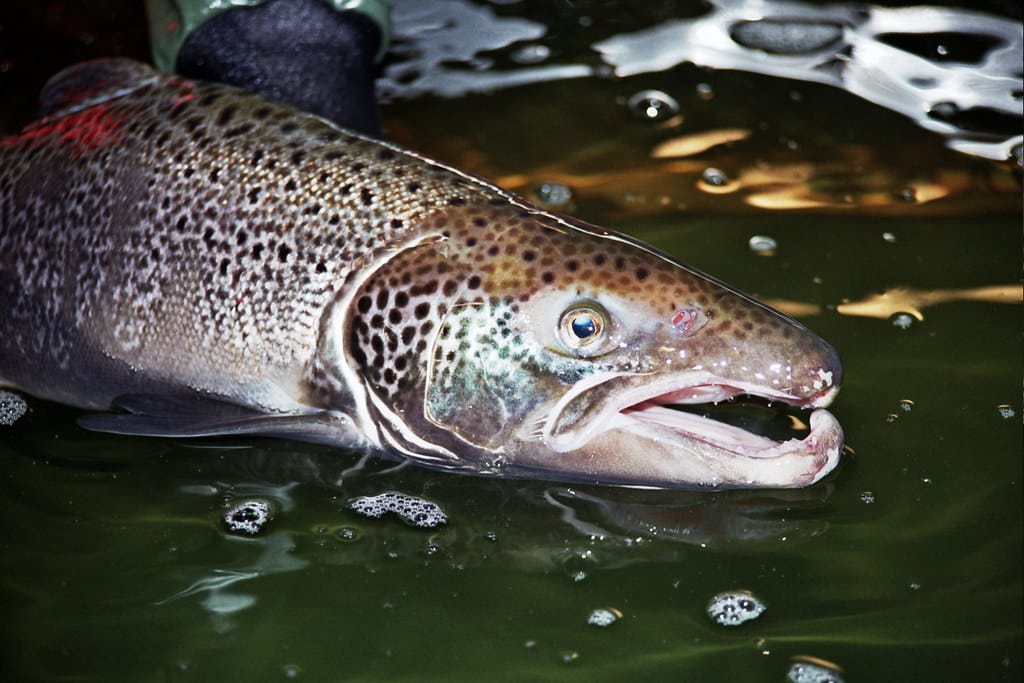
The study adds to a growing body of research about the impacts of psychoactive compounds on fish, including a recent study in Current Biology about salmon that were exposed to cocaine.
Similar experiments could eventually yield insights about the effects of psilocybin, and other substances, on humans given that we share some neural anatomy with fish. Forsyth is also interested in how an increased dose might affect fish, or whether they might develop a long-term tolerance to the compound that might shift their behavior back to a normal aggressive state.
“In terms of toxicology studies and exposing fish to a compound for a medicinal aspect, you always want the lowest dose that creates the outcome,” she said. “But it would be interesting to increase that dose and see if it almost reverses the effects. We don't know, but it would be interesting to see what that tolerance is for the dose, maybe even with repeated exposures over time.”
Key Takeaways
- The mangrove rivulus fish showed less aggression toward peers when dosed with psilocybin.
- This study opens up possibilities for future research into the neural mechanisms of behavioral changes in animals exposed to psychoactive compounds.
- Forsyth’s team plans to explore how an increased dose might affect fish and whether they could develop a tolerance, which is relevant both from a scientific and potential therapeutic perspective.
Originally published at 404media.co. Curated by AI Maestro.
Stay ahead of AI. Get the most important stories delivered to your inbox — no spam, no noise.