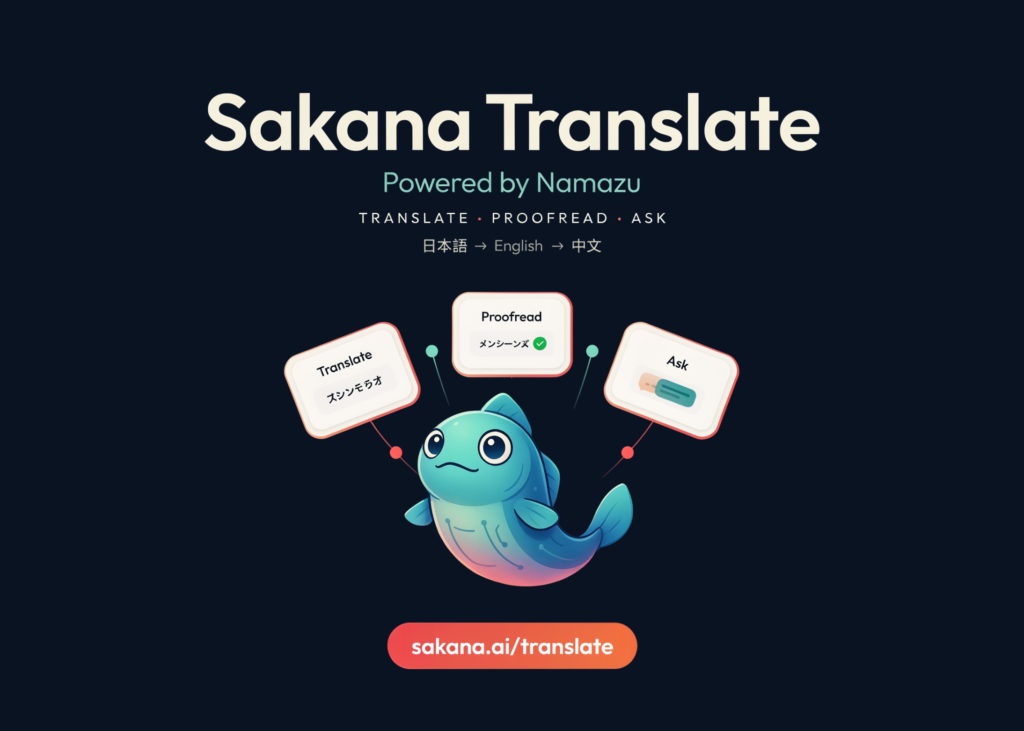
Sakana AI has launched Sakana Translate, a browser-based tool for translating between Japanese, English, and Chinese. It runs on Namazu, the company’s model series adapted for Japanese language and culture.
The service is free to use. A single account gives access to three functions: Translate, Proofread, and Ask.
What Sakana Translate does
Sakana Translate is not a new base model. It uses Namazu, which Sakana AI trained specifically for Japanese nuances.
The company describes the goal as “deep translation for Japan.” The aim is to carry context and tone between languages, not just swap words. General tools often fail here. They might handle grammar correctly but lose the interpersonal tone. They miss business honorifics, cultural concepts, abbreviations, and internet slang.
The product bundles three functions into one screen:
The three modes explained
Each mode targets a different everyday task. The table below summarises them.
| Mode | What it does | Key detail | Best for |
|---|---|---|---|
| Translate | Converts pasted text between the three languages | Up to ~5,000 Japanese characters, streaming output, history saved automatically | Emails, slide decks, articles, web pages |
| Proofread | Refines a draft into a more natural version | Changes shown with diff highlighting; adjusts tone, politeness, and formality | Business email and English writing checks |
| Ask | Answers follow-up questions about a result | Clarifies nuance, suggests alternatives, explains grammar in the same context | Learning why a translation reads the way it does |
A few terms are worth unpacking for engineers new to this space.
- Streaming output means the translation appears progressively, token by token. You do not wait for the full result before reading. This mirrors how chat models return text.
- Diff highlighting shows exactly what changed. Additions and removals are marked inline, like a version-control diff. Proofread goes past grammar. It also tunes naturalness, politeness, and the register a reader expects.
- Ask removes the tool-switching problem. You no longer jump between a translator and a dictionary. Nuance questions get answered against the same source and output.
You can try all three modes in the interactive demo below.
How Namazu powers it
Namazu is the engine, so its design matters here. Sakana AI is a Tokyo lab founded in 2023 by David Ha and Llion Jones.
Namazu is not trained from scratch. It applies post-training to existing open-weight foundation models. Reported base models include DeepSeek-V3.1-Terminus, Llama 3.1 405B, and gpt-oss-120B.
Post-training means adapting an already-trained model with further tuning. It is cheaper and faster than pre-training a model from zero. Sakana AI uses it to fit models to Japanese language and culture.
Sakana AI first announced the Namazu series on March 24, 2026. Sakana Translate applies that same adaptation work to the translation problem.
Benchmark and performance
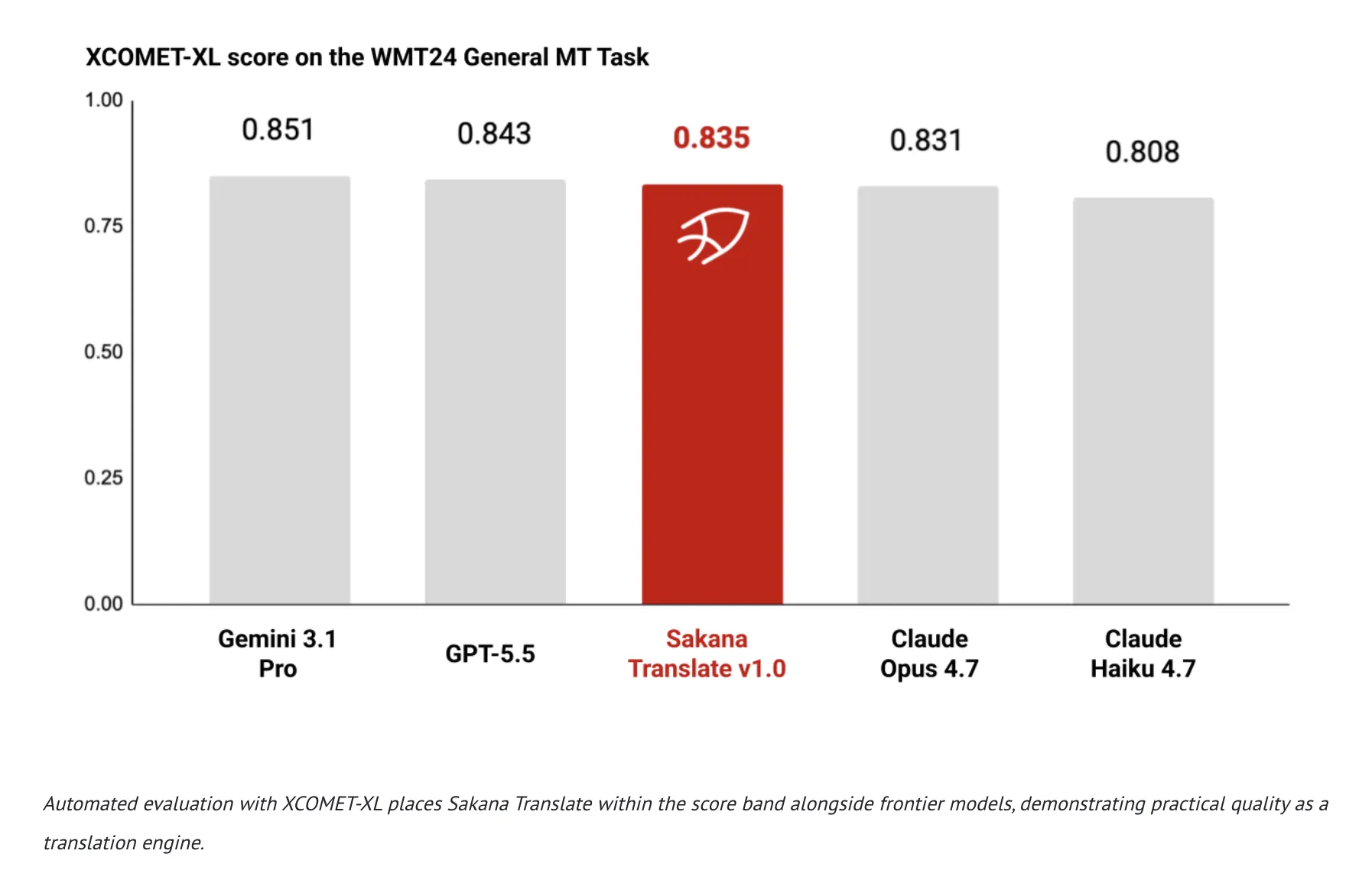
Sakana AI team evaluated translation quality with a standard setup. It used XCOMET-XL on the WMT 2024 General Translation task data.
Here is what those two names mean:
- WMT 2024 General Translation is a shared task from the Conference on Machine Translation. Systems translate test sets drawn from several domains across many language pairs. It is a common yardstick for machine translation research.
- XCOMET-XL is a neural evaluation metric from Unbabel, with roughly 3.5B parameters. It is a learned model that scores translation quality. It outputs a score and also flags specific error spans. Scores run from 0 to 1, where higher is better.
By the reported results, Sakana Translate landed in a score band close behind the leading models. Sakana AI describes this as competitive quality for a translation engine.
Sakana AI also ran a qualitative check on everyday Japanese texts. It reports strengths in honorifics, cultural concepts, place names, proper nouns, and everyday context.
Use cases with examples
Sakana AI published two concrete outputs. Both show the tone-preservation goal in action.
1. Business email (Japanese → English). The source is a polite, indirect request. It uses set business phrases such as o-mitsumori haiken shimashita and katte na onegai desu ga.
Source: お見積り拝見しました。勝手なお願いですが、もう少しご相談できますか?ご予算あれば社内で調整しますので、お聞かせください。
Sakana Translate: I saw your quote. This is a bit of a selfish request, but could we talk a bit more? If you have a budget in mind, I can work on it internally, so please let me know.
Sakana AI notes the polite tone is preserved. A flatter translation would drop that register.
2. Internet slang (English → Japanese). The source uses casual shorthand from a group chat.
Source: Iykyk, honestly. It’s an inside joke from the group chat.
Sakana Translate: まあ、わかる人にはわかるよね。グループチャットの内輪ネタだから。
The output keeps the same casual temperature in conversational Japanese.
Beyond these, practical scenarios follow naturally. A support agent can translate a long client thread in one paste. A developer can proofread an English release note before publishing. A learner can ask why a phrase carries a certain tone.
Comparison: what Sakana Translate targets
The table below frames Sakana AI’s stated design focus. The left column describes common behavior in general-purpose tools. The right column reflects Sakana AI’s own claims, not a head-to-head benchmark.
| Dimension | Typical general-purpose MT | Sakana Translate’s stated focus |
|---|---|---|
| Honorifics | Grammar correct, tone often flattened | Preserves polite and humble registers |
| Cultural concepts | Literal or generic renderings | Adapted to Japanese context |
| Slang and abbreviations | Frequently mistranslated | Matched to the original tone |
| Workflow | Separate translator and dictionary | Translate, proofread, and ask in one screen |
| Access | Varies | Free web app, single account, three languages |
A look at the evaluation metric
Sakana Translate has no public API yet. Sakana AI lists API access as a future, enterprise-focused plan.
You can still reproduce the evaluation method it used. XCOMET-XL is open and runnable. The snippet below scores one translation with it.
Related articles