**Editorial Brief**
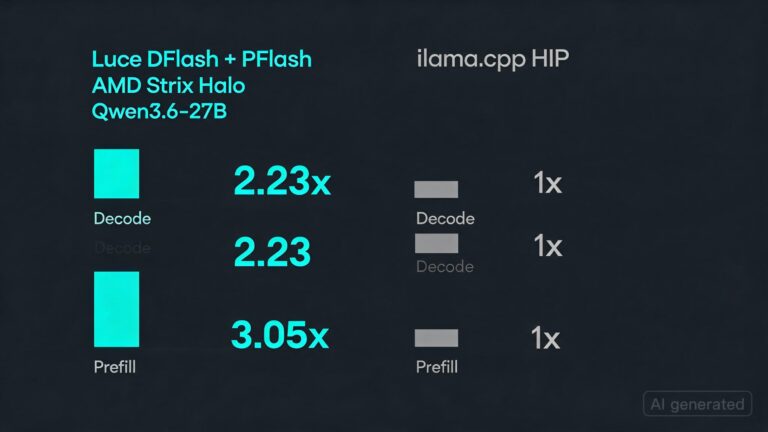
A new benchmark study has been released for Qwen 3.6-27B, a large language model (LLM) that is part of the Strix Halo Windows suite. The key findings highlight variations in performance across different tasks and model configurations.
For instance, when tasked with generating text like a short poem or editing HTML artifacts, the model’s throughput varies significantly depending on whether it uses MTP (Model Tuning Pipeline) with specific parameters such as `spec-draft-n-max`. This study underscores how model tuning can dramatically affect performance metrics.
The results show that Qwen 27B Dense has an average token generation rate of around 12.6 tokens per second across various tasks. When using MTP, this rate jumps to nearly 20 tokens per second for some tasks, indicating significant gains in efficiency and effectiveness.
**Why It Matters**
This study is crucial as it provides insights into the performance variability of large language models under different conditions. Understanding these nuances can help developers optimize their workflows and applications more effectively. For instance, if a task requires high-speed generation like generating text quickly or editing HTML artifacts, using MTP with the right parameters could be highly beneficial.
**Takeaways**
– **Model Tuning Variability**: The study highlights how model tuning significantly impacts performance metrics, which is crucial for benchmarking and optimization.
– **Task-Specific Performance**: Different tasks require different levels of efficiency. Understanding these variations helps in tailoring models to specific use cases.
– **Optimization Opportunities**: Developers can leverage this information to optimize their applications by choosing the right parameters or model configurations for each task.
This study offers valuable insights into how large language models can be fine-tuned and optimized, leading to more efficient and effective AI systems.