Three terms now compete for the same line in AI engineering job descriptions. Prompt engineering is the established one. Loop engineering entered the AI vocabulary in late 2025 and dominated developer discussion through June 2026. Graph engineering followed roughly six weeks later.
They get used interchangeably. They should not be.
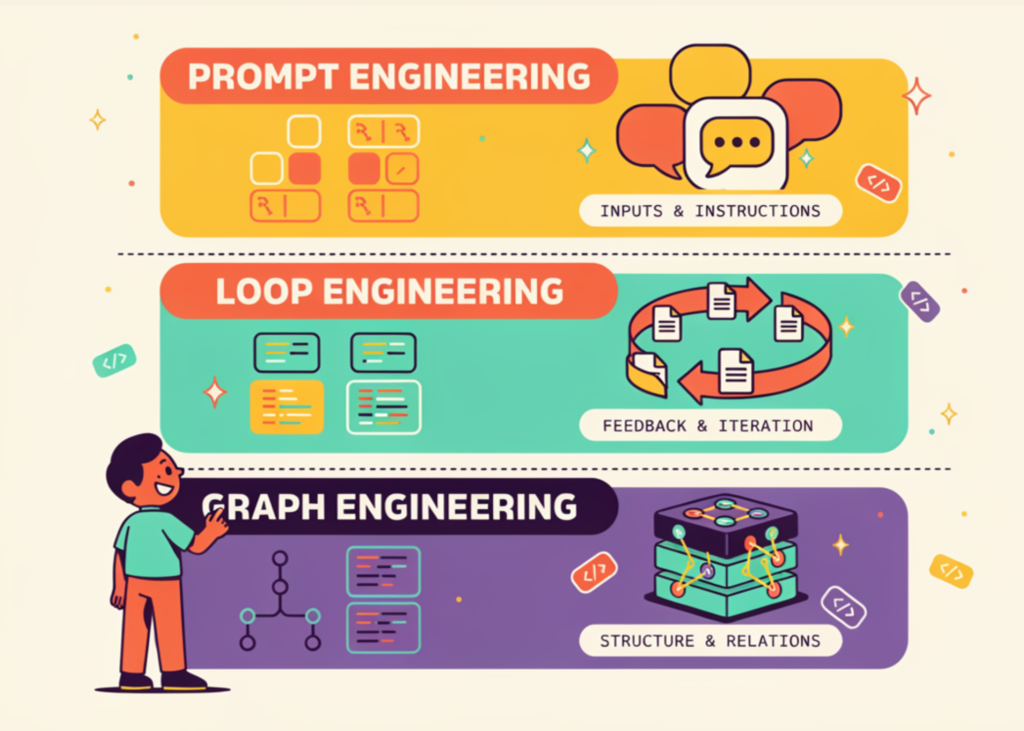
The three are not competing techniques. They are three different units of control, stacked. A prompt controls one model response. A loop controls one agent’s behaviour cycle. A graph controls the organisation of many agents. Each layer preserves the layer beneath it. A prompt does not disappear once a loop is built around it. It stops being the thing typed by hand.
This article separates the three: what gets designed at each layer, what the published claim says about when the higher layers pay for themselves, and where the skepticism is warranted.
One task, three layers
The three terms are not competing techniques. They are three different units of control. Here is the same job handled at each layer, step by step. Orange dots mark the moments a human is required.
The stack, in order
Each step in the progression was named in practice before it appeared in vendor documentation.
- Prompt engineering covers writing and structuring the instruction for a single call. Anthropic‘s guidance is to separate a system prompt into labeled sections — background information, instructions, tool guidance, output description — delineated with XML tags or Markdown headers. The recommendation is to supply the minimal set of information that fully specifies the expected behavior. Minimal does not mean short.
- Context engineering came next. Anthropic describes it as the natural progression of prompt engineering. The question moves from finding the right words to deciding what configuration of tokens belongs in the window at all. Context is a finite resource, and the engineering problem is optimizing the utility of those tokens against model constraints.
- Harness engineering covers the environment a single agent runs inside: files, tools, memory, feedback.
- Loop engineering sits one floor above the harness. A June 2026 arXiv paper on agentic AI in building engineering, Buildrix, sets out the same four-step progression explicitly — prompt, then context, then harness, then loop — with the final layer defining how a system repeatedly observes, acts, verifies and recovers.
- Graph engineering is the newest label and the least settled. One enterprise writeup notes that the term’s provenance is unresolved and that it collides with an older knowledge-graph usage of the same word. The underlying practice, graph-based orchestration, has a documented lineage in multi-agent systems research.
Layer 1: Prompt Engineering
The defining assumption is that a human is present at every iteration. A prompt is written, the model responds, the output is judged, the prompt is revised.
That assumption is what breaks. High volume. Multi-step tasks. No human available to grade the output. Results that feed the next step automatically. Any one of these, and the prompt alone stops being sufficient.
Nothing about the prompt got worse. The surrounding conditions changed.
Prompt engineering also does not vanish inside the higher layers. Anthropic’s multi-agent research writeup reports that prompt engineering was the primary lever for fixing coordination failures. Early versions spawned 50 subagents for simple queries, and the fix was prompting rather than topology.
What prompt engineering is
Prompt engineering is designing the text of a single call to a model. One input, one forward pass, one output — and a human who reads the result and decides whether to run it again. That last part is the assumption everything above this layer exists to remove.
For the people making things, this means you are the loop. You write the instruction, you wait for the answer, you decide if it is right, and you rewrite the instruction if it is not. This cycle works fine for a single task. It fails when volume rises or when the output must automatically trigger the next step without a human checking it first.
Layer 2: Loop Engineering
The framing is that a coding agent is a brute-force tool for finding solutions. The craft is designing the goal, the tools, and the rules that tell the agent when to stop.
Here, the human steps back from every single turn. Instead, you build a cycle. The agent runs a task, checks its own work, and decides whether to try again or move on. You define the trigger, the tools available, the stop condition, and the retry budget. The loop calls itself as a verifier.
This layer handles repetitive, machine-checkable work within one domain. If the agent cannot tell done from stuck, the loop fails. The prompt does not go away, but it is no longer the thing you type by hand.
Layer 3: Graph Engineering
You control how many agents are organised. This layer manages the connections between different tasks and the state they share.
Here you define nodes, edges, shared state, and failure routes. A routing rule written in advance decides which agent handles which part of a complex job. This is where you handle cross-domain work with parallel branches.
It breaks when context never crosses an edge you forgot to draw. The term is still settling, and it overlaps with older uses of the word graph in data structures. But the practice is clear: you are building the map that tells multiple agents how to work together.
What it means
The shift is about where the human sits in the chain. At Layer 1, you are the judge at every turn. At Layer 2, you are the architect of the judge. At Layer 3, you are the designer of the whole room.
For developers, this means the work changes from writing text to writing logic. You stop tweaking instructions and start building the systems that run them. For makers, it means you can build tools that keep working without your constant attention, provided you design the loop and the graph correctly.