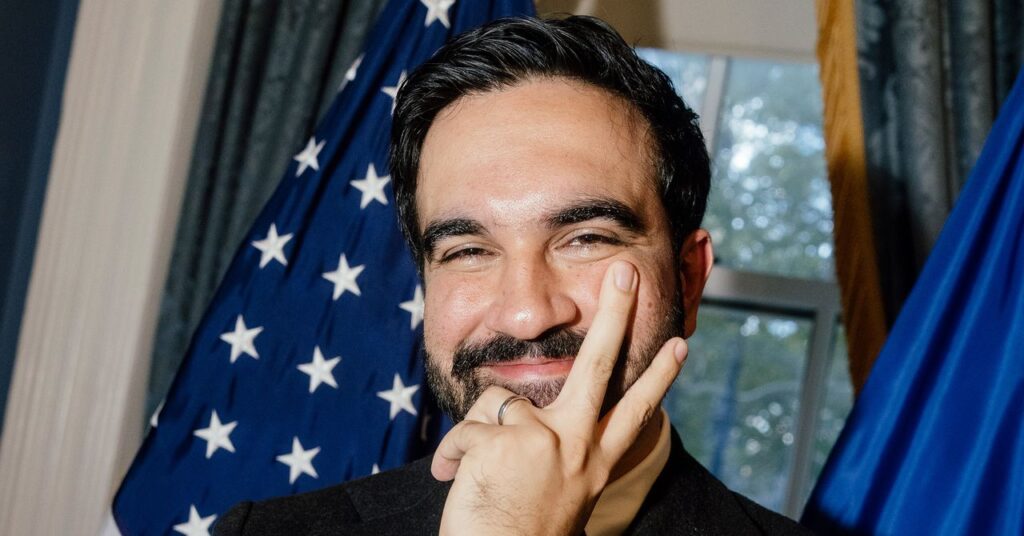
New York City Mayor Zohran Mamdani sits at a 69 percent approval rating among voters, yet he remains a lightning rod for polarizing debate.
The interview took place at City Hall after his first 10 months in office. He admitted, hoarsely, that it had been a long day.
Katie Drummond opened the conversation by recalling an interview from October 2025. Mamdani was 34 then. The setting was a campaign office in Sunset Park, Brooklyn. Drummond noted she had seen him being serenaded with “Happy Birthday” there. She did not join in.
“I was wondering, like, ‘Who’s that woman who’s not singing along?'” Mamdani said.
“Yes, the one with the really excited 9-year-old, and her mom was like, ‘No, we’re gonna keep going.’ That was me,” Drummond replied.
Mamdani described the last year as the most transformative of his life. He moved from being an unknown figure to leading the city. He is now 35.
“In the world of my friends, this is an age that has a lot of existential questions that come with it,” Mamdani said. “In the work that I do, most people are significantly older than me, and so the meaning of the age, it doesn’t really live in a professional setting.”
He addressed questions about his age being a barrier. He cited a meeting with Brazilian President Luiz Inácio Lula da Silva at the UN General Assembly. Lula had been excited by the fact that Mamdani was young.
“So young!” Lula kept saying.
Mamdani argued that being 35 means growing up through the housing crisis and the Iraq War. He believes these formative moments often affect other people more than the generation that shaped them.
The discussion turned to social media. WIRED had declared Mamdani the internet’s Mayor before the election. He stated he wanted his campaign to own the medium.
“I think the similarity is that you have to continue to recognize the fact that for many New Yorkers, this is how they engage with the world,” Mamdani said. “It is yet another medium that has to be treated with the same legitimacy and respect as traditional mediums.”
He explained that social media allows a single video to reach more than a million people. He noted the need to work backwards from how New Yorkers consume media.
An example involved Spanish-speaking constituents. The administration created a WhatsApp channel called El Chisme Oficial de NYC. They share information directly there. Mamdani recorded voice notes in Spanish to explain policies.
“I think for too long there’s been a sense of ‘pat myself on the back’ in government,” he said. “We have to make politics and political decisions something that reach people wherever they already are, as opposed to the condescension that comes with, ‘If you’re not reading this, then it’s not meant for you.'”
Drummond asked about the shift from campaigning to governing. She noted he had felt the need to put himself out there in ways he found embarrassing.
“You’re asking the wrong guy,” Mamdani replied.
“Have you tried to clean up your act a little bit?” Drummond asked.
“I feel like I’m equally embarrassing,” Mamdani said. “I think there’s a part of social media which is all about the presentation of cool and mystery. I don’t think that’s what you’re doing. That’s not where I live.”
“We’re not living in mystery,” Mamdani added. “I live in a world where you will know everything about me, and I have to utilize that to try and share the message of what we’re doing and why we’re doing it.”
He argued that abandoning the fear of embarrassment allows him to share information. He cited a specific example of jumping into freezing cold water to explain the Rent Guidelines Board.
“If the way that you can learn about the Rent Guidelines Board is me jumping into freezing cold water, then so be it,” he said.
He warned against complacency. He stated that putting tired, old ideas into a short-form vertical video does not answer the critical issue with politics today. It is not just the presentation, it is also the substance.
Drummond referenced a New York Times story from September about the office’s work with creators. The administration invites creators to cover events where traditional journalists might not be present. Creators sometimes receive talking points around initiatives.
Mamdani acknowledged wanting to leverage social media to reach people in new ways. He called that laudable.
He addressed the distinction between professional journalism and content creation. He noted that talking points are essentially the basis of a press release. When a new policy is announced, the press release includes quotes from himself and relevant agency heads, plus a description of the policy.
“To me, that is so critical because we’re looking to demystify politics,” Mamdani said. “Some policies are pretty self-explanatory, and other policies are ones that, frankly, if I didn’t have talking points, then I wouldn’t even be able to formulate what that is.”
He cited an example of an innovative solution to flooding in Central Park. The administration planned to lower water levels in three key water bodies before a storm to prevent typical storm water runoff. He argued they needed to explain that before having a conversation about it.
“To your question, you have to be able to treat all of these different mediums with respect and understand the differences between them,” Mamdani concluded. “If we were an administration that exclusively engaged with digital-first creators, then that would be an issue. But what I see as important is we have to speak to journalists for whom their medium is television, newspaper, radio, digital, magazine, as well as those for whom their only medium might be TikTok or Instagram or Twitter or Bluesky, whatever it may be.”
What it means
Mamdani treats social media as a legitimate channel for governance, not just campaigning. He adapts his communication style to reach specific groups, such as Spanish speakers via WhatsApp. He insists on using talking points to ensure complex policies are explained clearly before they are discussed. He maintains that the substance of the message matters more than the format, whether that is a press release or a short video.