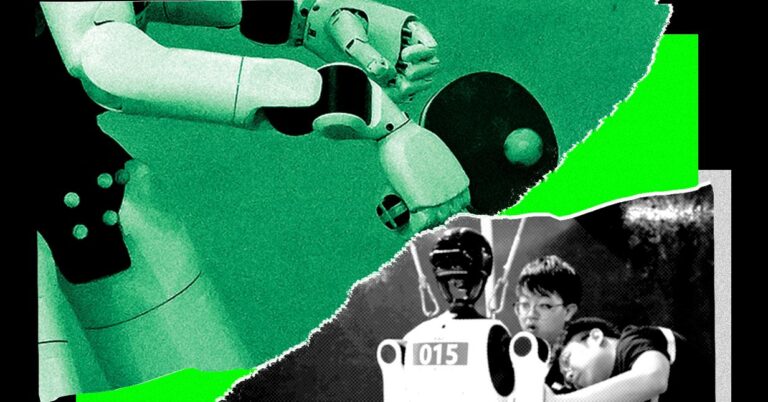
For makers and artists building physical AI, the landscape is shifting from pure software to embodied experience. In Shenzhen, China’s hardware capital, a new wave of blue-collar work has emerged where humans don’t just code robots but physically pilot them through virtual reality. At IO-AI Tech, a startup situated roughly 45 minutes north of the city centre, workers utilise headsets, handheld controllers, and motion-tracking rigs to remotely guide humanoid machines across factory floors and into convenience stores. The goal is twofold: to perform practical tasks like stocking shelves and retrieving items from bins, and to harvest the training data required for these bots to eventually operate without human intervention.
Teleoperating fifty robotic digits
During a demonstration at their offices, the company allowed me to command ten distinct robotic hands, each manufactured by a different vendor, using a bespoke motion-tracking glove. The system instantly mapped my finger movements to all 50 robotic digits simultaneously. While my initial instinct was to gesture rudely with every hand at once, the technology quickly proved its utility. The latency was negligible, and the haptic feedback loop was immediate; I could distinctly feel a ball placed into one of the electronic grippers.
Training data as the new currency
The startup also showcased a system currently being trialled by a major Chinese convenience store chain. Equipped with a VR headset and dual grippers, I attempted to pick up boxes of medication from a shelf. The experience was initially disorienting due to the slight lag between my physical movements and the robot’s execution, requiring a moment to recalibrate. Once adjusted, I was stacking inventory with the precision of a machine boss.
Elsewhere, the scene resembled a real-world version of a sci-fi novel, with operators donning VR headsets and body-tracking sensors. In a large room, I observed staff using various systems to control small Unitree humanoids. One operator marched alongside a robot that mirrored their steps within a simulated apartment environment. Wearing a headset and viewing the scene through the robot’s eye-level cameras, the human performed the nuanced motions required to remove a shirt from a hanger and fold it.
IO-AI Tech specialises in transferring a person’s movements across different robot forms, a capability that is increasingly vital given the dozens of humanoid and robotic hand variants flooding the Chinese market. The company’s algorithms must blend human control with a degree of autonomy, as a human operator and a robot will rarely share the exact same dimensions or weight. Without independent movement capabilities, a robot risks losing its balance when forced to mimic a human perfectly.
The Shenzhen advantage
Shenzhen, home to thousands of manufacturers, provides the perfect ecosystem for rapid prototyping. Si Chin, one of the cofounders, notes that the location facilitates the quick development and refinement of new hardware. IO-AI Tech is already collaborating with local manufacturers eager to automate labour-intensive tasks. For instance, Jack Sewing Machines, a producer of clothing manufacturing equipment, is partnering with the startup to train two-armed robots to iron shirts. An executive from the company indicated that these robots could integrate into existing production lines, automating work currently performed by hand.
An incremental approach to autonomy
While some roboticists argue that flooding AI algorithms with vast amounts of tele-operation data will unlock general-purpose models, Chin advocates for an incremental deployment strategy. “It is similar to self-driving cars,” she explains, drawing parallels to how those vehicles have been rolled out in increasingly complex settings with growing autonomy. “You need this training data that’s more focused on the specific thing you’re trying to address.” She notes that robot teleoperation is already gaining traction within Chinese vocational schools.
China’s manufacturing prowess already delivers affordable, high-quality hardware like Unitree’s units. If IO-AI Tech is any indication, it may soon be possible for AI to truly master the physical world through direct human guidance.
Key takeaways
- IO-AI Tech is bridging the gap between human dexterity and robotic hardware, allowing workers to pilot multiple robot hands and full-body humanoids simultaneously via VR.
- The company is leveraging Shenzhen’s dense manufacturing network to rapidly prototype solutions that integrate with existing production lines, such as automated ironing for the clothing industry.
- Leaders at IO-AI Tech favour an incremental approach to autonomy, prioritising high-quality, specific training data gathered through teleoperation over immediate full independence.