OpenAI has released GPT-6.2 Astra and GPT-6.2 Sol, two closed models designed for professional and agentic work. The new frontier tier, GPT-6.2 Astra, targets hard, long-horizon tasks, while GPT-6.2 Sol serves as the efficient everyday option. For developers, the primary change is a 20% reduction in token prices for Astra, coupled with the claim that both models complete tasks using fewer output tokens. Both are available in the OpenAI API as `gpt-6.2-astra` and `gpt-6.2-sol`.
Specification and Availability
The models share a 1,050,000-token context window, with a maximum input of 922,000 tokens and a maximum output of 128,000 tokens. They run exclusively on OpenAI’s hosted API, ChatGPT Work, and Codex.
Performance data shows Astra scoring 62 on the Artificial Analysis Intelligence Index, placing it second behind Claude Fable 5.2, which holds 65. However, Astra ranks first on the AA-3D benchmark with 1,318 Elo, ahead of Fable 5.2’s 1,271. Conversely, Astra posts a 59% hallucination rate on the AA-Omniscience test, while Sol records 55%. Sol’s Coding Agent Index score drops by three points.
Model Differences and Usage
GPT-6.2 Astra succeeds GPT-6 Astra as the frontier reasoning model for complex professional work. It is designed to produce cleaner slides, spreadsheets, and documents that adhere to templates and field conventions. The model also builds improved frontends, games, and 3D scenes. GPT-6.2 Sol replaces GPT-6.1 Sol as the everyday model.
Both models accept text and image input and return text only. They share the same context limits. The distinction lies in cost and depth.
- Astra: Knowledge cutoff is May 18, 2026. Built for the hardest multistep work.
- Sol: Knowledge cutoff is June 1, 2026. Built for fast, versatile everyday tasks.
Neither model accepts a reasoning effort setting of `none`. OpenAI recommends keeping prompt prefixes unchanged and appending new instructions. This approach improves cache reuse and preserves reasoning across turns.
Benchmark Results
OpenAI’s own claims focus on cost-adjusted gains.
- Agents’ Last Exam v1.1: Astra scores 5.2 points higher than GPT-6 Astra at under a third of the cost. It leads Claude Fable 5.2 by 5.5 points at 5% of the cost.
- Terminal-Bench-Science 0.1: Astra gains 9 points over GPT-6 Astra at under a third of the cost.
- GDPval v2 (internal): Astra gains 6.2 points with 22% fewer output tokens. Sol gains 5.3 points over GPT-6.1 Sol.
- FrontierCode 2.0: Sol lands within 0.5 points of Astra at about one-fifth the cost.
- AA-AnalystAgent: Astra answers 62.5% of questions correctly on all 5 attempts.
Independent results from Artificial Analysis mostly hold up. Astra scores 62 at max effort, with a cost of $4.00 per Intelligence Index task. Fable 5.2 scores 65, Gemini 4 Carbon 60, Claude Opus 5.5 59, and Sol 57. Sol matches GPT-6 Astra’s score at about 15% of its cost per task.
On Harvey LAB-AA, Astra passes 15.0% of legal assignments. The Astra for Law configuration passes 20.8%. Epoch’s Capabilities Index puts Astra at 174, tied with Fable 5.2.
API Pricing
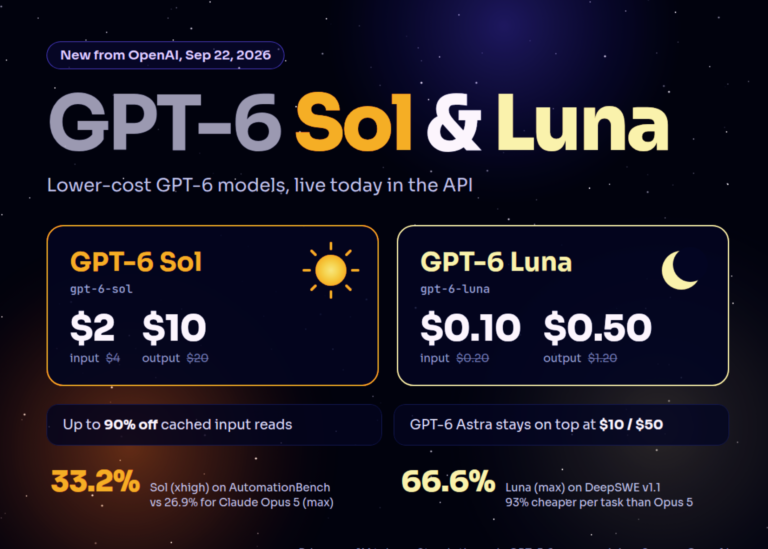
| Rate (per 1M tokens) | GPT-6.2 Astra | GPT-6.2 Sol |
|---|---|---|
| Input | $8.00 | $2.00 |
| Cached input | $0.40 | $0.10 |
| Output | $40.00 | $10.00 |
Astra’s input and output prices are 20% below GPT-6 Astra. Cached input is 60% cheaper. Sol keeps GPT-6.1 Sol’s rates. Requests over 272K input tokens double input and cache rates, and output costs 1.5x. Batch pricing is 50% of standard. Ultrafast is 3x standard through February 28, 2027, then 6x.
Competitor Comparison
| Feature | GPT-6.2 Astra | GPT-6.2 Sol | Claude Fable 5.2 | Gemini 4 Carbon |
|---|---|---|---|---|
| Parameters | Not disclosed | Not disclosed | Not disclosed | Not disclosed |
| Context window | 1,050,000 | 1,050,000 | 1,000,000 | 1,048,576 |
| Max output | 128,000 | 128,000 | 128,000 | Not disclosed |
| Input / output price | $8 / $40 | $2 / $10 | $8 / $40 | $2 / $10 (until Nov 30), then $4 / $20 |
| Cached input | $0.40 | $0.10 | $0.20 | $0.10 (intro) |
| AA Intelligence Index | 62 | 57 | 65 | 60 |
| AA-3D Elo | 1,318 | 1,259 | 1,271 | Not disclosed |
| AA-Robotics v0.1 | 79 | 78 | 75 | Not disclosed |
| Weights | Closed | Closed | Closed | Closed |
Index, AA-3D, and robotics figures for competitors come from Artificial Analysis as reported by The Decoder.
Astra is also OpenAI’s first released model to meet the High threshold for AI self-improvement.
What it means
Developers can now access these models at lower rates, but they must manage expectations regarding coding and hallucinations. The cost reduction applies strictly to API usage; there are no stated changes to customer products, account policies, or API behaviour beyond the pricing structure. For creative and professional work, the lower cost per task may improve throughput, though the high hallucination rate on complex knowledge tasks remains a significant constraint.