Andrew Ambrosino, lead engineer for OpenAI’s desktop application, grants the model full control over his inbox, Slack account, phone, and Notion workspace to test the technology. He accepts the personal risk of potential data leakage to ensure the system functions correctly for his job.
Expanding beyond code
OpenAI has released ChatGPT Work, a tool available on the lowest subscription tier for $20 a month. The product targets white-collar workers, allowing them to deploy AI agents that interact with digital workflows used by accountants, investors, and doctors. Marketing materials state the goal is for intelligence to help people turn their ideas into reality.
Software developers have already adopted this shift, but it has spread slowly elsewhere. ChatGPT Work adapts the company’s Codex coding tool to give non-engineers similar capabilities. Thibault Sottiaux, who leads core product work at OpenAI, told TechCrunch that the system can now perform complicated tasks autonomously in a safe manner.
Commercially, this matters because agents that run for longer periods consume more tokens, increasing revenue per user. Reaching new professions is essential for OpenAI to justify its investment in training and computation. While coding remains a lucrative area, vertical-specific competitors like Harvey and Clay target law and sales clients using a model-agnostic approach.
Adoption gaps
Analysts warn that if AI labs cannot secure key complementary assets to scale in the market, value will accrue to other entities. Christian Catalini noted this challenge on a16z’s “It’s time to build” blog.
Adoption rates highlight the difficulty of moving beyond software engineering. An OpenAI-backed study found that 98% of employees used Codex in June, but only 17% of organisational subscribers and less than 1% of individual subscribers used the agentic coding tool. Sottiaux argued that users will pay for the utility generated by the system.
Designing for the mainstream
Engineers describe the software surrounding a model as a “harness.” This layer decides what information the AI sees and what tools it can use. For developers, a command-line interface was sufficient to change how software is built. Most people do not use command lines, which explains why Windows replaced DOS.
An agentic product must interact with the messy reality of existing tools and websites. Ambrosino explained that the team is building experiences vital for expanding access to useful AI. Tools like OpenClaw allow coders to put LLMs to work, and OpenAI aims to make this functionality as easy as prompting.
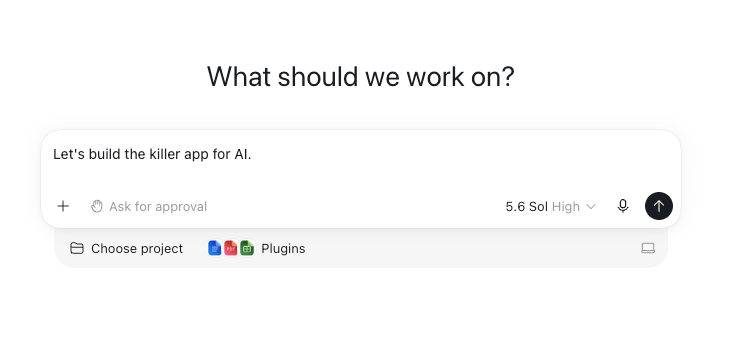
Some employees argue that users should simply ask the model directly without extra buttons. Ambrosino pushed back, stating that discoverability matters in the early phase. The interface includes buttons for selecting projects and plugins but aims for a magic box style similar to other OpenAI products.
Ambrosino compared this approach to skeuomorphism, where digital tools mimic physical objects. He noted that this design helped people transition to the technology. The joint app is used by 20 million people, compared to more than a billion users prompting ChatGPT online.
Real-world utility and friction
OpenAI pitches the tool for routine, data-intensive coordination tasks. Employees use it to set up weekly metrics reports and convert spreadsheets into planning tools. VCs use agents to assemble communications into investment memos, while operations teams create bespoke dashboards. Sam Altman uses the system to plan vacations.
Akshay Nathan, who leads product engineering, said the average worker is limited by the ability to parse available information. “The value of ChatGPT is you already have access to this, but now you truly have access to it,” Nathan said.
When the system functions, it can save significant time. I asked the tool to extract my son’s preschool calendar from email and add it to Google Calendar. It completed the task without error. I also tasked it with financial analysis on publicly-traded companies and created a queryable database of space launches, tasks I previously handled with Python scripts.
However, granting permissions was not straightforward. I struggled to give the model just “read” access to my cloud drive and received error messages. Eventually, a dialog box on the mobile app indicated that complete access was required. Many important settings are only available on the web app, forcing users to work in both versions simultaneously.
Limitations can be baffling. Linking the tool to a Google calendar allows event creation but not new calendar creation. Ambrosino warned that users should not attempt tasks unless the effort level is high, otherwise the experience feels like working with an unhelpful intern.
Joe Gershenson, engineering lead for the harness, admitted that effort settings are not intuitive for new users yet. He noted that the team is working to help users get the right level of reasoning.
Evaluation challenges
Breaking into normie white-collar work faces another hurdle. Most workflows are not as measurable as code. Software either works or it does not, but a good presentation or sales pitch is harder to evaluate. Ambrosino admitted that the team must parse out whether they are solving workflows everyone else will use.
OpenAI stated it uses a benchmark called GDPVal, drawn from 44 occupations and hundreds of knowledge work tests, supplemented by user feedback. Early adopters create valuable traces through actual usage, assuming they do not opt out of training data. I opted out.
Competitive landscape
Despite attention on the model interface, OpenAI engineers were reluctant to answer a simple question. They did not immediately explain what sets Codex and ChatGPT Work apart from Claude CoWork or other competing agentic harnesses intended for a mass user base.
What it means
The shift moves AI from a passive chatbot to an active worker that can manipulate files and schedules. For the average user, this means automating repetitive data entry and report generation without writing code. However, the friction in setting up permissions and the lack of clear guidance on which tasks to attempt suggest that the technology is still maturing for non-technical users.