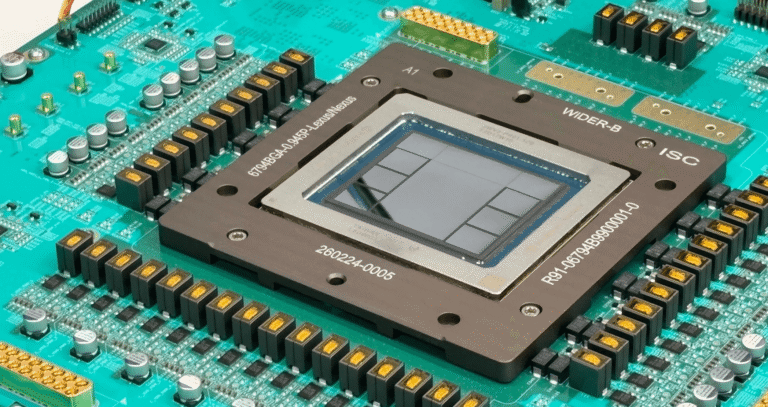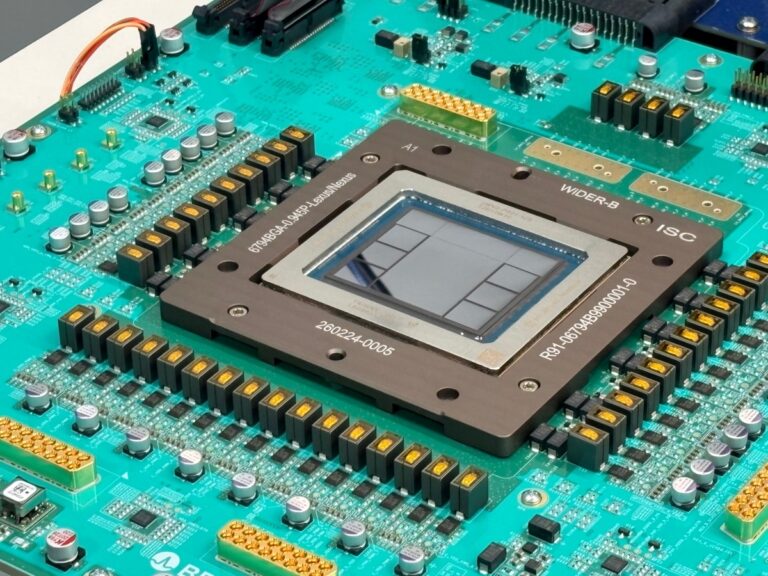
OpenAI and Broadcom have announced Jalapeño, a custom chip designed specifically for large language model inference. The hardware is OpenAI’s first “Intelligence Processor” and represents its entry into custom silicon after years of concentrating on models and software products.
Broadcom CEO Hock Tan and President Charlie Kawwas handed the first wafer to OpenAI CEO Sam Altman and President Greg Brockman. The companies did not describe the device as a modified general-purpose chip. Instead, OpenAI stated it was built from scratch for modern inference workloads.
OpenAI manages the chip design while Broadcom provides silicon manufacturing and networking technology, including its Tomahawk networking chips. Celestica will handle the boards, racks, and system integration.
Performance claims lack independent verification
Initial tests suggest performance per watt is substantially better than current state-of-the-art hardware. These are self-reported figures that have not been finalised. A technical report is expected to follow. At this stage, it is unclear which chips Jalapeño was tested against, on what tasks, and under what conditions.
The architecture reportedly reduces data movement and pushes utilisation closer to its theoretical maximum. Engineering samples are already running machine learning workloads in the lab, including the GPT-5.3-Codex-Spark model. That model currently runs on Cerebras hardware, which also specialises in inference.
OpenAI says the process from design to tape-out took just nine months. The company calls this the fastest ASIC development cycle for high-performance semiconductors it is aware of. OpenAI’s own models helped speed up parts of the design process. Rumours about the chip plans have been circulating since 2023.
What it means
For teams building and running AI systems, the shift to custom silicon aims to lower costs and improve reliability. OpenAI argues that controlling the full stack from chip to product allows for faster and more efficient model execution. Large-scale deployment is planned for late 2026. Microsoft is expected to purchase 40 percent of the chips to secure the first phase of rollout.