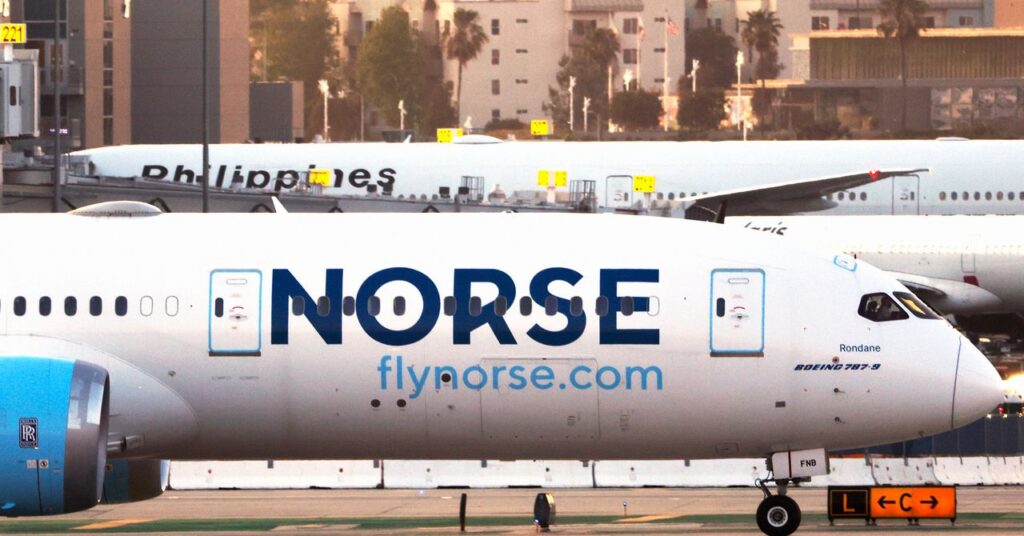
On March 31, I received an email from Norse Atlantic Airways. The $940 flights for my upcoming round trip to Rome had been canceled, it said, and I had 14 days to request a refund.
At first, I didn’t panic. That began to change when the company’s refund request page wouldn’t load on two browsers across three devices. After Norse didn’t respond to several emails, I looked for a phone number. There wasn’t one. On Reddit, I found dozens of posts about Norse’s allegedly haphazard customer service.
The same day, I filed a public records request with the Federal Trade Commission, which I hoped would give me a better idea of how common this experience was. I eventually received around 75 detailed complaints from people who had bought or tried to buy tickets from the airline. Many described a customer service operation in which the inability to get in touch with a human created a vacuum that scammers appeared happy to step into. Of the 41 complaints that reported a dollar figure, 21 claimed they lost more than $1,000.
Norse Atlantic Airways does have human customer service workers, but in recent years, the airline has leaned into a tech-forward approach, deploying AI agents to help power its operation.
“Technology will help us have a higher level of availability and customer support, while still maintaining low fares for more people to enjoy travel between continents,” Bård Nordhagen, the company’s chief customer and communications officer, tells WIRED.
Yet if what I and dozens of other people experienced is any indication, this version of customer service is time-consuming, frustrating, and at times expensive.
The Future Is Now
Norse Atlantic Airways, which was formed in February 2021, has described itself as a “modern, long-haul, low-cost airline” with a “lean” workforce. Early on, it implemented a tool from the customer service technology company Sprinklr that created a “unified” inbox of customer service queries. (Based on archives of the company’s website, it doesn’t appear to have ever listed a customer service number.)
In January 2025, the AI company Kindly wrote a blog post detailing how it developed a chatbot for Norse alternatingly called “Odin” or “Odin’s Wingman.” Norse also removed the customer support email from its support page in order to make Odin the “primary support channel,” according to the Kindly blog post.
By January 2026, Norse had “sunset” the chatbot and replaced it with its current AI agent, Freya. Delight.ai, the company that developed Freya, said that the airline’s no-human-intervention inquiry resolution rate “rose from 60 percent to 80 percent” within two weeks of its introduction.
“We see the future of our customer support team as AI agent managers,” Norse’s chief product officer, Alf Lim, said in a Delight.ai blog post. Lim added that Freya is a “core part of the team” at Norse.
According to the blog, Freya would allow Norse to “upskill” its customer support unit into these AI agent managers, which are described as “specialists who continuously optimize, train and step in when human-touch is required.”
Nordhagen tells WIRED that Freya has been a success and now manages “99 percent of inquiries from passengers.”
A Scammer’s Paradise
Many of the FTC complaints shared a common theme: A person, needing to change their flight or adjust their booking, searched online for the Norse Atlantic Airways phone number. Eighteen of the FTC complaints explicitly claimed that the person was scammed after they Googled Norse’s customer service information and found scam websites and phone numbers in the results.
In some cases, customers claimed they were told they owed money for a flight they thought they already paid for. Other times, they said they were told that they had to pay an exorbitant fee in order to make a change to their itinerary.
They passed along their credit card information, and in some cases, their social security numbers. Soon after, they said, huge charges appeared on their credit card statements.
In one complaint filed in March 2025, a person described trying to buy tickets over the phone. They said they disclosed information for “3 different credit cards” because the man on the other end of the line claimed that their payments weren’t going through. “Stupidly gave him my date of birth and last 4 of my [social security number],” the person wrote.
By the time they realized they had been scammed and canceled their credit cards, there was an unidentifiable charge for $1,258.88. “We are 72 and 79 years old [we] are scared,” the customer said. “Please help.”
This problem has apparently become so widespread that Norse’s official website includes a giant warning about “online scam and fraud.”
At the time of writing, a Google search for the “Norse Atlantic airways phone number” returned links to three Yelp pages, which listed two different phone numbers. Both of these appear to be scams.
When WIRED called the first number, a man claimed to be a representative of Star Alliance, a network of 26 airlines. However, Star Alliance’s website doesn’t list Norse Atlantic Airways among its affiliated airlines, and it doesn’t include the phone number. (A representative for Star Alliance confirmed that the number isn’t associated with the company, and said Norse isn’t one of its members.)
When WIRED called the second number, a different man said he was a representative of “Flight Travel Portal,” a service that does not appear to exist.
When WIRED asked the man about online posts that claimed his phone number was a scam, he sounded unfazed. People online can say anything, he offered.
A few complaints noted that the person had emailed customer service at their credit card company or a travel website they used to book a flight, only to be referred back to Norse or told there was nothing the company could do.
In August 2024, a person in New York wrote that they purchased a $397 flight from Paris to New York using Priceline, including cancellation insurance through the company Xcover, and installed payments through Affirm. When they realized they couldn’t make the flight, they contacted Priceline, which directed them to Norse. After looking for Norse’s phone number on Google, they wound up giving their credit card information to scammers, prompting them to lock their card. (Xcover and Priceline didn’t respond to requests for comment. A representative for Affirm said the company doesn’t comment on individual customers, and noted that returns are subject to each merchant’s policies.)
“The flight is scheduled for tomorrow, and despite reaching out to Norse Airways three days ago via email, I have received no response,” the person said. They had been in touch with Priceline, Xcover, and Affirm, but none of them were able to help. “I am concerned that without any intervention, it may appear that I missed the flight, making it even harder to obtain a refund.”
Even people who weren’t scammed said they wound up losing money.
One customer from Los Angeles said that they were “denied boarding” on their Norse flight from Rome to Los Angeles.
“At the airport in Italy, no Norse Atlantic staff were present, only contracted employees without contact information for the airline,” the complaint read. “The only other communication channel available was Norse’s chatbot; the airline has no live customer service or phone line.” As a result, they said, they were forced to “secure urgent, costly alternative arrangements to avoid being stranded abroad with a child.”
A Human Touch
On an earnings call in 2024, Norse’s then CEO Bjørn Tore Larsen said that the company is always “chasing ways where we can become more efficient, and that includes quite heavy investment in technology,” adding that doing so “gives a very quick payback, both in terms of reducing cost and in terms of revenues.”
In early May, Norse announced that it was cutting its administrative staff by 35 percent, and in an earnings call two weeks later, CEO Eivind Roald said that the airline is considering opportunities for a sale or merger.
Erie Meyer, a senior fellow at the Center for Law and the Economy and former chief technologist at the FTC and the Consumer Financial Protection Bureau, tells WIRED that the FTC complaints filed about Norse and its customer service are “particularly egregious.”
Customers are “not just vulnerable to scammers, but served up on a silver platter to the scammers,” she says.
She suggests that customers file claims to their state attorney general’s office, which is more likely to look into what happened, respond to the consumer, and look for others who may have been impacted. (The FTC said it “can’t comment on specific companies or practices.”)
As for me, I eventually found a way to get a refund: talking to a human.
The same day I sent the public record request, I emailed Nordhagen, the chief customer and communications officer, directly. (Though I clarified that I was reaching out as a customer and not as a journalist, my approach likely won’t work for everyone.)
Within an hour, I received an email confirming that my refund was being processed. It landed in my bank account two days later.