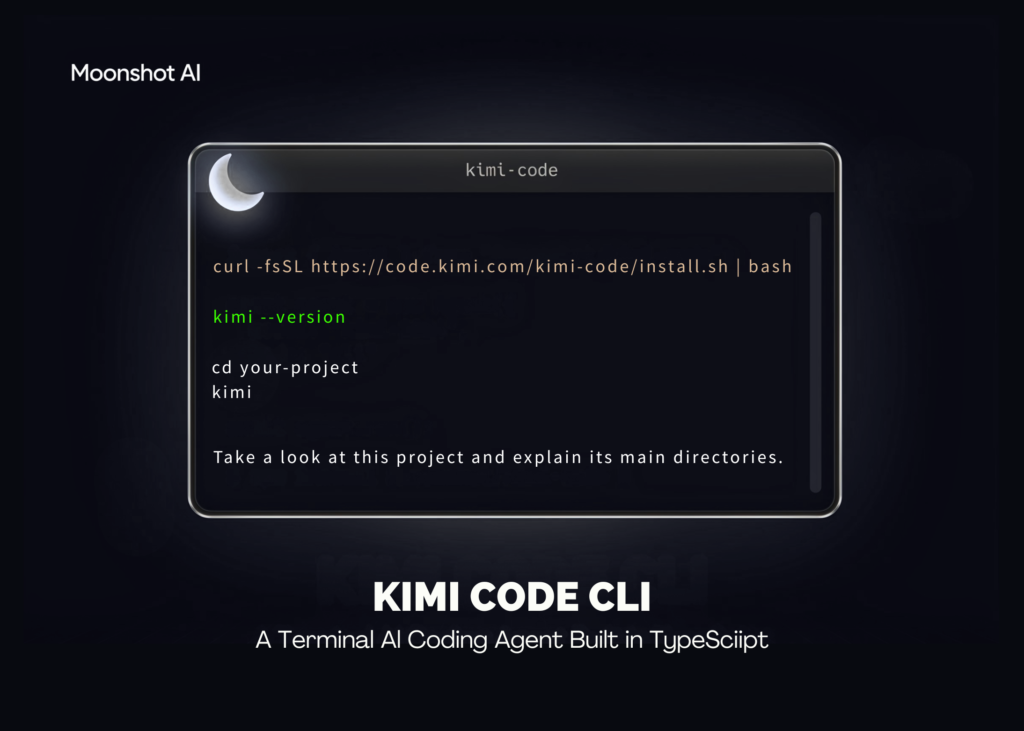
Developers and makers now have a new terminal-based AI coding agent that operates entirely within the command line. Moonshot AI has launched Kimi Code CLI, an open-source tool designed to read, edit, and execute code while managing shell commands and web searches. Unlike previous iterations, this agent loops through feedback to determine its next move. The project is MIT-licensed and hosted on GitHub.
Kimi Code CLI replaces the older kimi-cli. Built in TypeScript and available via npm, it integrates natively with Moonshot AI’s Kimi models but can also connect to other compatible providers out of the box.
What is Kimi Code CLI
Designed for software development and terminal operations, the agent handles feature implementation, bug fixes, and refactoring. It can also navigate unfamiliar codebases to answer architectural questions. The tool supports batch processing, builds, and chained test runs.
The workflow is feedback-driven. The agent plans steps, modifies files, executes tests, and reports actions. Read-only tasks run automatically by default. However, any file edits or shell commands require explicit user confirmation first, ensuring risky actions remain under developer control.
The CLI software itself is free under the MIT license. Access to the underlying models requires either Kimi Code OAuth or a Moonshot AI Open Platform API key.
Key Features
Moonshot highlights several capabilities aimed at sustaining long, focused agent sessions:
- Single-binary distribution. Installation requires just one command, eliminating the need for separate Node.js setup.
- Fast startup. The terminal user interface (TUI) becomes ready in mere milliseconds.
- Purpose-built TUI. The interface is optimised for extended interaction periods.
- Video input. Users can drop screen recordings or demo clips directly into the chat.
- AI-native MCP configuration. Model Context Protocol servers can be added and authenticated via the
/mcp-configcommand. - Subagents for parallel work. Built-in
coder,explore, andplansubagents can be dispatched in isolated contexts to handle multiple tasks simultaneously. - Lifecycle hooks. Developers can run local commands to gate tool calls, audit decisions, or trigger notifications.
Installation and First Run
There are two paths to installation. The official script works without requiring pre-installed Node.js.
On macOS or Linux, run the install script:
curl -fsSL https://code.kimi.com/kimi-code/install.sh | bash
On Windows, use PowerShell:
irm https://code.kimi.com/kimi-code/install.ps1 | iexThe global npm install requires Node.js 24.15.0 or later:
npm install -g @moonshot-ai/kimi-codeVerify the binary, then open a project and start the interactive UI:
kimi --version
cd your-project
kimi
On first launch, type /login inside the interface. You may choose Kimi Code OAuth or a Moonshot AI Open Platform API key. For a single instruction without the UI, use kimi -p "your task". To resume the previous session, add -C.
Use Cases
- Understanding a project: Request an architecture overview and a module dependency diagram.
- Implementing a feature: Define the signature, options, and acceptance criteria upfront.
- Fixing a bug: Provide the symptom, reproduction steps, and expected behaviour together.
- Writing tests and refactoring: Extract repeated patterns, then run tests to confirm behaviour.
- One-off automation: Analyse logs and output call counts with p50 and p99 latencies.
- Scheduled tasks: Ask the agent to set reminders or recurring checks via cron.
Plan mode is accessible via Shift-Tab or kimi --plan. It outputs a research plan before modifying any files. For safe batch work, --yolo or /yolo skips approval prompts. The /fork command creates an experimental branch you can discard. The /compact command compresses context to free up tokens. For large investigations, the main agent can dispatch subagents in parallel.
How Kimi Code CLI Compares
Kimi Code CLI joins a growing list of established terminal coding agents. The table below compares it with three competitors. Competitor details reflect mid-2026 and can change quickly.
| Attribute | Kimi Code CLI | Claude Code | OpenAI Codex CLI | Gemini CLI |
|---|---|---|---|---|
| Developer | Moonshot AI | Anthropic | OpenAI | |
| Backing model | Kimi models | Claude models | GPT-5.3-Codex | Gemini 2.5 Pro |
| Language / runtime | TypeScript | Node.js | Rust | TypeScript |
| Install | Script or npm (Node.js ≥ 24.15.0) | Native installer or npm | npm / native | npm single binary |
| MCP support | Yes (/mcp-config) | Yes | Yes | Yes |
| Subagents | Yes (coder, explore, plan) | Yes | Yes | No (sequential) |
| Plan mode | Yes (Shift-Tab) | Yes | Yes | Yes |
| IDE integration | ACP (Zed, JetBrains) | VS Code, JetBrains | VS Code, IDEs | VS Code (Code Assist) |
| License | MIT | Proprietary | Open source | Apache 2.0 |
All four agents support the Model Context Protocol. They differ on backing model, language, license, and orchestration. Kimi Code CLI and Codex CLI both ship native subagents. Gemini CLI runs tasks sequentially without subagent support.
Key takeaways
- Kimi Code CLI is an MIT-licensed terminal coding agent from MoonshotSource Read original →