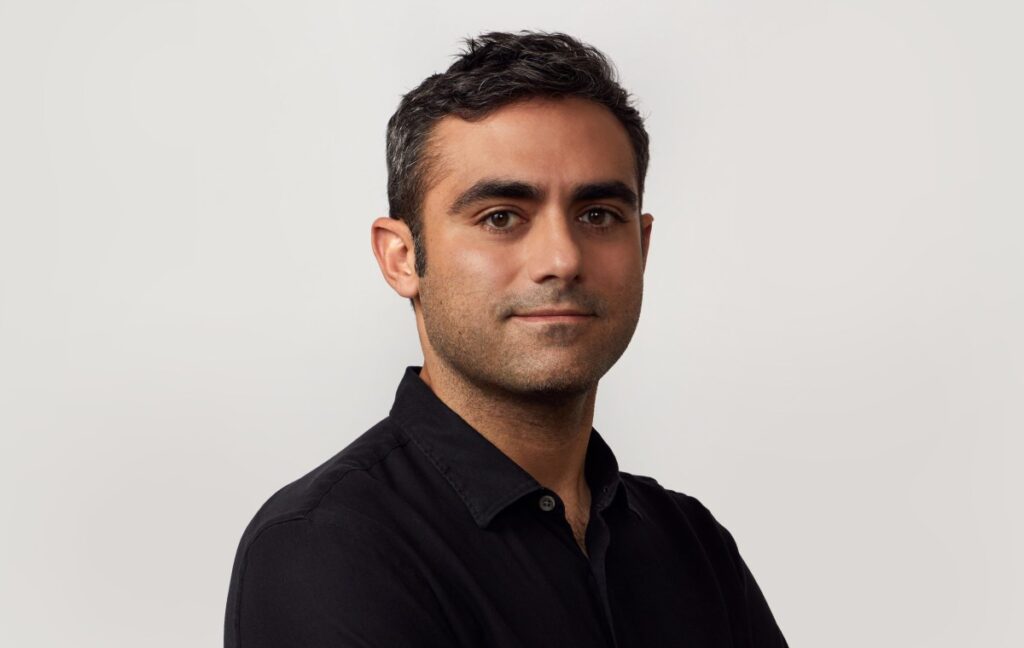
Michael Polansky is training an AI model on human skin that is still alive.
He sits at a patio table outside a bakery in Mill Valley, an affluent town 15 miles north of San Francisco. Polansky wears glasses and has dark hair streaked with grey, looking like a young professor rather than the co-founder of Outer Biosciences, an AI and biology startup. He is also the business and romantic partner of Stefani Germanotta, known to the public as Lady Gaga. The couple manages a dual life. They operate in celebrity circles while running a company that has spent years keeping living human tissue alive outside the body for over a month without telling outsiders.
Polansky did not expect this path. He grew up in Minnesota, attended Harvard to study applied mathematics and computer science, and graduated in 2006. He spent three years at the hedge fund Bridgewater Associates. He describes the experience as unique and positive, though not something he looked forward to doing every single day.
His move to Silicon Valley happened by chance. Sean Parker, a co-founder of Facebook, had an assistant who was Polansky’s childhood neighbour. At a wedding in Minnesota in 2009, the assistant mentioned Parker was looking for collaborators. Polansky knew Parker and wanted to move west. They met in New York and connected immediately. Polansky quit Bridgewater the next day and relocated to San Francisco.
He joined Founders Fund as a principal when the firm was run by its original four partners: Peter Thiel, Sean Parker, Luke Nosek, and Ken Howery. Polansky shared an office with Brian Singerman. He describes that period as a great experience.
When Parker left Founders Fund after his Facebook stock became liquid, he took Polansky with him to run a family office. Polansky managed Parker’s business, investment, and philanthropic interests. This included helping establish the Parker Institute for Cancer Immunotherapy, where Polansky remains executive director, until the pandemic changed his trajectory.
That shift involved Germanotta. Polansky met her in late 2019 at one of Parker’s birthday parties. Germanotta’s mother, Cynthia Germanotta, president of the Born This Way Foundation, had arranged the meeting after months of suggesting it to Polansky. Polansky initially thought she was joking. Their mothers have since become close friends, which Polansky says made the relationship feel natural.
Their partnership covers both personal and professional life. For Lady Gaga’s world tour, which ran from July of last year until April, the couple oversaw a massive operation involving three 747 aircraft. Polansky compares this to running a startup of 200 people that travels globally every day. The business also includes Haus Labs, a cosmetics brand Germanotta built from her kitchen floor rather than licensing to an existing company. The operation is based in El Segundo, California, employs about 70 people, and is reportedly thriving.
Germanotta sits on the board of Outer Biosciences. The two companies collaborate occasionally. Kyung-Jin Jang, chief scientist at Outer Biosciences, serves on Haus Labs’ scientific advisory board. They have executed joint projects together.
Polansky notes that the public rarely sees the business side of Germanotta. He describes her as a brilliant businessperson.
From cancer to tissue in a dish
Polansky identifies as a businessperson rather than a scientist. He entered life sciences accidentally through more than a decade working alongside Parker in cancer immunotherapy. The field was very fringe when they started.
Outer Biosciences, co-founded in 2022 by Polansky, Jang, Chris Hinojosa, and Stanley King, grew from frustration with the pace of innovation in biology and chemistry. Progress has never matched software speeds largely because there is no ethical way to run experiments directly on people. Scientists usually rely on animal models, simplified cell cultures, or lab-grown organoids. Polansky says these are poor stand-ins for how a real human organ behaves.
Outer Biosciences took a different approach. The company sources human skin that would otherwise be discarded after surgery, mostly plastic surgery. They obtain this material through vetted nonprofit and commercial biobanks and brokers operating under institutional review board oversight and documented donor consent. Principal suppliers include the National Disease Research Interchange and the Cooperative Human Tissue Network. Both outfits receive federal funding from the NIH and the National Cancer Institute without being federally operated.
Polansky notes there is no single government tissue network that qualifies buyers. Outer Biosciences pays fees to these suppliers on a cost-recovery basis rather than purchasing tissue outright. The company spent roughly two years building the pipeline and handling protocols required to receive tissue within hours of surgery while it remains living.
Regarding donor privacy, every sample arrives already de-identified. Supplying organizations strip names, contact information, and other direct identifiers upstream. A proprietary support system developed by Polansky’s team feeds the tissue nutrients and removes metabolic waste, extending its viable life well past the industry norm.
The industry norm is a matter of days. This duration is enough to test for acute toxicity but not for slower biological processes like collagen remodeling, pigmentation change, or barrier repair that take weeks to unfold. Dermatologists routinely tell patients to expect changes over weeks for this same reason.
Outer Biosciences keeps tissue alive for up to a month. Polansky says the system retains the tissue’s day-zero architecture and preserves its day-zero epidermal, stromal, and immune-associated molecular programs. In plainer English, 30-day-old tissue cared for by the company looks similar to day-one tissue, though it is not fully indistinguishable from it.
Sunburn is one of the clearer examples of what this extra time buys the company. Polansky says researchers can induce UVB damage in living tissue and track the stress, inflammatory, and recovery-related responses over the following weeks as an information-gathering exercise. He clarifies the team is not healing the skin but watching an injury happen and then observing the biology that follows over time.
Polansky is careful about how he frames the company’s achievements when asked about rival technologies. He states the startup’s value is not any single piece of what it does but how the pieces fit together. This includes human tissue kept alive for weeks, a diverse donor pool subject to controlled experimental conditions, and repeated molecular measurements taken along the way.
All elements feed into one closed self-enforcing system. An AI model predicts which untested chemicals are likely to have a beneficial effect on a specific skin function. Those chemicals run through the living-tissue system. The results, whether the prediction was right or wrong, feed back into the model to improve the next round of guesses. This loop is the actual product Outer Biosciences sells right now. It is not a single skincare ingredient but a faster way of finding one.
This speed is a more recent development and a giant improvement from where things started. Polansky says the company early on relied on a brute force approach, mining scientific literature and partnering with the National Cancer Institute on natural compounds from extreme environments. That phase produced a couple of leads over about 18 months. With AI layered in, the company now generates a new candidate roughly every six weeks. Six leads are currently active in the pipeline, and several dozen additional hits are logged.
What makes that pace astonishing, Polansky says as the lunch crowd thins out, is the size of the current universe of skin-active ingredients. It is almost impossible to know the exact number, but it is small.
The term active ingredient means something different informally than it does formally. While the FDA maintains rules covering 13 categories of over-the-counter skin drugs, such as sunscreen and antifungals, only about 120 to 130 active ingredients are approved across all of them. Add cosmetic ingredients backed by actual research, Polansky says, and that number is closer to 200.
This presents opportunities.
Outer Biosciences discovers cosmetic ingredients, not drugs, so there is no FDA approval to seek. The route runs through two steps. First, the ingredient gets a standardized industry name. Then safety testing occurs under guidelines set by the OECD, a Paris-based international body whose member countries agree to accept each other’s properly run studies.
A partner outfit then commercializes the whole thing. Rather than build its own consumer brand, Outer Biosciences plans to license or sell its finished ingredients to beauty or pharma outfits. These partners will formulate the ingredients into actual products, such as a serum or cream, and bring them to market under their own brands. Polansky says four of the six current leads look likely to reach commercialization.
In the meantime, the company generates money from collaborative research partnerships. These include a pharmaceutical partner studying why certain cancer drugs cause severe skin rashes and consumer beauty brands testing whether Outer Biosciences’ data holds up against their own product-development and marketing needs.
If Polansky is raising more money currently, he will not say. To date, the company has raised roughly $23 million. Early backers include Wing Ventures, Initialized, and Polansky’s own investing firm, Hawktail, among others. The company employs 19 people, with all but Polansky based just outside Cambridge, Massachusetts.
Asked why he chose now to talk about the company after years of near-total silence, Polansky points to the data the team is beginning to amass and the confidence it has given them. He says trying to do this in private is hard. He adds they want to start working in public now as the waitstaff start flipping chairs onto tabletops, signaling it is closing time at the bakery.
Outer Biosciences is not the only company chasing this idea, even if its use of real tissue rather than synthetic is distinctive. Vivodyne is another entity working in this space.