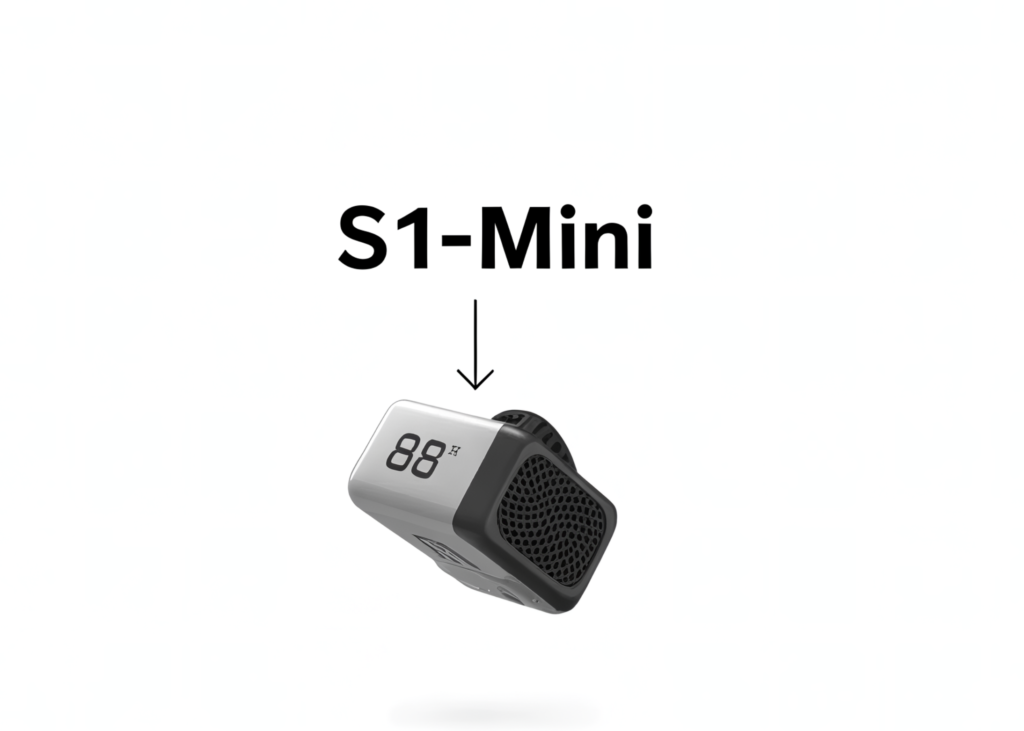
Superwhisper has released the S1 family of models, introducing S1-Voice, S1-Language, and S1-mini. The open-weights component, S1-mini, is a 0.6B text normalizer designed to convert raw automatic speech recognition transcripts into clean written text. It is not a transcriber and sits downstream of ASR tools to remove fillers, resolve self-corrections, and format spoken numbers, dates, and email addresses.
The model is fine-tuned from Qwen/Qwen3-0.6B and covers English only in release v1. Superwhisper reports 94.8% token accuracy on a held-out set of 7,519 cases, measured greedy on the quantized build. The system steers the output entirely via a three-axis control line placed above the transcript.
Deployment and availability
Only S1-mini is deployable locally. It is published on Hugging Face under Apache 2.0 plus a naming clause. S1-Voice and S1-Language are cloud-only services provided by Superwhisper.
- Company level: Any level. The Q4_K_M GGUF build is a 462 MB file that runs on a laptop CPU. Solo developers can ship it inside a desktop app. Enterprises can run it behind a VPC where audio transcripts cannot leave the network.
- Industries: Healthcare and clinical documentation, legal, financial services, customer support, developer tooling, accessibility and live captioning.
- Applications: Dictation apps, meeting-notes tools, live captioning, voice-driven editors, voice-to-CRM entry, and any pipeline that turns raw ASR output into text a human will read.
How the model functions
S1-mini is a text normalizer, not a transcriber and not a chat model. It sits after automatic speech recognition:
audio → ASR (Whisper, Parakeet, …) → S1-mini → clean text
It removes filler words, resolves false starts and self-corrections to the value the speaker landed on, applies punctuation and capitalization, and renders spoken numbers, dates, times, currency, and email addresses in written form. Say “support at superwhisper dot com” and you get su*****@**********er.com.
The model is fine-tuned from Qwen/Qwen3-0.6B. It has 596M unique parameters (0.44B non-embedding), 28 layers, 16 query heads and 8 key/value heads with GQA, and BF16 weights. The Hub sidebar reports 0.8B because the tied embedding is stored twice; the card explains the discrepancy explicitly. Release v1 covers English only, and recommended input is roughly 1,000 tokens.
The control line is the entire interface
S1-mini takes a fixed system prompt, then a control line, then the raw transcript:
[Styling: <value>] [Structure: <value>] [Context: <value>]<raw transcript>
Styling takes casual, semi-casual, semi-formal, or formal. Structure takes prose or lists. Context takes general or email. All three axes are independent, and every combination was trained. Send values outside those sets, or reword the system prompt, and output can degrade or garble. Note the small mismatch worth knowing: the Superwhisper app exposes a five-stop tone slider that adds a “balanced” preset, while the open weights document four trained Styling values.
The model is also constrained by design. It does not add content you did not say, correct facts, soften profanity, or rewrite dialect. Filler-only input returns an empty string, and integrations should treat that as a valid result.
Two settings that break most integrations
First, enable_thinking=False is required. The chat template is Qwen3’s, unchanged, and Qwen3 defaults to thinking on. S1-mini was trained with thinking off, so the assistant turn must open with an empty <think> block. Omit the flag and you usually get no usable output at all.
Second, decode greedily. generation_config.json ships do_sample: false. The GGUF builds still carry Qwen3’s inherited temp = 0.6, top_p = 0.95, and top_k = 20 metadata, so pass temperature 0 explicitly on every request. In llama.cpp, use --jinja with --chat-template-kwargs '{"enable_thinking":false}' rather than --reasoning-budget 0, which degrades output.
Reported evaluation
Superwhisper evaluated S1-mini on a held-out set of 7,519 cases across 104 transcripts. Token accuracy is 94.8%, measured greedy on the Q4_K_M build, with a text-edit error rate of 11.6%. On email-formatted text it identifies the greeting line 99.3% of the time and the sign-off 97.9%. It matches the correct output structure, list versus paragraph, 97.6% of the time, and produces exact email addresses in 92% of cases. Fewer than 1% of generations show looping or truncation, and the model correctly withholds output 98.6% of the time when nothing should be transcribed. These are vendor-reported numbers on an internal test set, not third-party results.
The two cloud models
S1-Voice is the hosted speech-to-text model. Superwhisper reports transcription up to 46x faster than speaking time, with most dictations under 30 seconds appearing 0.32 seconds after you stop. Across eight datasets including meeting audio and earnings calls, it averages 6.8% word error rate and drops to 2.2% on LibriSpeech. Superwhisper says that 6.8% average was the lowest of 15 models it tested, and that S1-Voice scored 83 out of 100 on its blended metric against WisprFlow’s 76.
S1-Language is the hosted instruction-following model for cleanup, formatting, and summarization, and it appears in the model picker alongside models from Anthropic, OpenAI, and Groq. The recommended defaults are Cohere Transcribe plus S1-mini offline, or S1-Voice plus S1-Language in the cloud.
What it means
Developers building voice interfaces now have a lightweight tool to clean up ASR output without relying on a cloud API. The 462 MB GGUF file allows running the normalizer on local hardware, which helps with data privacy and latency. However, the strict requirement for a specific control line and the disabled thinking mode mean that integrating this model requires careful handling of the prompt structure to avoid broken outputs.