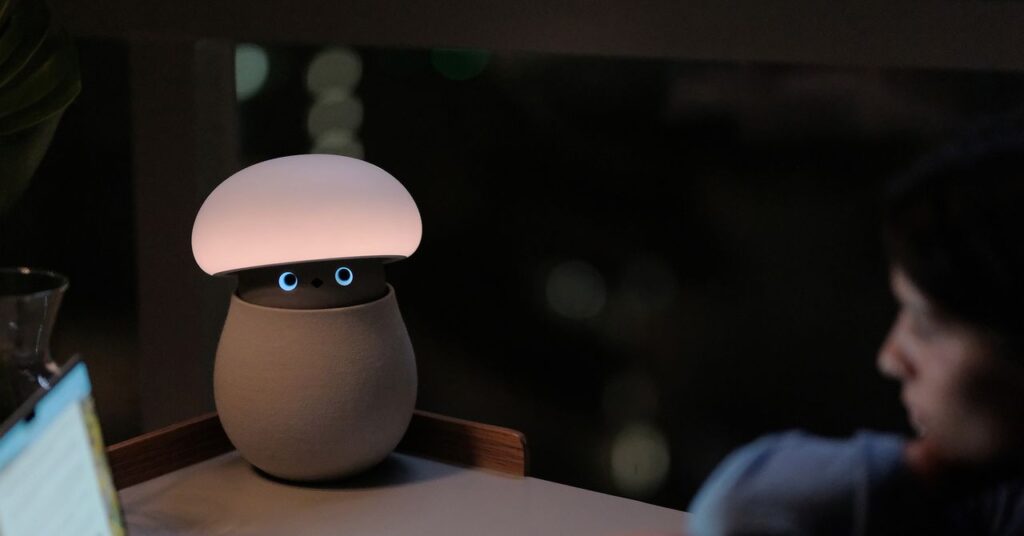
OKA, a startup based in Cambridge and Shenzhen, is selling a robot mushroom for $649 that does not function as a voice assistant.
The device
The product, named Mori, sits on a shelf and looks like a lamp. Its head retracts into the base when you touch it. When extended, round eyes and a diamond-shaped nose appear. The nose contains a camera. The device makes soft noises that sound like a bird mixed with R2-D2.
Mori follows you as you move around the room. It plays nature soundscapes when you touch its head. It glows with colors inspired by rain, forests, fire, and wind. It can guide you through breathing exercises.
The company states the goal is to reconnect owners with nature. It also acts as a companion. Ask it about your outfit and it will jiggle. It dances to music and reacts to TV screens.
It deliberately avoids other functions. You cannot use voice commands to control lights or play music. It will not answer questions about the weather. It is not an assistant.
Price and subscription
The Founder’s Edition costs $649 and includes a two-year warranty and a two-year subscription. Stock is limited to a few hundred units.
A standard edition costs $799. This version does not include the subscription features. You can access the breathing exercises for free without paying. Nature soundscapes require the subscription. Without it, the device is a lamp that dances while pointing a camera at you.
How it works
OKA CEO Hua Wang says the company plans to create five experimental Artifacts. Wang previously worked as a general manager at Meipai and cofounded Bondee, a social media app that became popular in Asia.
Wang believes current home robots look too machine-like. OKA designed a lamp that blends into the environment but remains anthropomorphized to make the home feel better.
The system uses local large language models to understand the room. The company calls this Attentive Intelligence. The device has memory. It remembers you and changes how it interacts over time. It acts shy if you bring home a guest. It forgets people if it does not see them for a month.
It might notice you on your phone for two hours. It could try to get your attention so you listen to wind sounds and rest your eyes. During a phone call or an argument, it stays silent to avoid distraction.
Wang says gadgets usually try to capture your attention. Mori gives your attention back to you. It invites meditative experiences. Nature has restorative power for humans.
Privacy and security
Mori connects to Wi-Fi for firmware updates only. It processes images and audio locally. The device discards these files. Facial feature data is encrypted on the device and never uploaded.
The camera turns off when the head retracts. The microphone turns off when you double-tap the top of the head. The device runs on battery power or can stay plugged in.
Wang says the feature set is limited now but could expand. Future versions might connect to Oura Ring data or Spotify accounts. Voice commands could arrive later.
Expert opinion
Chris Harrison, director of the Future Interfaces Group at Carnegie Mellon University, notes that cute robot pets have existed before. Sony released Aibo in 1999.
Harrison says the crucial ingredient AI provides is the ability to understand and react to human actions and emotions. Previous robots were too simplistic. Modern versions could be more impactful.
Humans have always wanted to anthropomorphize objects. Harrison points to Meta’s new Muse agent as a hyper-capable pet.
When asked about Mori’s limited capabilities, Harrison compares it to owning a goldfish or a hamster. He asks if people hold it to an unrealistic bar. He notes people extract pleasure from caring for less sophisticated pets.
Whether people will pay hundreds of dollars for a robot that cannot fetch or tell the time is uncertain. If the mushroom lamp can fool overstimulated brains into feeling less alone at the end of the day, that may be enough.