Moonshot AI has released Kimi K3, a 2.8-trillion-parameter open model that immediately moved to the top of the Artificial Analysis Intelligence Index with a score of 57. It now sits just behind the proprietary Claude Fable 5 and GPT-5.6 Sol. Three Chinese labs—Moonshot AI, DeepSeek, and Zhipu AI—currently hold the leading positions on the open-weight leaderboard. They all use sparse Mixture-of-Experts architectures and support million-token context windows. The comparison below looks at measured capability, license terms, and serving cost.
The three contenders
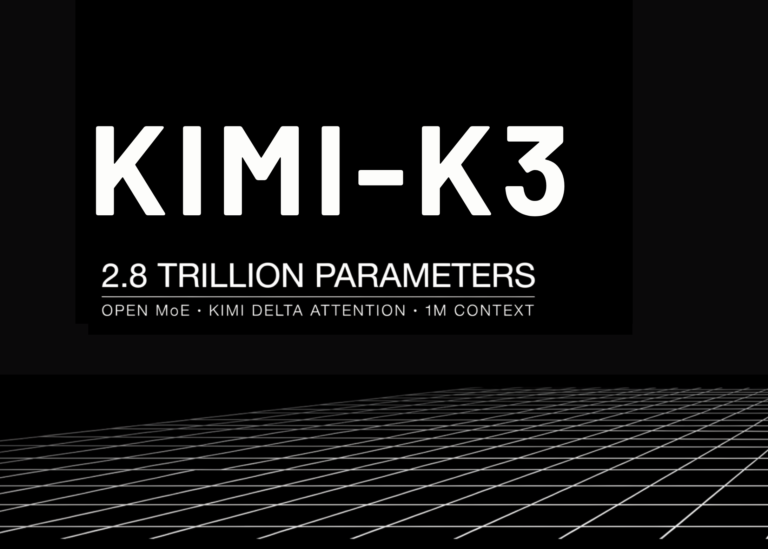
Kimi K3 is a Stable LatentMoE model with a total of 2.8 trillion parameters. It activates 16 of 896 experts for every token. Moonshot has not published the exact active-parameter count. The model includes native vision and video capabilities, a 1 million-token context window, and always-on reasoning. Moonshot describes it as the first open model in the 3-trillion-class. Weights are not available yet.
DeepSeek V4 Pro is a 1.6-trillion-parameter MoE model. It uses 384 routed experts plus one shared expert, resulting in 49 billion active parameters. It carries a 1 million-token context window with a 384,000-token maximum output. A smaller V4 Flash variant exists with 284 billion total parameters and 13 billion active parameters for cheaper workloads. The weights are available on Hugging Face.
GLM-5.2 is a 744-billion-parameter MoE model with roughly 40 billion active parameters. It has a 1 million-token context window. Zhipu ships the model with High and Max reasoning modes. API access is available.
| Spec | Kimi K3 | DeepSeek V4 Pro | GLM-5.2 |
|---|---|---|---|
| Total parameters | 2.8T | 1.6T | 744B (753B per Artificial Analysis) |
| Active parameters | Not disclosed (16/896 experts) | 49B | ~40B |
| Context window | 1M | 1M (384K max output) | 1M (131K max output) |
| Modality | Text + vision + video | Text | Text |
| Released | July 16, 2026 | April 24, 2026 | June 13, 2026 |
Benchmarks
Vendor-reported scores use different harnesses, so per-benchmark numbers rarely line up cleanly across labs. The neutral comparator is the Artificial Analysis Intelligence Index, which scores all three on the same suite.
On that index, Kimi K3 scores about 57. DeepSeek V4 Pro (Max reasoning) scores 44. GLM-5.2 scores 51. Kimi K3 ranks #3 overall, behind only Claude Fable 5 and GPT-5.6 Sol, and is comparable to Opus 4.8 and GPT-5.5. GLM-5.2 held the top open-weight spot until Kimi K3 shipped.
Coding benchmarks tell a similar story with caveats. Moonshot’s own table runs Kimi K3 and GLM-5.2 through matched harnesses. There, Kimi K3 leads GLM-5.2 on every shared benchmark by wide margins.
| Benchmark (Moonshot harness) | Kimi K3 | GLM-5.2 |
|---|---|---|
| DeepSWE | 67.5 | 46.2 |
| Program Bench | 77.8 | 63.7 |
| Terminal Bench 2.1 | 88.3 | 82.7 |
| FrontierSWE | 81.2 | 67.3 |
| SWE Marathon | 42.0 | 13.0 |
| Automation Bench | 30.8 | 12.9 |
| GPQA-Diamond | 93.5 | 91.2 |
DeepSeek does not appear in Moonshot’s table, so its numbers come from separate testing. DeepSeek-V4-Pro-Max scores 80.6% on SWE-bench Verified, the highest open-weight result at its release and tied with Gemini 3.1 Pro. It also posts 83.5 on MRCR 1M, confirming serious long-context ability. GLM-5.2 scored 62.1 on SWE-bench Pro, edging GPT-5.5 at 58.6.
So, Kimi K3 is the strongest of the three on measured capability. DeepSeek V4 Pro is competitive on isolated coding tasks. GLM-5.2 trails Kimi K3 but remains a capable open-weight option.
License
All three ship as open-weight models, but the practical status differs today.
DeepSeek V4 Pro is MIT-licensed, with weights on Hugging Face from day one. GLM-5.2 is also MIT-licensed, with full weights on Hugging Face under the zai-org organization. Both allow unrestricted commercial use, fine-tuning, and self-hosting now.
Kimi K3 is the exception. Moonshot has committed to publishing weights by July 27, 2026, expected under a Modified MIT license. Until then, K3 is usable only through the API and Kimi apps. Moonshot’s recent Modified MIT terms add one attribution clause. It triggers only above 100 million monthly active users.
Serving cost
API list pricing separates these models sharply.
| Model | Input ($/MTok) | Output ($/MTok) | Cached input |
|---|---|---|---|
| Kimi K3 | 3.00 | 15.00 | 0.30 |
| DeepSeek V4 Pro | 0.435 | 0.87 | ~0.0036 |
| GLM-5.2 | 1.40 | 4.40 | 0.26 |
DeepSeek V4 Pro is the cost leader by a wide margin. At list output rates, one dollar buys roughly 1.15 million output tokens from V4 Pro, about 227K from GLM-5.2, and about 67K from K3.
Artificial Analysis prices every model on one blended 7:2:1 cache/input/output basis, which removes vendor framing. On that basis it lists K3 at $2.31 per 1 million tokens, GLM-5.2 at $0.90, and DeepSeek V4 Pro at $0.18. On cost per task, the same source reports K3 at $0.94, GLM-5.2 at $0.32, and DeepSeek V4 Pro at $0.04.
Speed also differs. Artificial Analysis measures GLM-5.2 at about 168 tokens/sec, well ahead of DeepSeek V4 Pro and Kimi K3 at about 62 each. Moonshot reports above 90% cache hits in coding workloads, which drops K3’s effective input cost to $0.30 per million.
Self-hosting is a different constraint. GLM-5.2 at 744 billion needs over 1TB of VRAM in BF16, or roughly 8x H200 at FP8. DeepSeek V4 Pro at 1.6T needs more still. Kimi K3 is heaviest: Moonshot recommends 64 or more accelerators, putting local serving out of reach for most teams. K3 uses MXFP4 weights with MXFP8 activations for broader hardware support.
Which model for which job
For lowest cost per token at strong coding quality, DeepSeek V4 Pro is the clear pick. Its weights are downloadable, its license is clean, and its output price undercuts both rivals.
For the highest measured capability, Kimi K3 leads, but at 5x to 17x the output price and no downloadable weights until July 27. GLM-5.2 sits between them: cheaper than K3, faster than both rivals, self-hostable today, and more capable than its size suggests.
If you are planning to choose based on verification depth and license clarity, favour DeepSeek and GLM now. Buyers chasing peak benchmark scores wait for K3 weights or pay the API premium.
What it means
The choice for teams depends on budget versus immediate capability. DeepSeek V4 Pro offers the best value for coding agents today. Kimi K3 provides the strongest performance but requires patience or a high API budget while waiting for weights. GLM-5.2 remains a practical middle ground that supports local deployment.