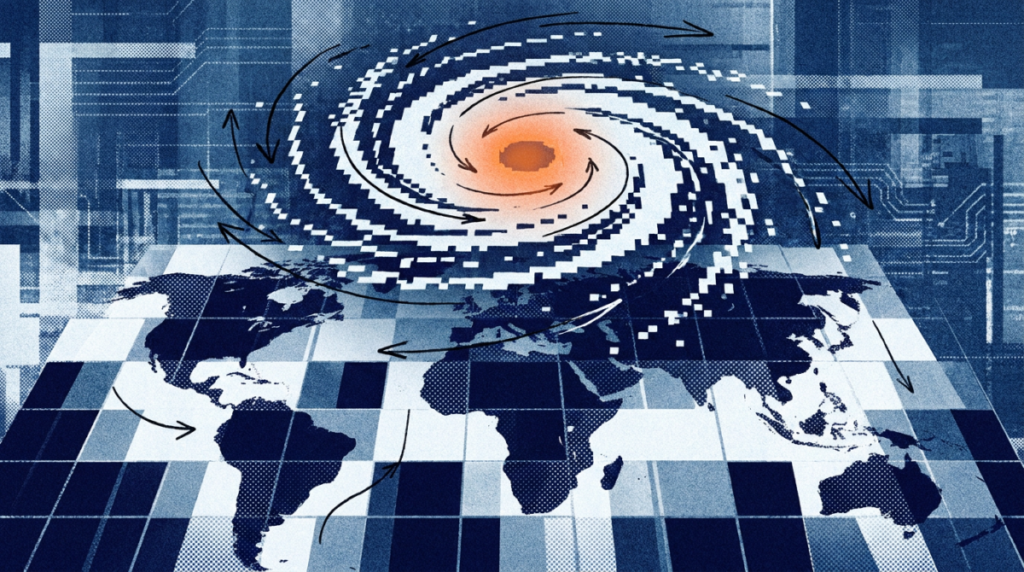
Fathom, a subsidiary of Swiss Re, is using diffusion models to generate tens of thousands of synthetic weather events for a projected 2030 climate.
Insurers have relied on catastrophe models since the 1980s to estimate exposure to earthquakes, hurricanes, and floods. These physics-based tools divide the world into grid cells and solve equations for gravity, friction, and flow. The finer the resolution, the more expensive the computation. A tradeoff between detail and geographic coverage is unavoidable.
Generative AI is now pushing that boundary. Fathom first trained its diffusion tool on roughly 1,000 years of existing climate simulations, then had it produce far more scenarios than the original climate model could. A second, image-sharpening model refines the initially coarse 100 × 100 kilometer resolution down to 10 × 10 kilometers, which is good enough to capture precipitation patterns. Oliver Wing, Fathom’s scientific director, says AI has completely reframed what is possible.
Competitor Verisk now uses generative AI to model extreme wind and rain together instead of one after the other. Research chief Jay Guin says the approach captures spatial variability far more precisely than traditional machine learning. Moody’s RMS uses AI to analyze satellite imagery after wildfires and hurricanes and estimate insured losses. Firas Saleh, who leads Moody’s flood and wildfire modeling for North America, notes the technology is especially valuable for tail-risk events, rare catastrophes with almost no historical data.
Like every form of generative AI, hallucinations are a problem here too. Models can produce events that look plausible but violate basic laws of physics. Wing warns that you can hallucinate some absolute slop using these techniques. According to Swiss Re, natural disasters caused $220 billion in damage in 2025. Only $107 billion of that was insured.
Better models aren’t in every insurer’s interest
More precise models could theoretically let insurers cover regions like Bangladesh or Brazil that major modeling firms have skipped because of low asset values. Whether the new tools actually show up in premiums remains an open question. Better models might reveal that potential losses are higher than previously assumed, which could require larger capital buffers against the most extreme losses.
One modeler told the Financial Times that insurers will generally purchase the model that allows them to do more business – that produces a lower loss estimate. Underwriters just want to write more business. Better science can end up clashing with sales logic, even when the risk picture objectively looks worse.
For people making risk assessments, the change means access to data where none existed before, but it also introduces a new risk of physical impossibility in the outputs. The practical outcome depends on whether insurers prioritise accuracy or simply the ability to sell more policies.