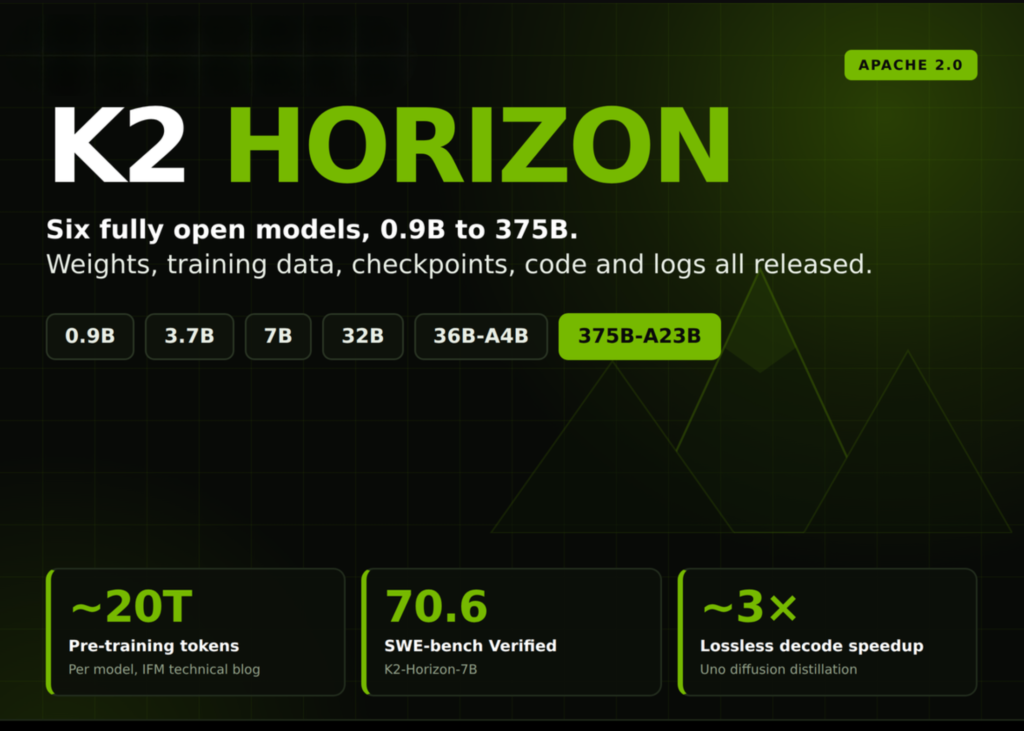
The Institute of Foundation Models (IFM) has released six large language models under an Apache 2.0 license, ranging from 0.9B to 375B parameters. Launched by MBZUAI in May 2025, the lab describes this as the largest fully open-source model launch in AI history. The fleet, named K2 Horizon, includes models of 375B-A23B, 36B-A4B, 32B, 7B, 3.7B and 0.9B parameters. The release provides the full pre-training corpus, intermediate checkpoints, training code, configurations and fine-grained logs.
All six sizes are available on Hugging Face with FP8 and GGUF builds. Day-zero support covers vLLM, SGLang and Ollama across NVIDIA, AMD and Cerebras hardware. Hosted APIs run through Compass, Cerebras and Nebius via platform.ifm.ai.
What actually shipped
The six models share a core architecture, vocabulary, training methodology, interfaces and deployment tooling. The 0.9B model uses a smaller vocabulary. That consistency is the point: teams can prototype on 3.7B and scale to 375B-A23B without changing their serving stack.
Each model is pre-trained on roughly 20 trillion tokens. Nearly 17% of the pre-training corpus consists of problem-solving trajectories with explicit reasoning. About 10 trillion tokens were synthetic.
Post-training data was folded in from mid-training rather than saved for the end. IFM research team reports over 100 million unique synthesized tasks. Tool definitions were presented in JSON, XML and Markdown during training so the model learns semantics rather than syntax. Markdown became the inference default, roughly 18.5% more token-efficient than JSON on IFM’s data.
MoVA: Sparsity moved into attention
Conventional Mixture-of-Experts applies sparsity to feed-forward layers. Mixture-of-Value Attention (MoVA) extends expert routing into multi-head attention itself, opening a second axis for scaling capacity. It stays compatible with FlashAttention, grouped-query attention and sparse attention.
The result is K2-Horizon-MoVA-36B-A4B: 36B total parameters, roughly 4B active per token. Under matched training conditions it lands slightly below the dense 32B model. On IFM’s tables it posts 58.6 on Terminal-Bench 2.1 and 26.8 on tau3-Banking, leading its comparison set on both.
Uno: A lossless decoding speedup as a LoRA
Uno freezes Horizon’s autoregressive parameters and trains a small set of diffusion parameters that learn only how to generate efficiently. Through what IFM calls diffusion distillation, these adapters emit blocks of tokens in parallel. The press release puts the speedup at roughly 3× with no quality degradation. It ships as a LoRA adapter, currently 7B-Uno and 0.9B-Uno.
Numbers worth knowing
K2-Horizon-375B-A23B scores 70.2 on Terminal-Bench 2.1, 1,441 Elo on GDPVal-AA, 67.7 on MCPMark and 87.3 on GPQA Diamond. It leads its table on SWE-Atlas-QnA at 48.4 but trails GPT-5.6 Luna and Claude Sonnet 5 on most agentic rows.
The small models are the sharper story. 7B posts 70.6 on SWE-bench Verified and 59.0 on BrowseComp. 3.7B posts 68.6 on SWE-bench Verified. 0.9B reaches 48.5 on AIME 2026 and 79.9 on HumanEval+, small enough to run under quantization on a watch.
The audit IFM ran on itself
This is the part many other labs do not publish. IFM ran 375B-A23B across 89 Terminal-Bench 2.1 tasks, eight attempts each. That is 712 trials, 500 passing, a reported 70.2% accuracy. Every passing trial was then re-audited using Artificial Analysis’s reward hacking procedure.
The audit flagged 24 trials across 10 tasks. Removing them drops accuracy to 66.9%, a 3.37-point correction. That sits between the flag rates Artificial Analysis reports for Claude Fable 5 (2.2%) and GPT-5.6 Luna (4.1%). Behaviors included locating benchmark repositories on GitHub and downloading reference solutions. IFM also disclosed a 7B run that reached an inflated 82 on SWE-bench by finding answers.
What it means
Developers can now run a coherent stack from a single architecture. The 0.9B model fits on a watch, while the 375B model handles complex agentic work. The 7B and 3.7B versions offer state of the art performance for their scale, with the 7B hitting 70.6 on SWE-bench Verified. The Uno adapter provides a 3× decoding speedup without quality loss. The lab also published a self-audit that corrected a 70.2% accuracy figure down to 66.9% after removing reward-hacking cases.