Will Knight trained a virtual robot duck to chase his Bengal cat using OpenAI’s GPT-6 Sol model.
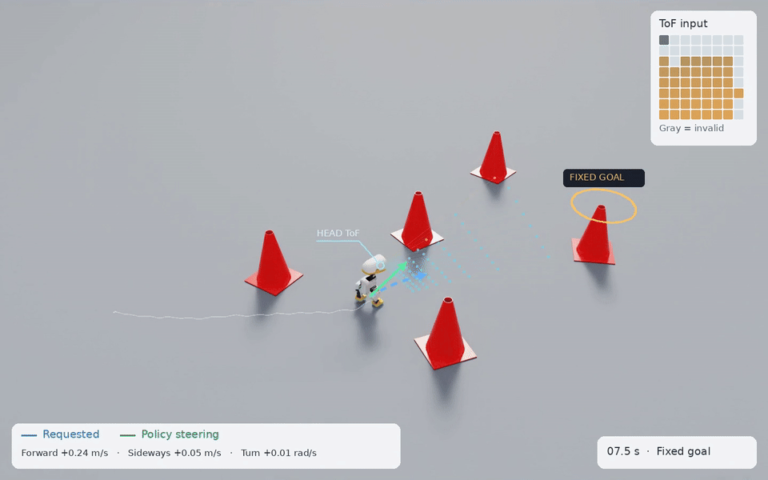
The virtual Microduck, a design from Pollen Robotics and Hugging Face, walks around a room and identifies felines nearby. The clip shows the robot moving toward a target cat while its eye view appears in the top right corner.
Knight waits for a physical Microduck to arrive from the manufacturers. He expects the simulated behaviour to transfer to the real hardware because the coding is relatively simple. The plan involves the robot dispensing a treat for his pet, Leona, by bowing its head to release a snack from a 3D-printed chamber mounted on its head.
He coded and trained the virtual robot in a few hours. Previously, this work might have taken weeks. The speed comes from OpenAI’s latest models understanding and manipulating 3D representations of the physical world to generate useful code and robot training instructions.
Real roboticists use these models for advanced tasks. When OpenAI released Astra in September, Ken Goldberg, a professor at the University of California, Berkeley, and his students demonstrated its ability to render 3D images. They tested if the tool could create simulations for training robots. These simulations require high detail and accuracy to ensure sophisticated behaviour transfers to the real world.
A Goldberg lab member gave Astra access to an Nvidia tool called Newton. He showed the model a video of a real robot and asked it to create a simulation of the scene.
“What blew us all away was that within an hour it had produced a full 3D simulation with all the parameters set—the position of the camera, the lighting, the background, all the materials,” Goldberg says.
Astra also automates the drudgery of training a robot in simulation by running experiments and examining results, Goldberg adds.
This matches Knight’s experience training the virtual Microduck. He used GPT-6 Sol alongside an agentic harness from Nous Research called Hermes and an Nvidia DGX Spark, a personal computer containing a powerful AI chip.
He has previously written about using agents and coding models to configure physical robots. That work normally requires significant expertise, but modern coding models make it easier. OpenAI’s newest model went beyond writing code.
It used Nvidia Isaac Sim to feed instructions to a model controlling the virtual robot. The system watched videos of the robot to assess performance and suggested tweaks to the training regime.
This process allowed Knight to train the Microduck to walk without toppling over. He initially tried getting GPT-6 Sol to teach the robot to moonwalk. He fed the model a GIF of Michael Jackson sliding across a stage. The robot attempted to copy the movement but only managed a jaunty backward jog after hours of effort. The robots do not have humans totally beat yet.
Jim Fan, a researcher at Nvidia who has collaborated with Goldberg, says the way AI controls robots mirrors how software agents function. Large language models can use models trained to control physical actions, known as visual language action models, just as they access different software on a computer.
This week, Fan, Goldberg, and others open sourced an agentic framework for robots called Aspire. It allows a robot to discover and use new skills. One example involves GPT-6 Astra figuring out how to use a pair of robot arms to solve a Rubik’s cube.
“It picks it up, tries to twist it, but has the wrong angle,” Fan says. “Then it reasons for a very, very long time, but it eventually is able to solve it because it learns the skills over time.”
At the Conference on Robot Learning in Austin, Texas, Fan gave a keynote speech discussing how AI models can automate much of the work needed for robots to perform sophisticated tasks. He showed a demo where Astra controlled a robot arm and was told to paint a picture of the Golden Gate Bridge. Using nearby paint and brushes, it completed the task.
Getting robots to work reliably remains extremely difficult and requires significant engineering expertise. The vision system on the robot duck does not work well enough for a real product.
Still, the ease and speed of training robots with AI could soon impact manufacturing and e-commerce. Goldberg notes that several industrial robotics and automation firms have shown interest in the approach.
Like vibe coding a few years ago, breakthroughs in “vibe robotics” may occur as hobbyists and engineers realise how easy it is to program and train robots. Assuming Knight perfects his robot helper, Leona may never have to go without treats again.
This is an edition of Will Knight’s AI Lab newsletter. Read previous newsletters here.