Simon Willison has stopped reading full descriptions of pull requests written by AI coding agents.
Why the summaries fail
Willison relies on pull requests to bundle commits, document decisions, and track progress on his projects. These requests are often opened automatically by tools like Claude Code or Codex.
The problem is that the AI-generated descriptions are too detailed. They accurately cover the problem, the solution, and verification steps. They read like slop.
It takes longer for Willison to read the description than it took the agent to write it. He wants human editorial judgement. He wants a short introduction that tells him if the change is worth his time.
Using HTML to hide the text
Willison now hides the bulk of the AI text inside HTML <details><summary> elements. These render as a collapsed heading with a small arrow. Clicking the arrow expands the full text.
The code structure looks like this:
<details>
  <summary>Claude Opus 5.5</summary>
  <h2>The hook</h2>
  Plugins implement <code>register_agent_reference_types(datasette)</code>...
</details>
GitHub supports these tags in Markdown. You can drop them directly into a pull request body and the platform will hide the details by default.
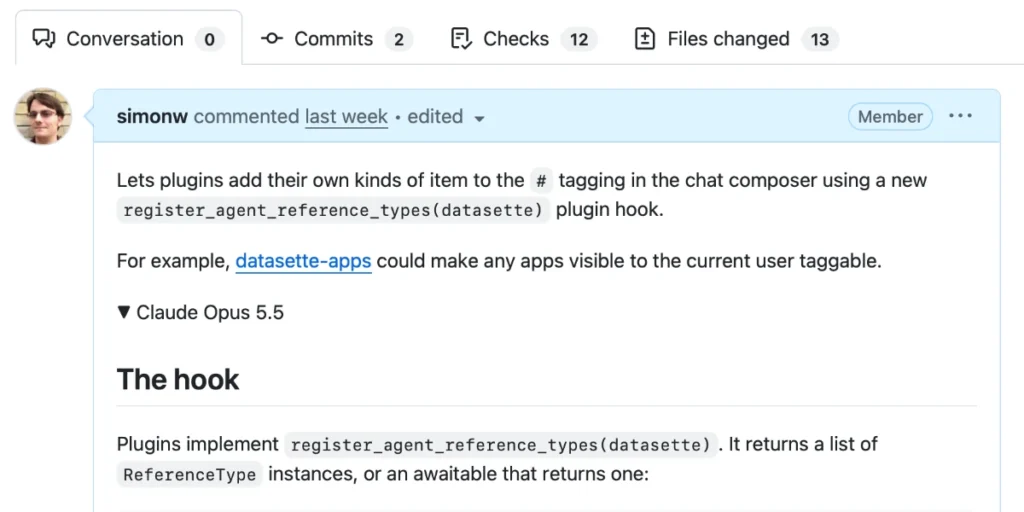
Willison uses the opening paragraph to provide a high-level explanation. He often adds a screenshot to illustrate the change. The full agent-written essay follows inside the collapsed section.
He labels the summary with the model name and effort level. An example is “Claude Opus 5.5 Medium”.
The information remains available. A reader can glance at the opener to get the human-curated summary without reading multiple paragraphs of agent text.
Willison does not always write the introduction himself. Sometimes the agent provides the necessary summary hidden within the larger text. His promise to the reader is that the short opener represents his judgement on what deserves attention.
Recent examples
Here are some recent pull requests where he used this pattern:
- datasette PR #3052: Redesign row page as a vertical list of fields – “The row page showed its single row as a one-row table. For wide tables, like a 46-column GitHub
repostable, that scrolled far off to the right and left most of the page blank.” (then a screenshot) - datasette PR #3043: Pagination bar showing which rows are on the current page – “Table pages that span more than one page now make it obvious where you are, and offer navigation at the top of the page as well as the bottom.” (plus screenshot)
- datasette PR #3042: Load edit-tools.js on demand via a small loader – “
edit-tools.js(~220KB) was loaded on every table, row and database page, even for users who couldn’t edit anything. Now only load it for users who can edit when they first interact with an edit feature (including mouse over an edit link).” - datasette-agent PR #51: register_agent_reference_types plugin hook – “Lets plugins add their own kinds of item to the
#tagging in the chat composer using a newregister_agent_reference_types(datasette)plugin hook.” – pictured above. - llm PR #1838: Add llm openai endpoint add/list/remove/path commands – “Adds commands for managing the records in
extra-openai-models.yaml, so OpenAI-compatible endpoints can be saved from the command line instead of by hand-editing YAML.” – then copied--helpoutput.
The mnemonic
Willison used to struggle with the order of the tags. He asked himself if it was <details><summary> or <summary><details>.
He remembers that the <summary> is the part where you summarise the details. That is the tag for the line of text you click to expand. The <details> element must wrap everything else.
He also refers to the tags as “details-summary”.
That phrase has two syllables followed by three. It rolls off the tongue more smoothly than the three-two punch of “summary-details”.
Saying “details-summary” out loud a few times helps him remember the order.
Willison wishes GitHub would add a button to their Markdown editor for this. He wants to save time typing on his mobile keyboard and help spread the word to other users.