Voice agent teams hit a hard limit when the script asks for a Quebecoise receptionist for a Montreal dealership. The existing catalog of 400 voices does not contain that specific character. Cloning works one speaker at a time, but it requires sourcing, consent, and a licence for each.
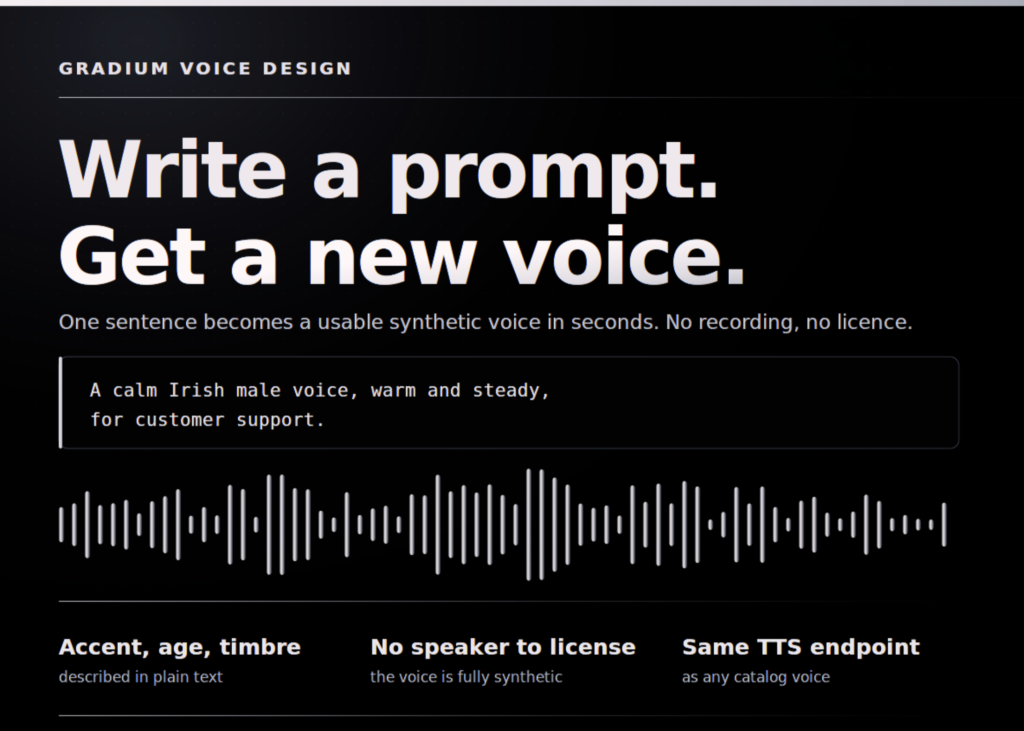
Gradium, the Paris-based voice AI company spun out of the Kyutai research lab, has shipped a different answer. Voice Design reads a written description and returns complete new voices in a few seconds. The process needs no reference audio, no speaker samples, and no rights to clear.
Is it deployable? Yes. Voice Design is live in the Gradium API and in Studio. It is free on every plan, including the free tier. A kept voice runs on the same streaming Text-to-Speech endpoint as any catalog voice, at the same latency and output formats.
The casting brief is the API
The description is the only input the model gets. Gradium’s documentation lists the attributes it responds to. They read like a casting call: gender, age band, accent or origin, pitch, pace, energy, timbre and resonance, register and manner, and the job the voice is doing. Descriptions run 1 to 500 characters in English, French, Spanish, Portuguese or German. Gradium advises ending with the intended use, because it steers delivery and register rather than only the colour of the voice.
One request returns 1 to 5 candidates, typically ready in 3 to 5 seconds. They are variations on a single character, so a different character means a different description, not more samples.
From candidate to production voice
The flow is four calls. POST /voice-generator/generate mints candidate ids with ready: false. GET /voice-generator/embeddings polls until they flip. Each candidate auditions through the ordinary TTS endpoint, using the candidate id as voice_id. POST /voices/from-embedding promotes the one you keep.
Candidates carry three restrictions converted voices do not. Audition text is capped at 100 characters. They are REST only. The TTS WebSocket and Speech-to-Speech reject them. Unconverted candidates are deleted after 30 days. Converting is free, clears the expiry, and uses one custom voice slot shared with clones. The free tier holds 5, paid plans 1,000.
Sampling is deliberately non-deterministic. The Gradium team expands the description first, and that expansion varies per request. The same prompt with a fixed seed still yields a different voice.
The benchmark, and how to read it
Gradium ran a blind pairwise listening test on accent prompts across six voice design systems reachable through public APIs and five languages. Native speakers heard two unlabelled clips and picked the closer match, or a tie. Across 7,627 comparisons, Gradium reports a 72.6% win rate against the field. That is 13.6 points ahead of ElevenLabs eleven_ttv_v3 at 59.0%. Inworld sits at 44.8%, Fish Audio at 36.7% and MiniMax at 31.7%. Win rate is wins plus half of ties, so 50% is par. Gradium placed first in all five languages. The widest margins came on regional accents that most catalogs flatten: Quebecois French at 97%, Rioplatense Spanish at 86%, Bavarian German at 85%, Colombian Spanish and African Portuguese at 83%.
A model judge over the same prompt set agreed. Gemini 3.1 Pro rated single unlabelled clips from 1 to 5 and produced the same ranking: Gradium 4.06, ElevenLabs 3.86, Inworld 3.64, Fish Audio 3.51. Separately, the product page claims 83.4% prompt adherence on the English split of InstructTTSEval, the academic benchmark for instruction following in TTS. Note: All of these numbers are vendor designed and vendor run.
What it means
Developers can now generate a voice that matches a specific role without hunting for a reference sample. The tool handles the generation and conversion internally, removing the friction of manual cloning. Users get a standard voice_id that works across all standard endpoints immediately after approval. The free tier allows five kept voices, while paid plans allow 1,000.