
Gemini 4 Hydrogen beats the larger Argon model on benchmarks just four weeks after launch
Google has launched Gemini 4 Hydrogen, a general-purpose AI model designed for coding and agentic workflows. It replaces Gemini 3.8 Flash and currently outperforms the larger Gemini 4 Argon in standard tests.
The new model offers four reasoning tiers, a one-million-token context window for both input and output, and pricing of $1.50 per million input tokens and $7.50 per million output tokens.
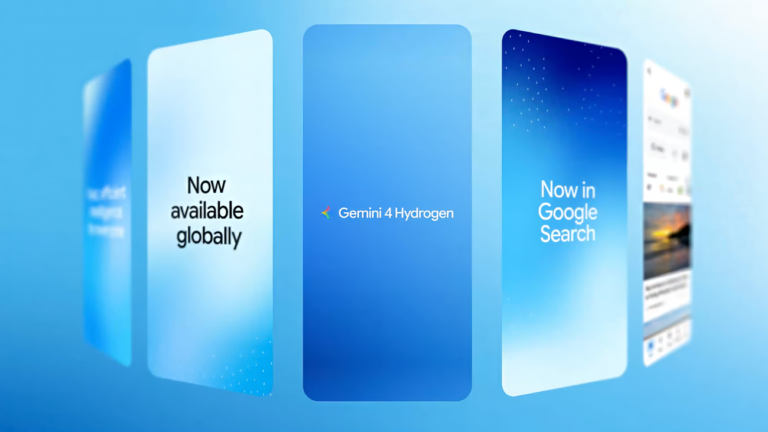
Hydrogen is available now via the Gemini API, the Gemini app, Google Search, and Google Antigravity.
Google positions Hydrogen as a fast, cheap option for everyday tasks, distinct from the frontier models Gemini 4 Carbon and Gemini 4 Argon, which handle deep, long-horizon reasoning. It acts as the successor to the earlier Flash series.
That label might undersell it. Google claims Hydrogen beats the larger Argon on the Artificial Analysis Intelligence Index at the default “high” thinking level, scoring 51 against Argon’s 50. At the highest “xhigh” tier, Hydrogen reaches 54.
Hydrogen offers four thinking levels: low, medium, high, and xhigh. Argon provides only medium and high. The model handles one million input tokens and outputs one million tokens. Cache hits cost $0.075.
Hydrogen appears more capable and cheaper than Argon. This creates confusion because Google recommended Argon for daily coding work just two days ago when announcing Carbon. Hydrogen should make that advice obsolete less than four weeks after Argon’s release.
Hydrogen improves on the previous Flash generation
Google pitches Hydrogen as a standalone upgrade over Gemini 3.8 Flash. At the default thinking level, Google says it finishes tasks 2.5 times faster. On Terminal-Bench 4.1, the score jumps from 18.2 percent for Flash to 57 percent for Hydrogen. Hallucinations dropped by a factor of five, and the model recovers better when a tool call fails or a search returns nothing.
On open-ended agent tasks like research, data analysis, and code navigation, Hydrogen ranks fifth on the Agent Arena leaderboard. Google says it takes first place on the Vals Tax Agent Bench with 52.3 percent and ties for first on the Vals Legal Research Bench with 55.8 percent.
For multimodal knowledge work like summarising large PDFs, spreadsheets, or videos, Hydrogen supports up to one million output tokens on top of its one-million-token input window. It scores 53.4 percent on Google’s new Multimodal Knowledge Agent Benchmark and 71.6 percent on Agents’ Last Exam v1.1.
Hydrogen is available now
Google is rolling Hydrogen out globally across all platforms. Developers get access through the Gemini API in AI Studio and Android Studio. Paying Pro and Ultra subscribers can use it through Google Antigravity. Business customers get it through Gemini for Business, and it is available to everyone in the Gemini app and Google Search.
In the Gemini app, Google says the model sticks more closely to tone, format, and instructions over longer conversations. Drafts, summaries, and documents are more often usable on the first try. Hydrogen can also pull in context from Google apps like Gmail and Drive, as well as third-party apps like Airtable and Dropbox.
Google claims Hydrogen is an upgrade for Search. The model handles search queries better, even when they contain typos, multi-part questions, or very specific requests. Results are more visual and easier to scan, and an improved query fan-out technique pulls in a wider range of relevant links.
In Antigravity, Google’s coding tool, a new orchestrator switches dynamically between Carbon and Hydrogen within a session instead of sticking with one model. On the external benchmark Terminal-Bench 4.0, Google says the orchestrator nearly matches Carbon’s success rates while using 24 percent fewer resources and cutting processing time by 19 percent.
Independent test finds Hydrogen rarely hallucinates but lags on terminal work
An independent evaluation by Artificial Analysis puts Hydrogen roughly on par with Claude Sonnet 5.5 at its highest thinking level. At the default “high” level, the score drops to 51, slightly behind GPT-6.1 Sol (xhigh, 52) and Claude Opus 5.5 (high, 52).
On the AA-Omniscience benchmark, Hydrogen makes things up only 8 percent of the time, according to Artificial Analysis. It also beats other Gemini models, including Carbon, on presentation quality in AA-Briefcase, which evaluates agentic knowledge work.
Hydrogen is weaker at agentic terminal work, scoring 54 percent on Terminal-Bench 4.0 and just 50 percent on Terminal-Bench-Science 0.1. Claude Sonnet 5.5 (max) reaches 64 and 53 percent respectively, while GPT-6.1 Sol (max) scores 56 and 58 percent.
On price-performance, Artificial Analysis puts Hydrogen at about $3.16 per task at xhigh. This is roughly a third of what Claude Sonnet 5.5 (max) costs at nearly the same intelligence level but about 2.5 times as much as GPT-6.1 Sol (max).
At “high,” costs drop to $1.87, at “medium” to $0.80, and at “low” to $0.29. Intelligence scores fall sharply at the lower levels, though, with medium reaching only 41 and low just 27 on the index. Artificial Analysis notes that xhigh uses nearly twice as many output tokens as high, which accounts for the price jump. At the high, medium, and low tiers, the model sits on the Pareto frontier, meaning no other model is both cheaper and smarter at those price points.