Google Research has released a new system designed to generate coherent video stories lasting several minutes. The suite addresses identity drift and cascading errors, the two main failures that break most current multi-shot AI video pipelines.
Why Long AI Videos Fall Apart
Diffusion models can render high-fidelity clips in seconds. Stitching those clips into a story is harder. Most agentic pipelines chain modules with independent, handcrafted prompts. That causes semantic drift, where attire or scenery shifts between shots. It also causes cascading failures, where one bad upstream asset corrupts every later shot.
Google frames this as a credit assignment problem. A broken final video is difficult to trace back to the specific prompt that caused it.
The Four Frameworks
The system sits on top of Gemini and Veo. It is model-agnostic, so the same layer can drive other generators. Outputs inherit SynthID watermarking from the base models.
1. Co-Director: creative planning as a bandit search
Co-Director, accepted at COLM 2026, uses a multi-armed bandit approach. An Orchestrator Agent picks a configuration across Creative Strategy, Narrative Mode, and Aesthetic Archetype. A Pre-Production Agent builds the storyboard. Keyframe, Video, and Audio sub-agents produce the media. An MLLM Judge then scores the cut and sends a factored reward back to the bandit.
2. CANVAS: persistent visual memory
CANVAS, accepted at EMNLP 2026, tracks characters, locations, and object states as the story evolves. It retrieves stored visual anchors when a scene returns. In Google’s museum heist test, AutoStudio lost the thief’s cap and Gemini-3.1-Pro changed the gemstone. CANVAS kept both consistent.
3. A²RD: segment-by-segment long video
A²RD (Agentic Autoregressive Diffusion) is a training-free architecture. Each segment runs a Retrieve, Synthesize, Refine, Update loop against a multimodal video memory. The agent switches between extrapolation for new story beats and interpolation for returning entities. Google shared a 10-minute film generated this way.
4. VQQA: closed-loop prompt refinement
VQQA (Video Quality Question Answering) generates visual questions for each prompt. VLM critiques act as semantic gradients that rewrite the text prompt. It needs no access to model internals. A Global Selection step picks the best video across all iterations, not simply the last one.
Benchmarks and Results
Google built three new benchmarks. GenAD-Bench has 400 ad scenarios across 200 fictional products from 50 brands. HardContinuityBench stresses scene reappearances and prop state changes. LVBench-C has 120 scenarios where key assets vanish for at least 10 segments before returning.
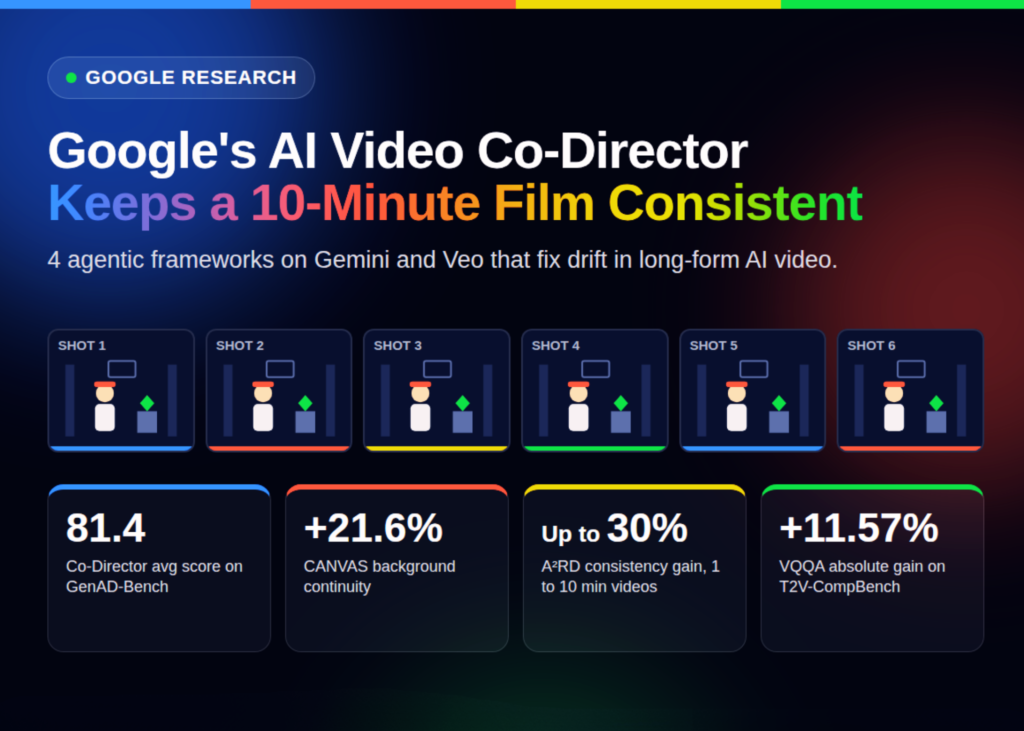
- Co-Director: 81.4 average on GenAD-Bench and 3.96 of 5 in human ratings, per the project page. Baselines included Veo 3.1, Kling 3.0 Omni, Wan 2.6, and MovieAgent.
- CANVAS: gains of 21.6% in background continuity, 9.6% in character consistency, and 7.6% in props consistency.
- A²RD: up to 30% better consistency and 20% better narrative coherence on 1 to 10 minute videos.
- VQQA: absolute gains of 11.57% on T2V-CompBench and 8.43% on VBench2 over vanilla generation.
How It Compares
| Feature | Google AI Video Co-Director | StoryMem (ByteDance, NTU) | MovieAgent (Show Lab, NUS) | AutoStudio |
|---|---|---|---|---|
| Output | Minutes-long multi-shot video with voiceover and score | Minute-long multi-shot video | Multi-scene, multi-shot video with subtitles and audio | Multi-turn image sequences (no video) |
| Architecture | 4 frameworks in a hierarchical multi-agent orchestration layer | Memory-to-Video diffusion model, shot by shot | Multi-agent chain-of-thought planning (director, screenwriter, storyboard artist, location manager) | 3 LLM agents plus a Stable Diffusion based agent |
| Consistency mechanism | Persistent visual memory (CANVAS) and multimodal video memory (A²RD) | Keyframe memory bank from earlier shots | Hierarchical planning plus per-character customization | Subject manager plus Parallel-UNet |
| Self-correction loop | Bandit search with MLLM Judge; VQQA prompt refinement with Global Selection | Semantic keyframe selection and aesthetic filtering | Not reported | Not reported |
| Model training | No fine-tuning; orchestrates existing models | LoRA fine-tuning on the base model | Per-character LoRA (ED-LoRA via ROICtrl) | Training-free |
| Base generators | Gemini and Veo (model-agnostic) | Wan2.2 | ROICtrl, SVD, HunyuanVideo I2V | Stable Diffusion |
| Longest reported output | 10 minutes (A²RD) | About 1 minute | Not specified | N/A (images) |
| Code | Co-Director and A²RD public; CANVAS coming soon | Public | Public | Public |
Sources: linked papers, project pages, and GitHub repositories. Verified September 27, 2026.
What it means
For people making video, the practical change is a shift from manual stitching to automated correction. Previously, a user would generate a shot, see a mismatch in lighting or character appearance, and restart the whole sequence. This system allows the generation to continue across a full minute or more without losing track of the scene. It also provides a method to fix errors without retraining models. Co-Director and A²RD code is available on GitHub. CANVAS code is pending, and the full pipeline is not a Google product.