Why scattered documentation matters for makers building AI agents
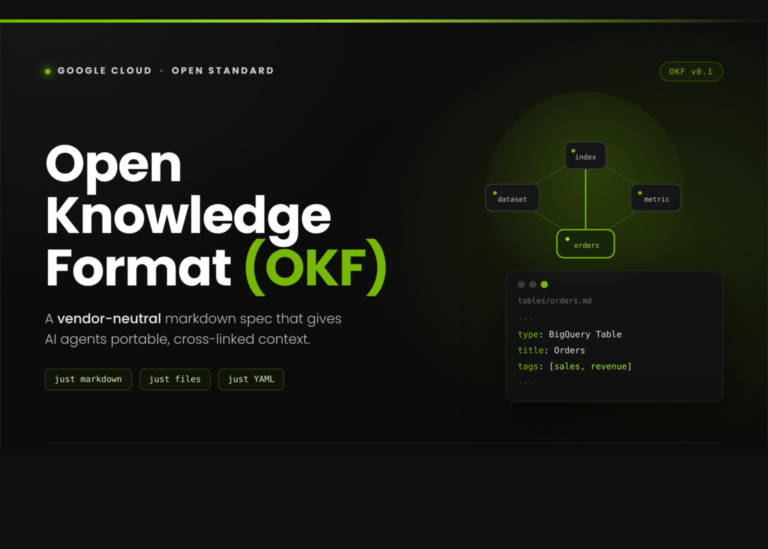
For developers and creators working with artificial intelligence, the current landscape is a patchwork of incompatible systems. Knowledge is trapped inside specific wikis, code comments, notebook cells, and the minds of individual engineers. When an agent needs to construct a SQL query for a specific dataset, it must currently hunt for fragments across these disparate sources. Google Cloud is addressing this fragmentation with the Open Knowledge Format (OKF), a specification designed to turn scattered documentation into portable Markdown files that any AI system can ingest.
Borrowing the “LLM wiki” pattern championed recently by Andrej Karpathy, OKF v0.1 structures knowledge as a directory of Markdown files featuring YAML frontmatter. The specification is intentionally lean. It mandates a single required field, type, alongside optional metadata such as title, description, resource links, tags, and timestamps, with the rest of the content housed in a standard Markdown body. Concepts connect through conventional Markdown links, effectively building a knowledge graph. The result is a bundle that opens in any text editor, renders natively on GitHub, and indexes easily with standard search tools.
Breaking the silos that slow down agents
Organisations already know the bottleneck: context is locked away. Every developer currently reinvents the wheel to solve the context problem. Whether using Obsidian Vaults linked to coding agents, convention files like AGENTS.md or CLAUDE.md, or “metadata as code” repositories on data teams, the approach remains the same. Yet, as Google Cloud notes, these solutions are custom-built and fail to interoperate. Knowledge remains siloed within the system that created it, preventing true portability.
A minimal standard for universal consumption
OKF enforces minimalism to ensure maximum compatibility. It requires only the type field; how extra fields are defined or how the body is structured is entirely up to the producer. This decouples producers from consumers. A bundle crafted by humans can be processed by an AI agent, while a machine-generated bundle can be viewed in a visualizer. Crucially, the format works regardless of the underlying cloud provider, database, or agent framework.
To support adoption, Google Cloud is releasing several reference implementations alongside the spec. These include an enrichment agent that crawls BigQuery datasets to generate an OKF document for every table, a static HTML visualizer, and three sample bundles covering GA4 e-commerce, Stack Overflow, and Bitcoin datasets. Furthermore, Google Cloud has updated its Knowledge Catalog to ingest OKF bundles and serve them directly to agents. The full specification and code are now available on GitHub, with specific documentation for the Knowledge Catalog integration.
Key takeaways
- OKF standardises knowledge as portable Markdown files with YAML frontmatter, ending the practice of reinventing context management from scratch.
- The format is decoupled, allowing human-crafted bundles to be consumed by AI agents and machine-generated data to be visualised by humans.
- Google Cloud is providing reference implementations, including a BigQuery enrichment agent and sample datasets, to help teams adopt the standard immediately.