Thore Graepel, a former DeepMind researcher, proposes that the logic behind AlphaGo can eliminate AI hallucinations by separating knowledge from model weights and storing it in an external ledger.
Graepel founded Metis Reasoning to build systems that track their own knowledge and verify every conclusion against evidence. His team argues that scaling language models will not fix these reliability issues. Instead, the approach relies on principles that allowed AlphaGo to defeat professional Lee Sedol in 2016.
The former researcher presented the method at Nvidia’s GTC conference in Berlin. The chipmaker has been expanding its platform for robotics and physical AI, aiming to turn robotics’ data problem into a compute problem.
A knowledge ledger instead of knowledge baked into model weights
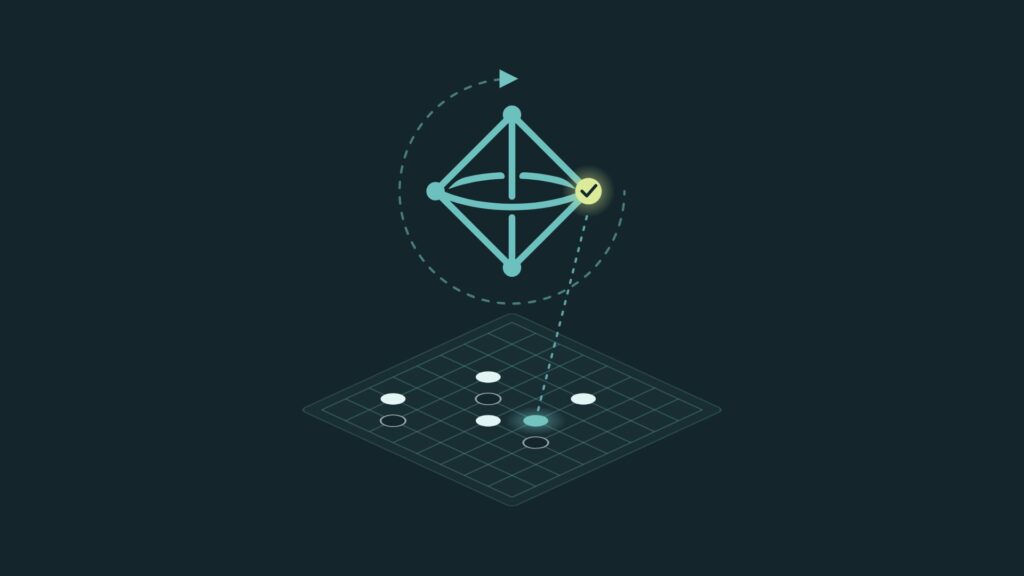
Metis describes today’s language models as equivalent to just AlphaGo’s prediction network. That network suggested possible moves, but the system paired it with a systematic search through game sequences. This process found the famous Move 37, a play the network would have assigned a human player roughly a one-in-ten-thousand chance of making.
Metis wants to bring that kind of search to general reasoning. Doing so requires an explicit knowledge ledger, comparable to the game board. Similar ideas already exist: Microsoft’s GraphRAG organizes knowledge outside model weights in a knowledge graph, and Google’s AlphaGeometry2 pairs a language model with a symbolic engine that verifies mathematical proofs.
Metis aims to extend those principles to open questions in the real world. Its knowledge ledger records what is known, how confident the system is, and which questions remain open. A separate module checks new entries against calculations, formal proofs, or empirical evidence. When an assumption falls away, every conclusion that depended on it gets re-evaluated.
A move can be a question, an experiment, or a challenge to an existing assumption. The system picks whichever one reduces uncertainty about the original question the most, ultimately delivering either an answer or a justified abstention.
As in AlphaGo, two neural networks suggest and evaluate moves. They are trained on logged prior investigations but unable to override the verification rules. Metis says the setup should produce fewer hallucinations, explanations with source citations, and knowledge that can be changed or deleted without retraining. Because reasoning breaks into small steps, the approach could also favour smaller models running on edge devices and in robots.
Companies still don’t trust language models enough to deploy them
More data and compute improve language models but do not solve the technology’s fundamental problems, according to Metis. The models fabricate answers, their reasoning chains cannot be verified, and their knowledge is locked inside the weights. Hallucinations come from the training process itself, the paper argues, because models learn to produce plausible text rather than true text.
Even the chains of thought in today’s reasoning models often fail to show how an answer was actually reached. That, the paper says, is why AI has had so little economic impact so far. When an agent acts on behalf of a company, errors are hard to trace back to their source and wrong knowledge cannot be removed from the model.
AI took off in software engineering because code is easy to test and roll back. But in medicine, finance, chip design, and robotics, the paper argues, AI needs to be verifiable from the ground up.
The white paper describes only a research program, with no working system, no benchmarks, and no comparisons with current reasoning models. The team acknowledges that the real world, unlike Go, provides only partial information. Evidence can be expensive to obtain, and some questions simply have no answer.
The biggest open question is how a verified knowledge ledger would take shape in messy domains beyond textbook examples. This is given that symbolic AI systems once failed precisely because all their knowledge had to be entered by hand.
After Silver and Rocktäschel, another Deepmind veteran strikes out on his own
Graepel earned his PhD in machine learning in Berlin in 2001. At Microsoft Research he helped build TrueSkill, the matchmaking system behind Xbox Live. He then moved to DeepMind, where he worked on AlphaGo, AlphaZero, and MuZero.
After a stint at Altos Labs he most recently served on Google DeepMind’s post-AGI team, which he left over the summer. He also holds the machine learning chair at University College London. According to Bloomberg, Graepel is raising a low tens-of-millions round for Metis, with a follow-on of several hundred million dollars at a higher valuation already in the works.
He is the latest architect of DeepMind’s best-known breakthroughs to build something outside Google. Former colleague David Silver founded Ineffable Intelligence and closed the largest seed round of any European startup. Tim Rocktäschel co-founded Recursive, now valued at $4.65 billion.
Others are going straight to competitors. According to the Financial Times, DeepMind dissolved the team behind AlphaFold, and Nobel laureate John Jumper left for Anthropic with two colleagues. CNBC traces the talent drain partly to limited internal access to Google’s TPU chips and bureaucracy, while DeepMind itself is losing its independence and founder Demis Hassabis has stepped back from day-to-day operations.
What it means
For people making things, this proposal changes the workflow from generating text to verifying steps. Instead of trusting a black box to produce an answer, users would interact with a system that logs every assumption and checks it against a ledger. This means explanations would include source citations, and errors could be traced back to specific assumptions rather than the whole model. However, because the approach exists only as a theoretical framework, there is no current tool for creators to use. The shift implies a move away from generating plausible text toward producing verified conclusions, which may slow down output but increase reliability in high-stakes fields like robotics or medicine.