European leaders are demanding their own artificial intelligence infrastructure because they fear being locked out of American systems trained on US values. While the United States and China compete in an arms race, France and Germany feel excluded despite their engineering strength. They are now proposing specific plans to secure their position, making “sovereignty” a frequent topic at recent conferences.
The funding gap
Reports on technology have covered many attempts to copy the Silicon Valley model. While some individual successes exist, no nation has matched the ecosystem that produced Google, OpenAI, and Anthropic. Investment flows heavily toward American firms, leaving European startups with a fraction of the capital. Anthropic recently secured a $65 billion fundraise, a sum greater than the total investment in European and UK AI startups last year. EU figures support this disparity.
Discussions at Vivatech carried a tone of hope. Optimists point to new funding, collaboration, and next-generation technology that requires fewer resources than current large language models. One variable could be Donald Trump.
Macron’s warning
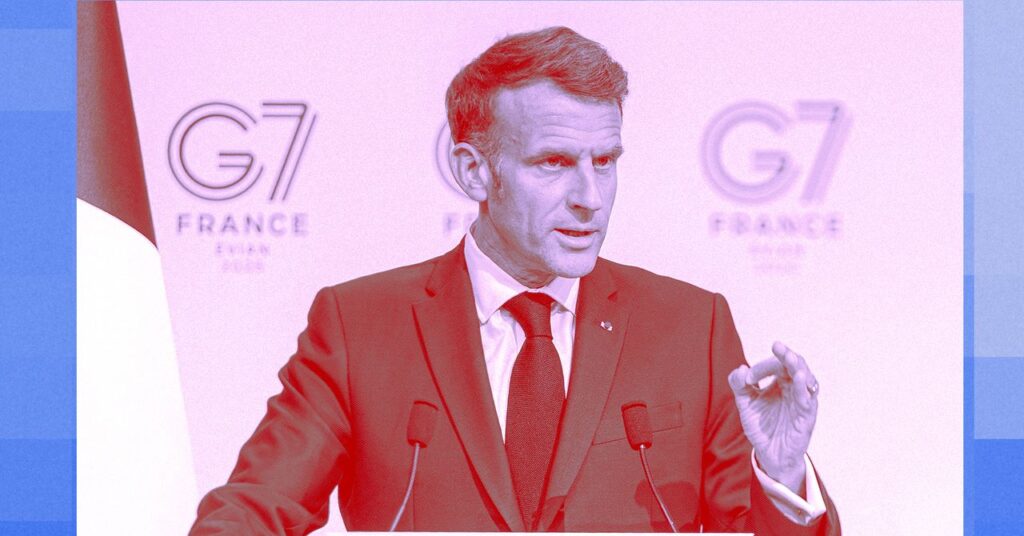
Vivatech coincided with the G7 summit in Evian-les-Bains, France. President Emmanuel Macron addressed AI executives there. He warned that if the US continued down a path of nationalistic AI policy, France would develop its own independent path. Aiden Gomez, CEO of Toronto-based Cohere, shared a similar sense of urgency with the crowd in Evian.
“We need to ensure that a democracy occupies the number two position, and that’s not true today,” Gomez told me at Vivatech. “I think the G7 understands that we need a diverse supply chain of AI providers.”
Building a second-best AI system sounds difficult. More than 20 nations would need to cooperate, overcome bureaucratic barriers, and attract unprecedented investment. Europe must also shift from a risk-averse approach to one that accepts high-risk projects. Macron has made some progress. His “Choose France” initiative has secured pledges of over 100 billion euros for AI infrastructure. This includes a 75 billion-euro commitment from Softbank to build large data centers in France, pending approval.
Building partnerships
Gomez says Cohere is creating a multinational chain of partnerships, starting with German firm Aleph Alpha. The goal is to pool engineering and infrastructure resources for a “sovereign-first” strategy. “A few weeks ago, I was with the king of Spain to sign an MOU with Indra, which is the largest tech company in Spain,” he says.
Yann LeCun, the AI pioneer who resigned from Meta, is pursuing Project Tapestry. This is a massive effort involving governments and private industry to build a state-of-the-art foundation model. “The governments of the world all want AI sovereignty,” LeCun says. “The only way I can see this happening is if there’s an open, free foundation model, on top of which anybody can build their own specialized assistant for their own language, culture, value system, and political biases.”
American talent leaving
These plans resemble previous failed attempts to boost European technology. However, 2026 introduces a new factor: the Trump administration’s policies make the current situation intolerable. For generations, the US has attracted Europe’s best scientists, but they now feel unwelcome. European student enrollment in US universities has declined. Jakob Uszkoreit, CEO of the AI-based biotech firm Inceptive, notes that talent is already moving away from the US, a trend accelerating under the current administration.
Uszkoreit says it would not take much to drain that talent further. “I’d have no problem assembling an all-star team of Europeans, many of which would leave their very cushy current US frontier lab jobs, provided two things: reasonable personal incentives and they have to be able to do their best work,” he says. Both Uszkoreit and Gomez exemplify what the US might lose if foreign researchers do not come to America; they are among the eight coauthors of the famous Transformers paper that spurred generative AI. Seven of the eight were foreign-born.
Export controls as a catalyst
Earlier this month, the Trump administration gave European tech a significant incentive to accelerate its own ecosystem. The US attempted to limit Anthropic’s Claude Fable model by placing it under strict export control regulations, denying access to foreigners. This move was a wake-up call from the European perspective that sovereignty now equals survival. A foreign company cannot build a reliable business around Claude or other American models if the US government can deny access at any time. The designation bans access even for foreign nationals working at Anthropic, including those who helped develop Fable. Anthropic removed the model from the market quickly, but the message was clear: Europeans cannot rely on American companies.
European startups are already feeling a push from these US actions. “The attention we currently have in Europe would not have been the same without Trump,” says Michael Förtsch, CEO of Qant, a chip startup. The short-lived export controls on Fable, he says, “triggered a complete new discussion on sovereignty in Europe.”
“Europe had gotten pretty complacent in light of a very reliable, well-aligned, near-hegemonic [situation],” says Uszkoreit. “The US just made it clear that in the new world order, that’s over.” Europe has no choice but to pursue AI sovereignty.