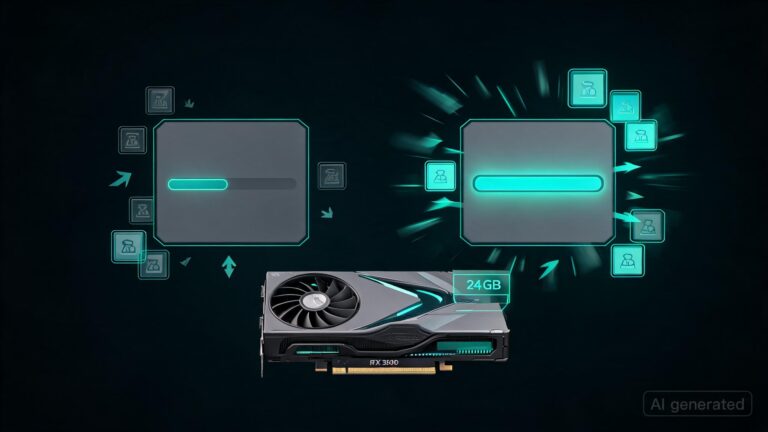
Bigger ubatch made gpt-oss-120b prompt processing much faster on my RTX 3090
I was tuning gpt-oss-120b-F16.gguf with llama.cpp on a 24 GB RTX 3090 and found that increasing the physical micro-batch size (-ub) can significantly improve prompt processing throughput, as long as you also raise --n-cpu-moe enough to keep the run inside VRAM.
The llama.cpp defaults are -b 2048 and -ub 512; I included that default run as its own point in the chart.
| ubatch | n-cpu-moe | prefill | generation |
|---|---|---|---|
| 256 | 25 | 240.03 tok/s | 33.14 tok/s |
| 512 (default) | 26 | 380.27 tok/s | 32.29 tok/s |
| 2048 | 25 | 1112.54 tok/s | 32.96 tok/s |
| 4096 | 26 | 1682.47 tok/s | 32.38 tok/s |
| 8192 | 28 | 2090.68 tok/s | 30.05 tok/s |
Compared with the llama.cpp default -ub 512, prompt processing went from about 380 tok/s to about 2091 tok/s, roughly a 5.5x gain. Compared with the smaller -ub 256 run, it was about an 8.7x gain. Token generation dropped from about 32.3 tok/s at default settings to 30.1 tok/s at -ub 8192, about a 7% reduction.
The catch is that the larger ubatch needs more GPU compute workspace. On my machine, -ub 4096 needed --n-cpu-moe 26, and -ub 8192 needed --n-cpu-moe 28. So this is a throughput trade: move a few more MoE layers to CPU to make enough room for the bigger batch, and prompt-heavy workloads get dramatically faster while generation gets a little slower.
Note: the first four prefill points are pp4096; the 8192 ubatch point is from a pp8192 run, so treat this as an informal tuning result rather than a perfectly controlled benchmark.
One of the reasons I bought a DGX Spark was to have better prompt processing speeds. If I had known about this trick, I might not have done that in retrospect, even though it is a very nice machine, and still gets slightly better prompt processing performance and like double the token generation speed for gpt-oss-120b. Higher ubatch drastically closes the gap.
Key Takeaways
- Bigger micro-batches (
-ub 8192) can dramatically increase prompt processing speed on a RTX 3090. - This requires increasing the number of CPU MoE layers (via
--n-cpu-moe). - The trade-off is between faster prompt processing and slower token generation.
- The trick can be applied to reduce the need for a more powerful machine like a DGX Spark.
Note: The results are based on informal testing and may not represent a perfect benchmark. For production use, further validation and optimization would be recommended.