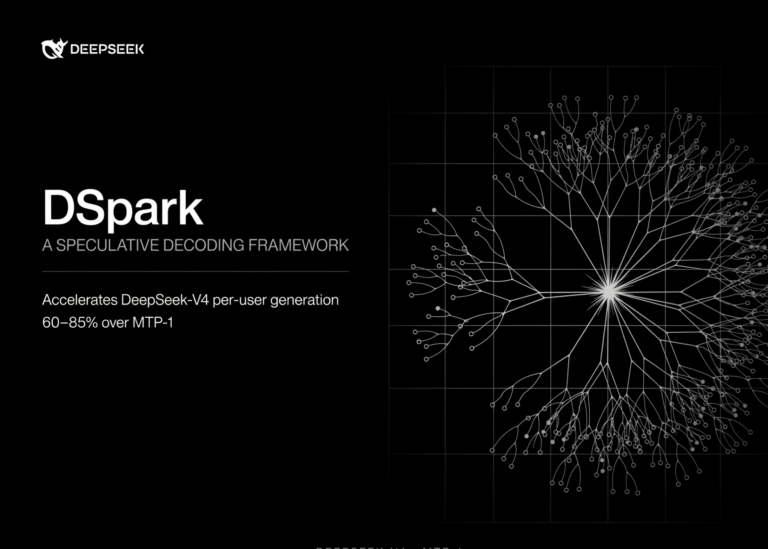
Deepseek has released DSpark, a new inference framework that increases per-user response speed for its AI models by up to 85 percent. The technology addresses the inefficiency of generating text one word at a time, which often leaves graphics processing units underutilised and creates long wait times for users. DSpark employs speculative decoding, where a smaller, lightweight model proposes answer candidates for a larger model to verify in batches. It also generates small groups of words rather than single tokens to improve overall efficiency. A confidence-based system adjusts verification depth dynamically depending on current compute load, reducing wasted processing on rejected proposals. The company tested DSpark with open models from Google DeepMind and Alibaba, suggesting the approach works broadly. The framework and the Deepseek-V4-Pro model, developed jointly with Peking University, are available on Hugging Face and GitHub under the MIT license.
This release matters strategically for China because faster inference lowers chip requirements and cuts infrastructure costs. This advantage is significant for China and potentially the EU, both of which trail the US in data centre buildout and high-performance chip access. Tighter US export controls restrict the flow of advanced hardware, yet DSpark allows operators to squeeze more performance from fewer high-end chips. In the short term, these efficiency gains reduce the US ability to use chip supply as a geopolitical lever. However, the Jevons paradox suggests that freed-up compute capacity may be absorbed immediately by more AI requests or longer contexts, meaning total chip demand could remain flat or even grow.
- Framework available on Hugging Face and GitHub
- Developed jointly with Peking University
- Distributed under the MIT license