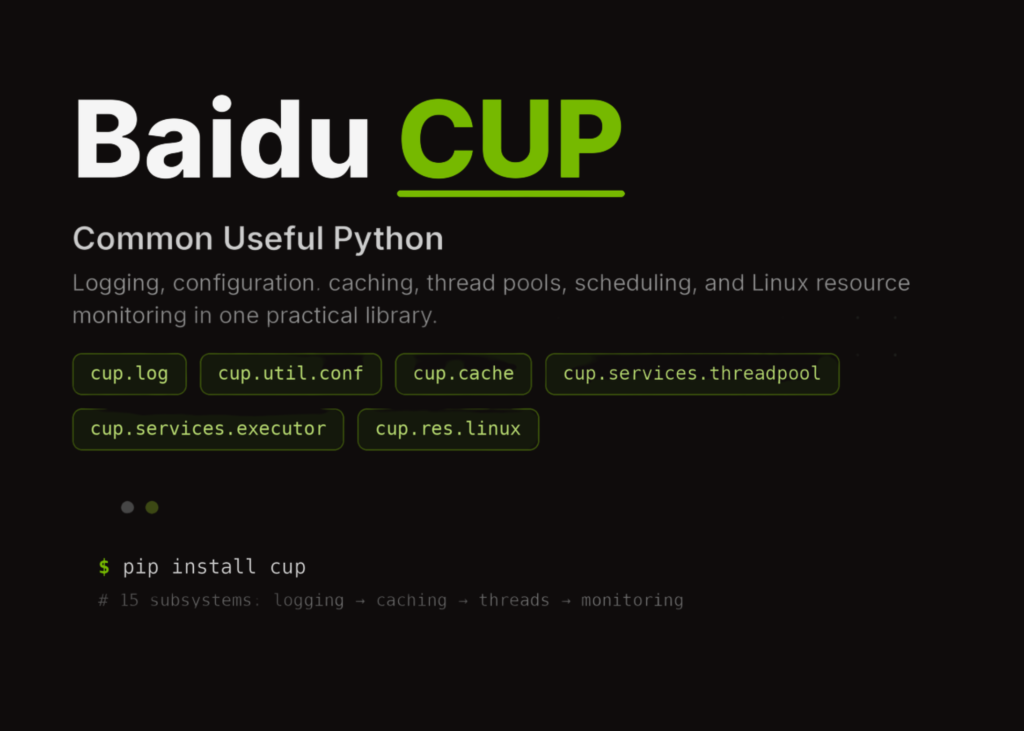
Baidu has released CUP, a library of common Python utilities designed to build more reliable workflows. The toolkit includes modules for logging, decorators, nested configuration, caching, ID generation, thread pools, interruptible threads, delayed execution, time utilities, Linux resource monitoring, file locking, networking helpers, object storage interfaces, type maps, and built-in testing assertions. The tutorial demonstrates how each module fits into real-world development tasks such as monitoring, automation, concurrency, configuration management, and reliability checks.
CUP Setup and Logging
The environment is set up by installing the library and pytz directly from Python. Helper functions keep the notebook readable and allow failed sections to be skipped safely. The code checks CUP version details, runs platform checks, and sets up structured logging to understand the library’s foundation.
Decorators and Nested Config
CUP decorators help create single-instance classes, track execution time, and protect Linux-only functions. The configuration system handles nested files with sections, child sections, and repeated values. The workflow demonstrates updating the configuration and writing it back to disk to confirm the read-modify-write flow works correctly.
Caching, IDs, Thread Pools
The in-memory cache stores key-value pairs with temporary and permanent lifetimes. Unique names, counters, UUID-style values, random strings, and cycling IDs generate distributed-style identifiers. A thread pool submits jobs, collects results, and observes callback behavior for both successful and failed tasks.
Threads, Scheduling, Time Utilities
The code block for this section was cut off in the source material. It is intended to cover CUP’s thread management, scheduling mechanisms, and time utility functions.