The conversation around AI coding tools in 2025 has a habit of circling the same benchmarks: HumanEval scores, SWE-bench pass rates, tab-completion latency. Almost none of that reflects what actually matters when you are three SSH hops deep into a relay server at midnight, debugging a PostgreSQL JSONB operation that silently fails, with a Docker network mismatch blocking your n8n instance and a bash heredoc stripping your template literals before they ever reach the database.
That is the real test. Not a curated coding problem in a sandbox. A live, stateful, multi-system problem where the solution requires reasoning about infrastructure, not just syntax.
This is that comparison.
What We Are Actually Comparing
Three tools. Three very different philosophies about what AI coding assistance means:
- Claude Code (Anthropic), Agentic CLI tool. Reads files, runs bash, SSHes into remotes, edits configs, interprets tool output, reasons across the whole system.
- GitHub Copilot / Codex, OpenAI’s engine. Inline autocomplete in your IDE, chat sidepanel, limited terminal assistance. The market leader by install count.
- Cursor, IDE-native, Claude or GPT-4o under the hood depending on plan. Strong at refactoring within a codebase, weaker outside the editor.
Codeium, Tabnine, Amazon Q follow similar patterns to Copilot and don’t need separate treatment here.
The Fundamental Split: Completion vs Agency
Copilot and most coding AI tools are sophisticated autocomplete engines. They predict what comes next in a file. That is valuable. It is also fundamentally different from what Claude Code does.
Claude Code is an agent. It does not just write the next function, it figures out what the next function needs to do, checks the current system state, runs a command to verify, reads the error output, revises its understanding, and tries again. It operates a feedback loop that Copilot does not have access to, because Copilot cannot run anything.
This is not a criticism of Copilot. They are different tools solving different problems. The mistake is assuming they are comparable.
A Concrete Example: Debugging a Live System at Depth
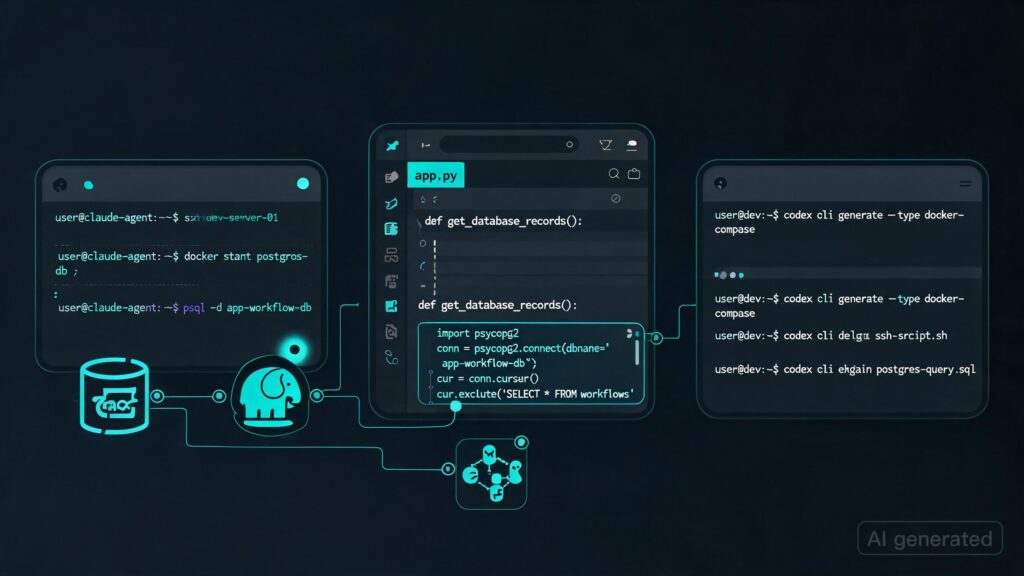
Here is what a real session looks like. Updating a node in an n8n workflow stored in PostgreSQL inside a Docker container on a remote relay. The node contained JavaScript with template literals, backtick strings with variable interpolation.
The problem: every approach using bash heredocs to inject the JS into a psql command stripped the dollar signs before they reached the database. The node ended up with empty expressions. $input.first().json became .first().json. The workflow failed with Unexpected token ‘.’. Then when switching to a Code node using fetch(), it failed with fetch is not defined, because n8n’s sandboxed runner does not expose the global fetch.
Three compounding problems. None obvious from the error messages alone.
Claude Code worked through all three: identifying the bash interpolation issue, proposing the pg_read_file() workaround to avoid shell quoting entirely, then recognising that fetch is unavailable in n8n’s Code node sandbox and reverting to an HTTP Request node with hardcoded headers. The entire diagnostic chain happened in one session without the operator having to explain n8n’s execution model.
Could Copilot help here? For the SQL syntax, yes. For reasoning about why bash heredocs strip dollars, or why n8n’s Code node sandbox lacks fetch, no. That requires understanding the execution environment, not just the code.
Claude Code vs Codex CLI: The Closer Fight
OpenAI’s Codex CLI is the more direct comparison, both terminal-native, both capable of running commands. The real differences:
| Capability | Claude Code | Codex CLI |
|---|---|---|
| File reads and edits | Full, reads entire files, targeted edits with diff review | Yes |
| Bash execution | Yes, with configurable approval | Yes |
| Multi-step reasoning across tools | Strong, holds state across 20+ tool calls | Degrades on long chains |
| Context window | 200K tokens | ~32K (GPT-4o) |
| Remote system reasoning | Yes, SSH paths, Docker networks, relay hops | Limited |
The context window gap matters more than it sounds. A complex infrastructure session, reading five config files, running eight commands, parsing error output, revising approach, burns context quickly. Claude Code’s 200K window means you do not lose the beginning of the session when things get complicated. Codex CLI’s 32K can force you to start over.
Where Copilot Still Wins
Inline autocomplete during active coding, writing a new React component, filling in TypeScript interfaces, generating boilerplate, Copilot is faster and less friction than switching to a terminal agent. The IDE integration is seamless in a way nothing else currently matches.
For greenfield development where you are writing a lot of fresh code and want suggestions as you type, Copilot earns its subscription. For operating and debugging existing systems, Claude Code is in a different class.
Cursor: The Middle Ground
Cursor occupies an interesting position, IDE-native, whole-codebase embeddings, agentic modes with terminal access. The refactoring experience is genuinely strong.
The limitation: it is fundamentally IDE-centric. Work that spans the editor boundary, infrastructure, remote systems, Docker, deployed services, it handles less naturally. If your primary workload is writing and refactoring code within a project, Cursor is worth serious consideration. If your work is operating systems that happen to involve code, Claude Code is the better fit.
The Verdict
The setup that actually makes sense for practitioners doing serious work:
- Claude Code as primary for infrastructure, agentic tasks, debugging live systems, anything requiring commands and reasoning about output
- Copilot or Cursor for inline assistance when writing fresh code inside an editor
- Codex CLI if you are deep in OpenAI’s ecosystem and prefer GPT-4o’s output character
These tools are not mutually exclusive. The mistake is treating this as a single-tool decision.
Key Takeaways
- Claude Code and Copilot solve different problems. Comparing them as if they are alternatives misses the point entirely.
- For live system debugging and infrastructure work, agentic reasoning across tool output is the decisive advantage, Copilot cannot offer this.
- Copilot remains best-in-class for inline completion during active coding sessions in an IDE.
- Cursor is the strongest option for navigating and refactoring large codebases, but weakens outside the editor boundary.
- Claude Code’s 200K context window is a practical advantage over GPT-4o-based tools on complex multi-step sessions.
- The real differentiator is not benchmark scores. It is what happens when something breaks on a live system and the error message tells you nothing useful.