Enterprises are moving past isolated AI pilots and facing a harder problem: how to build autonomous agents that function reliably across the whole business. This shift requires treating AI as a core part of the operating model, not just a collection of disconnected tools.
Building a foundation for reliability
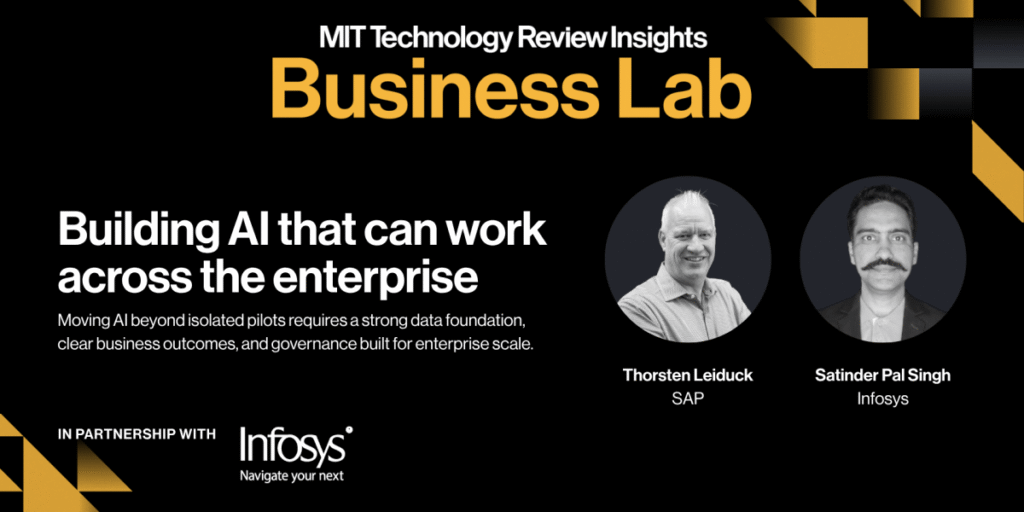
Thorsten Leiduck, SVP and global head of SAP Business AI Platform Ecosystem, says this transition starts by viewing AI as a platform. He argues that companies need a connected, semantically rich data layer that mirrors their business operations before they can deploy AI safely across processes.
The requirements change when AI enters mission-critical workflows. For some everyday applications, “80% might be good enough,” he says. In areas such as supply chains or financial close, that level of accuracy is “a very terrible result.”
Choosing the right use cases
Satinder Pal Singh, associate VP North America for SAP BAIP and SAP AI Strategy at Infosys, describes AI agents as “digital coworkers.” He recommends evaluating potential applications through three lenses: impact, feasibility, and scalability.
Companies must identify where an agent can move meaningful business metrics, determine whether their data and talent can support the use case, and establish whether successful applications can be replicated. “A pilot that can’t scale is just an experiment,” he says.
Both executives see a future where agentic systems coordinate work across applications, while customer-specific knowledge graphs and governed data become critical enterprise assets. For Singh, the longer-term opportunity is a shift from AI as a productivity tool to “AI as a decision-making partner,” helping leaders understand what is happening, anticipate what comes next, and determine how to respond.
The cost of ignoring governance
Scaling brings governance into sharper focus. Clear policies, access controls, monitoring, and oversight are necessary to ensure agents remain trustworthy and aligned with business requirements. “The absence of governance doesn’t speed up AI adoption,” Singh says. “It creates a risk backlog” that can ultimately force a more disruptive stop and audit.
What it means
Practically, this means companies cannot simply add AI to their existing toolkit. They must reconfigure how data, processes, and people work together. Leaders should stop treating AI as a technology initiative owned by IT and start viewing it as an operating model transformation involving every function. Early movers are building a structural advantage through calibrated knowledge graphs and workforce internalization, while others risk falling behind as the gap widens.