“`html
Build a Hybrid-Memory Autonomous Agent with Modular Architecture and Tool Dispatch Using OpenAI
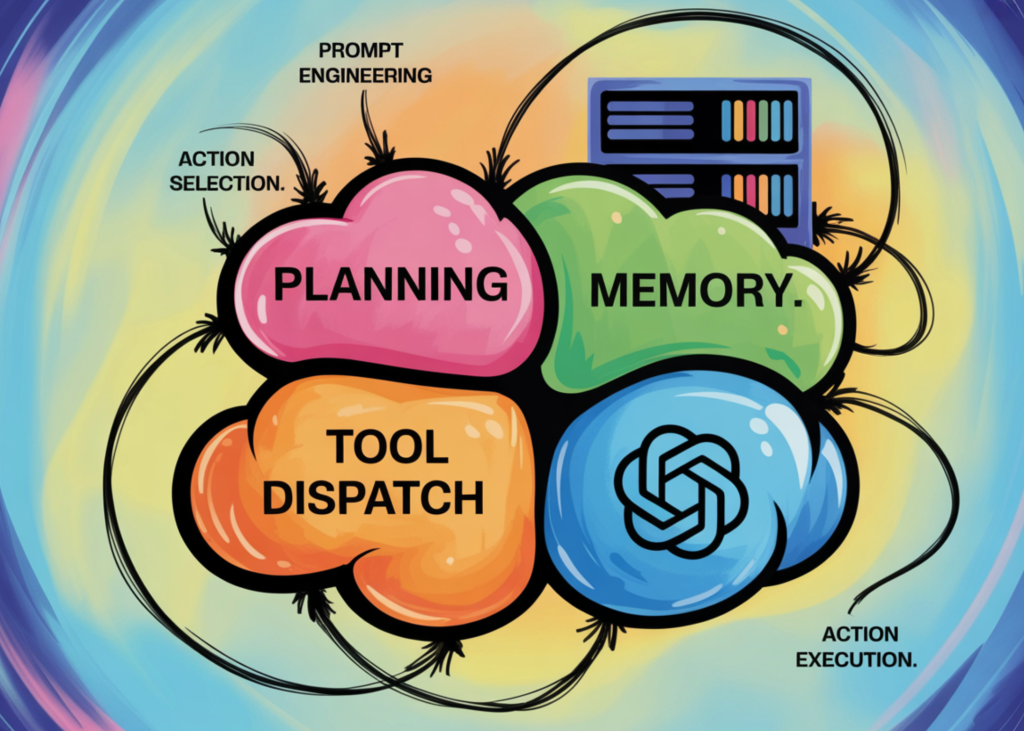
In this tutorial, we begin by exploring the architecture behind a hybrid-memory autonomous agent. This system combines semantic vector search, keyword-based retrieval, and a modular tool-dispatching loop to create an agent capable of reasoning, remembering, and acting autonomously. We walk through each layer of the design from the ground up, starting with abstract interfaces that enforce clean separation of concerns, all the way to a live agent that manages its own long-term memory.
We kick things off by installing all required dependencies and configuring our Python environment with the necessary imports. We securely collect the OpenAI API key using getpass, ensuring the key is never echoed to the terminal or notebook output. We also define the two global constants, the embedding model and the chat model, that every subsequent snippet depends on.
We define the three core abstract base classes: MemoryBackend, LLMProvider, and Tool, which serve as the interface contracts every concrete component must honour. We then implement HybridMemory, a concrete memory backend that stores embeddings for vector search and maintains a live BM25 index for keyword matching, merging both result sets using Reciprocal Rank Fusion. Finally, we close the snippet with OpenAIProvider, a concrete LLMProvider that normalises the OpenAI response into a provider-agnostic dictionary the agent can consume without knowing which model sits underneath.
We define two tool classes: MemoryStoreTool and MemorySearchTool. The former allows saving important facts or pieces of information to long-term memory, while the latter enables searching through this stored knowledge. Both tools are designed to be simple functions that use the underlying memory backend.
We also introduce a CALCULATOR_TOOL, which is a concrete tool for evaluating safe mathematical expressions. This example demonstrates how we can extend our agent with additional capabilities beyond just searching and storing memories.