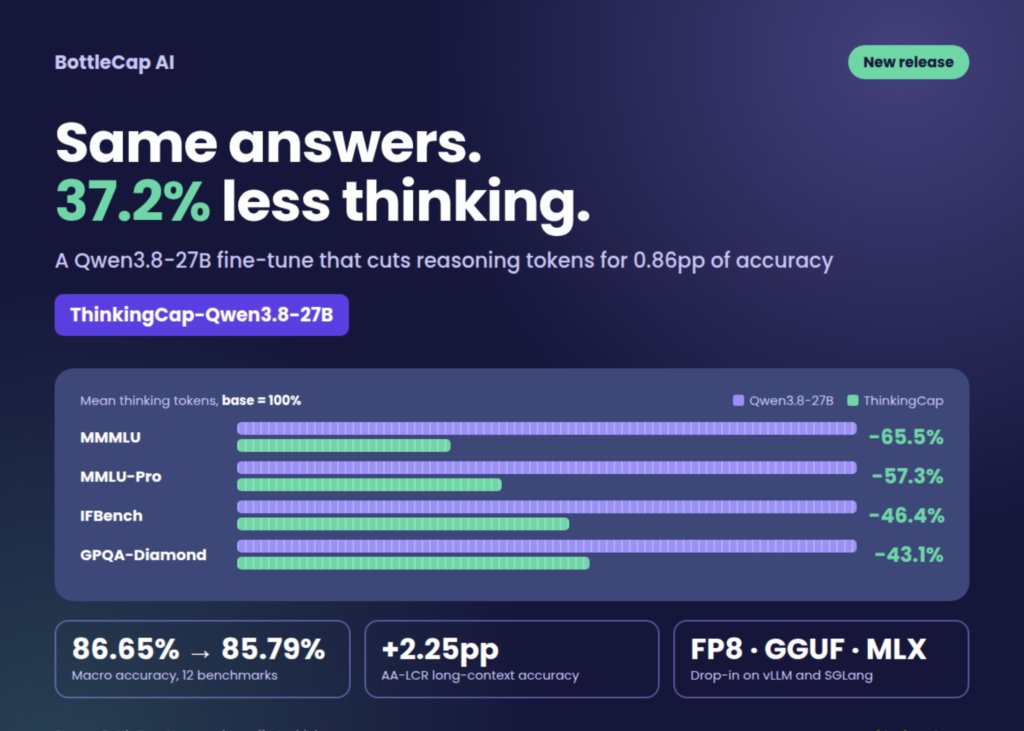
BottleCap AI has released ThinkingCap-Qwen3.8-27B, a fine-tuned version of Qwen3.8-27B designed to reduce the number of tokens used during reasoning. Across 12 benchmarks, the model generates 37.2% fewer thinking tokens on average. This reduction comes with a macro-average accuracy drop of 0.86 percentage points, moving the score from 86.65% to 85.79%.
Deployment and Licensing
The model integrates directly with Qwen3.8-27B via vLLM or SGLang. It supports FP8, NVFP4, GGUF, and MLX builds. Access to the repository is gated, and commercial use beyond the small-business license requires a separate agreement with BottleCap.
Targeted Efficiency Gains
The project addresses the inefficiency where reasoning models generate more tokens than necessary to reach a correct answer. The previous release in the series applied this logic to Qwen3.6-27B. This iteration took a conservative approach, avoiding changes to knowledge or response style while preserving instruction following and safety protocols. The team prioritised improvements in mathematics, reasoning, long-context handling, and agentic tasks.
Performance metrics rely on the reasoning_effort=xhigh setting. Reductions in thinking tokens range from 10.7% to 65.5% across the board.
Knowledge and multilingual tasks show the largest improvements. MMMLU thinking tokens fall by 65.5%, dropping from 1,656 to 571. MMLU-Pro sees a 57.3% reduction. GPQA-Diamond tokens decrease from 12,772 to 7,267, a 43.1% cut. IFBench thinking drops 46.4% while maintaining near-identical accuracy at 79.71% compared to 79.75%.
Long-context retrieval and code generation also benefit. AA-LCR accuracy improves by 2.25 percentage points to 84.00%, with 38.6% fewer tokens. LiveCodeBench v6 accuracy rises slightly by 0.07pp while thinking tokens fall 20.3%.
Agentic benchmarks remain stable. τ²-bench accuracy decreases by 1.01pp for a 30.9% reduction in tokens. Terminal-Bench 2.1 loses 0.56pp, staying within the ±4.26 variance interval, while tokens drop 10.7%.
The steepest trade-off appears in AIME 2026, where accuracy falls 3.85pp to 94.27% for a 30.2% reduction in thinking tokens. The 37.2% figure represents the mean of the 12 per-benchmark reductions. Pooled mean thinking tokens fall from 15,735 to 12,144.
Under a 16K-token response cap, ThinkingCap outperforms the base model. Truncated traces drop from 0.51% to 0.34%, and looping falls from 0.06% to 0.05%.
Interaction With Reasoning Settings
The model works alongside Qwen3.8-27B’s native reasoning-effort dial. All comparisons below use the base model at xhigh averaged over 11 benchmarks.
At medium effort, the base model reduces thinking by 52.1% with a 9.16pp accuracy loss. ThinkingCap achieves a 60.2% reduction for a 9.90pp drop. At low effort, the base model cuts 55.4% for a 9.71pp loss, while ThinkingCap cuts 62.3% for a 10.79pp loss. With thinking disabled, ThinkingCap trails the base model by 5.7pp.
The BottleCap team recommends xhigh for the best balance between accuracy and token efficiency. They note that individual thinking modes will be addressed in a future release.
Evaluation Methodology
Testing occurred on a single NVIDIA H200 using vLLM 0.29.0. Sampling parameters were identical for both models: temperature 1.0, top_p 0.95, top_k 20, and min_p 0.0. Accuracy was calculated using multi-seed means with 95% intervals. Seed counts ranged from 32 on AIME 2026 to 1 on MMLU-Pro and MMMLU. MMMLU used a fixed 10,000-question sample; the remaining 11 benchmarks ran complete sets.
MTP speculative decoding using three draft tokens proved accuracy-neutral on AIME 2026. The system accepted 53% of drafted tokens, averaging 2.6 tokens per step, matching the base model.
Builds and Serving
The bf16 checkpoint contains 28B parameters and accepts both image and text input. BottleCap provides five quantized builds:
- FP8: 31 GB, compatible with vLLM, Hopper, and Blackwell.
- NVFP4 weight-only: 21 GB, for vLLM, Hopper (Marlin kernel), and Blackwell.
- NVFP4 W4A4 (AWQ): 23 GB, Blackwell only.
- GGUF: 16 to 55 GB, for llama.cpp, LM Studio, and Ollama.
- MLX 4-bit DWQ: 21 GB, for Apple Silicon Macs with 32 GB RAM.
Serving follows the base model’s recipe: --reasoning-parser qwen3 with the qwen3_xml tool-call parser on vLLM. Reasoning outputs appear in a separate field.
The license is PolyForm Small Business 1.0.0 plus a BottleCap personal-use grant. Upstream Qwen materials remain under Apache-2.0. No inference provider currently hosts the model on Hugging Face.
What it means
For developers running these models, the practical change is faster response times and lower compute costs per query. The model is ready to drop in without altering existing vLLM or SGLang configurations. Users should expect a slight dip in accuracy on complex math problems like AIME, but gain efficiency on knowledge retrieval and long-context tasks. Commercial deployment requires checking the specific licensing terms.