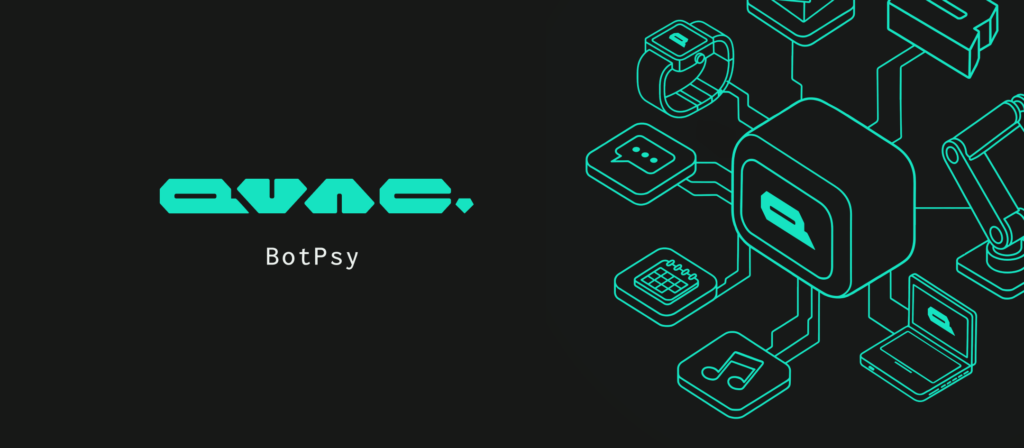
BotPsy: On-Device Personal Assistant with a Sub-Billion-Parameter Agentic Language Model
Tether AI Research has released BotPsy, an 0.8B-parameter model designed for function calling and agentic workflows. The system runs on a Qwen3.5-0.8B base and targets on-device deployment for tasks ranging from web search and finance to device control and calendar management.
Because of its small size, the model is best suited for low to medium difficulty tasks. It achieves state-of-the-art performance for its class, beating every model up to 1.2B parameters on the tests the authors ran.
🤗 Model (safetensors) | 📦 GGUFs (bf16, Q8, Q4)
Copyright Complaints
We will take appropriate actions in response to notice of copyright infringement. If you believe your work has been used or copied in a manner that infringes upon your intellectual property rights, please email da*******@****er.io identifying and describing both the copyrighted work and alleged infringing content to file a notice of infringement.
Key Highlights
Benchmark results
- Twice the performance of its base model: BotPsy roughly doubles the agentic capability of Qwen3.5-0.8B-Think on key benchmarks: BFCL v4 rises from 23.4 to 44.0, ACEBench from 30.1 to 58.7, and τ-bench from 23.2 to 51.5 (mean of the retail, telecom and banking subsets).
- Best agent in its category: BotPsy outperforms leading models in the ≤1.2B-parameter weight class (Qwen3.5-0.8B-Think, LFM2.5-1.2B-Think, MiniCPM5-1B-Think) on all six tool-use and agentic benchmarks: BFCL v4, ACEBench, τ-bench, ToolSandbox, Claw-Eval and BrowseComp-Plus.
- Outperforms its larger sibling: BotPsy has the highest score of all models tested on five of the six benchmarks, beating Qwen3.5-2B-Think, a model 2.5× its size, on BFCL v4 (44.0 vs 37.7), ACEBench (58.7 vs 55.4), τ-bench (51.5 vs 46.5), ToolSandbox (64.6 vs 41.2) and BrowseComp-Plus (4.5 vs 2.8). Only on Claw-Eval does Qwen3.5-2B-Think lead (48.9 vs 46.5).
Model capabilities
- More reliable in multi-turn workflows: On τ²-bench, where the agent must hold a long customer conversation, follow a strict policy, and act on the customer’s behalf, it scores 82.5 in telecom, ahead of Qwen3.5-2B-Think (69.3). On BFCL v4’s multi-turn tasks, it rises from 7.5 to 46.1 over its base, nearly double Qwen3.5-2B-Think (23.8). Grouped by application, its multi-step scores lead all models tested in commerce and services (58.3 vs 47.4 for the next best, Qwen3.5-2B-Think) and in device and system management (46.1 vs 31.9).
- Knows when (not) to call tools: An agent that acts must also know when not to act. On BFCL v4’s hallucination tests, which check that the model declines when no appropriate tool exists, BotPsy scores 86.1, the highest of all models tested. On ACEBench’s special cases, where the request is incomplete, contains wrong parameters, or cannot be served by the given tools, it scores 51.3, up from 13.7 for its base model.
- Follows instructions while preserving knowledge: BotPsy specializes in tool use while preserving general skills. Instruction following improves sharply, with IFEval rising from 59.7 to 90.8 and IFBench from 22.0 to 55.9, the highest IFBench score of all models tested. General knowledge also improves, with GPQA Diamond rising from 33.2 to 38.1 and MMLU-Pro from 41.6 to 48.9. On all four benchmarks, BotPsy outperforms every other model of 1.2B parameters or fewer that we tested.
Safety, efficiency and deployment
- Safer than leading models in its category: In automated red-teaming across six harm categories, BotPsy produces unsafe responses 21% of the time, compared with 36% for its base model. This is the lowest rate of all models of up to 1.2B parameters (LFM2.5-1.2B-Think: 35%; MiniCPM5-1B-Think: 47%). Under prompt-injection attacks, which matter most for agents that read untrusted tool outputs, the unsafe rate drops from 46% for its base model to 31%.
- More efficient reasoning and less looping: On questions that all five models answer correctly, BotPsy reaches the answer with about 3× fewer reasoning tokens than its base model on GPQA Diamond (3,690 vs 11,563) and 2.7× fewer on MMLU-Pro (1,912 vs 5,105). Across all IFBench attempts, its rate of getting stuck in repetitive reasoning loops falls from 22.9% to 1.4%, and runs that hit the 32k-token limit fall from 28.3% to 0.2%. Shorter, more decisive reasoning should reduce latency on-device.
- Open-source and ready to use: BotPsy will be released with open weights under the Apache 2.0 license for research and educational use. It will be available in three precisions (bf16, Q8, Q4), as Hugging Face safetensors and as GGUF files for the QVAC SDK and llama.cpp.
Broader Vision
Building upon the foundation of BotPsy, future development by Tether Data, S.A. de C.V. will focus on expanding on-device agentic capabilities to integrate with a broader array of hardware and local services. Tether’s Hypersearch will evolve to support more robust decentralized peer-to-peer queries, further ensuring private, encrypted web searches that bypass corporate trackers. QVAC Fabric local fine-tuning mechanisms will be optimized to adapt more deeply to individual user preferences, workflows, and specialized tool environments. Future iterations will allow the smartphone interface to delegate heavy computational tasks to home PCs or trusted secure P2P nodes during offline-online transitions. Privacy protocols will be continuously strengthened to guarantee that all personal data, credentials, and decisions remain strictly on local hardware. Collaborative features will be introduced to allow secure agent-to-agent communication across trusted local networks without compromising user confidentiality. Ultimately, these advancements will solidify BotPsy as a fully autonomous, highly capable personal AI ecosystem that keeps users entirely in control of their digital lives.
Methodology
BotPsy is based on Qwen3.5-0.8B and is post-trained in four sequential stages: Supervised Fine-Tuning (SFT), Multi-teacher On-Policy Distillation (MOPD), and two rounds of Reinforcement Learning (RL). Each stage uses the previous stage’s best checkpoint as its starting point and benefits from a different learning signal: imitation of reference trajectories, the token distributions of much larger teacher models, and rule-based tool-calling rewards.
Training procedure: four stages, three types of feedback
Our approach uses four stages of training, which learn from three types of signal: demonstrations, specialist teachers, and verifiable rewards.
Learning from demonstrations (SFT)
We first perform full-parameter supervised fine-tuning on tool-use conversations. These include multi-turn agent trajectories from simulated environments, replayed single, parallel and multi-step calls, and cases where no tool should be called.
Learning from teachers (MOPD)
Next, the student is trained with on-policy distillation: it generates its own responses, and a specialist teacher provides feedback on every token, using the per-token reverse KL divergence as the training signal. To build the teachers, we first RL-trained three Qwen3.5-4B models to specialize in tool use, general reasoning, and instruction following. During training, every prompt is routed to one of these teachers. This stage mainly aims to recover knowledge and instruction following, which degraded during the SFT stage, although the tool-use metrics also increase.
Learning from rules and environments (RL stages)
Finally, the model is trained with reinforcement learning using DAPO, learning only from rewards computed by rules and verifiers. The first round focuses on tool calling, accompanied by instruction following and STEM multiple-choice questions. As in Tool-N1, the tool-calling reward first checks the reasoning and tool-call format. Instead of Tool-N1’s binary correctness reward, however, it gives fine-grained partial credit in the spirit of ToolRL, matching the predicted tool names, argument names, and argument values against the ground truth.
The second round widens the training mix to general-domain verifiable tasks: math, code, knowledge questions, instruction following, structured outputs, and multi-step tool use in a simulated workplace environment. Although this mix contains no multi-turn conversations, it further improves multi-turn function calling.
Data composition
Each stage of training uses a different data mixture. The SFT stage focuses mainly on tool use and prepares the ground for the subsequent stages. The MOPD mixture combines tool-use, knowledge and instruction-following data, both to further improve function calling and to recover the general-domain regressions from the SFT stage. The first RL stage again focuses mainly on tool use, while the second RL stage shifts the balance toward general-domain data, keeping a smaller share of tool use.
Results
Tool use & agents
BotPsy roughly doubles the tool-use performance of its Qwen3.5-0.8B base and is the strongest of the five models on five of the six agentic benchmarks: BFCL v4 (44.0 vs 23.4), ACEBench (58.7 vs 30.1), τ-bench (51.5 vs 23.2), BrowseComp-Plus (4.5 vs 1.9) and ToolSandbox (64.6 vs 30.5). On all five, it is also ahead of Qwen3.5-2B-Think, a model