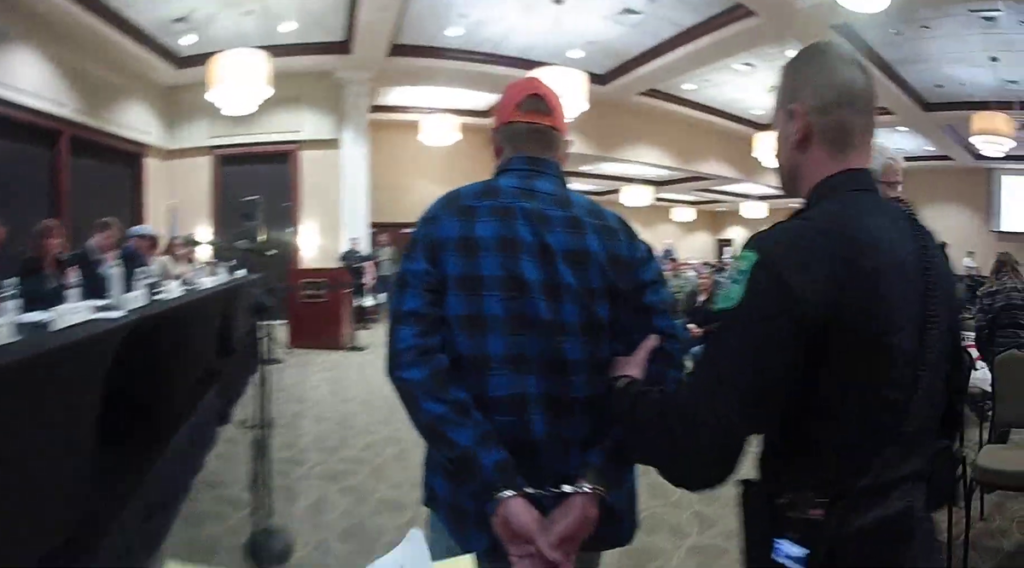
In February, police in Claremore, Oklahoma arrested farmer Darren Blanchard for speaking too long during a community meeting about a new data center. The city charged him with criminal trespass, a crime carrying a $200 penalty, though he has vowed to fight the charge. Blanchard recently shared video of the bodycam footage with 404 Media and answered questions about the moment officers took him into custody for going over his time at a February 17 town hall.
The February meeting was intended for the City Council to hear citizen concerns regarding Project Mustang. Residents in Claremore oppose the facility and believe the construction project was approved without their input. City officials signed non-disclosure agreements on behalf of the project’s developers and have not shared details about the construction.
Bodycam footage
Blanchard told 404 Media that his legal team filed a motion to dismiss the charge and asked the city’s attorney to recuse himself. The lawyer was present at the city council meeting and witnessed the arrest.
“I continue to maintain that my arrest was retaliatory, as I was engaging in protected speech at a public meeting. These actions as well as the undue resulting responses by the City of Claremore should raise major concern,” Blanchard said.
He added that he is allowing the legal process to move forward at whatever pace it may take. Blanchard remains confident the truth will eventually come out and that this charge should never have been brought in the first place.
Blanchard said he has no criminal history and that the arrest has been overwhelming. Even if the charges are dismissed and the arrest is deemed unlawful, he said the process itself is the penalty.
“I went to a public meeting to speak about an issue affecting my community of Northeast Oklahoma […] I ended up in handcuffs, jailed and later seeing that moment played and replayed nonstop on television and social media. That is not something you simply move past,” he said.
He noted that his arrest has brought attention to the fight against data centers. Communities deserve transparency, due process and protection from being industrialized without meaningful public input. But personally, he said it has been traumatic.
“What concerns me most is the chilling effect. If someone can be arrested after speaking at a public meeting, others may decide it is safer to stay quiet. That should trouble everyone, regardless of where they may stand on data centers, artificial intelligence, energy infrastructure or matters of economic development,” he said.
Blanchard said he is not shocked by the rise of anti-data center sentiment in America. Across the country, people are beginning to recognise that these projects are not just abstract technology investments. They impact land, water, electricity rates, housing, agriculture and the overall character of communities.
“A pattern is unfolding where these developers come in with promises of jobs and investment, public officials are swayed to move quickly, oftentimes incognito via nondisclosure agreements and the long-term costs are pushed onto residents who had little say in the process,” he said.
He questioned whether rising utility bills, unsustainable demands on water, transmission lines and concern for eminent domain, nonsensical tax incentives or the loss of farmland and rural ways of life serves the people. “People are asking a very basic question: who is this ultimately serving?”
Blanchard raised these issues during the February community meeting. In an attempt to accommodate the overwhelming number of people who wanted to speak, the City of Claremore established a hard and fast three minute time limit for public comments.
In the bodycam footage, Blanchard went a few seconds over that three minutes and two police officers swooped in.
“You need to leave,” one officer said.
“I’m done with the mic,” Blanchard said. He held up documents he brought with him. “Can I present my records?”
“Sir, you’ve been asked to leave,” the cop said. Blanchard walked to the front of the room, began to give his documents to the city council and the officers followed.
“You can give them to Sarah and then let’s go,” one of the officers said. “You’ve been asked to leave.”
“This is a public meeting,” Blanchard said as he sorted through the documents.
“OK. You can give them to Sarah but you’ve been asked to leave,” the officer said.
“On what grounds?” Blanchard said.
“Right now,” the officer said.
“I said on what grounds?” Blanchard said.
“Arrest him,” an officer, identified from the police report as Sergeant Sanger, said. Then the two officers had Blanchard’s hands behind his back and in cuffs. The crowd booed and shouted.
“That’s a cowardly thing to do,” a woman shouted over the noise of the crowd as the officers escorted Blanchard out.
A man yelled, “So you can break the law but we can’t?”
Another woman rushed to one of the police officers, her phone out and filming. “This is ridiculous,” she said. “It’s ridiculous, people.”
The arrest has not stopped Blanchard from speaking out. He has appeared on local news outlets several times and is speaking out against the data center in public every chance he gets.
“When utility bills rise, when land is taken or devalued, when public resources are committed and when tax breaks are handed out without real accountability, that functions as a de facto tax on the local citizenry. So the question becomes one of representation,” Blanchard told 404 Media.
He asked whether the people were truly heard or if these decisions were effectively made before the public ever entered the room.
He is confident he will prevail in the courts. “I still believe justice will be done, but again, the process itself has already become part of the punishment. That cannot be undone,” he said.
The Claremore Police Department did not respond to 404 Media’s request for a comment.
What it means
For residents in places like Claremore, the incident highlights a growing tension between community input and rapid development. When officials enforce strict time limits that result in arrest, it discourages others from attending future meetings. The fear of legal trouble may silence people who want to ask questions about land use, water rights or tax incentives. This dynamic shifts power away from the public and toward developers and officials who operate behind closed doors.