A hundred people marched through Lower Manhattan on Fourth of July weekend without a single smartphone in sight.
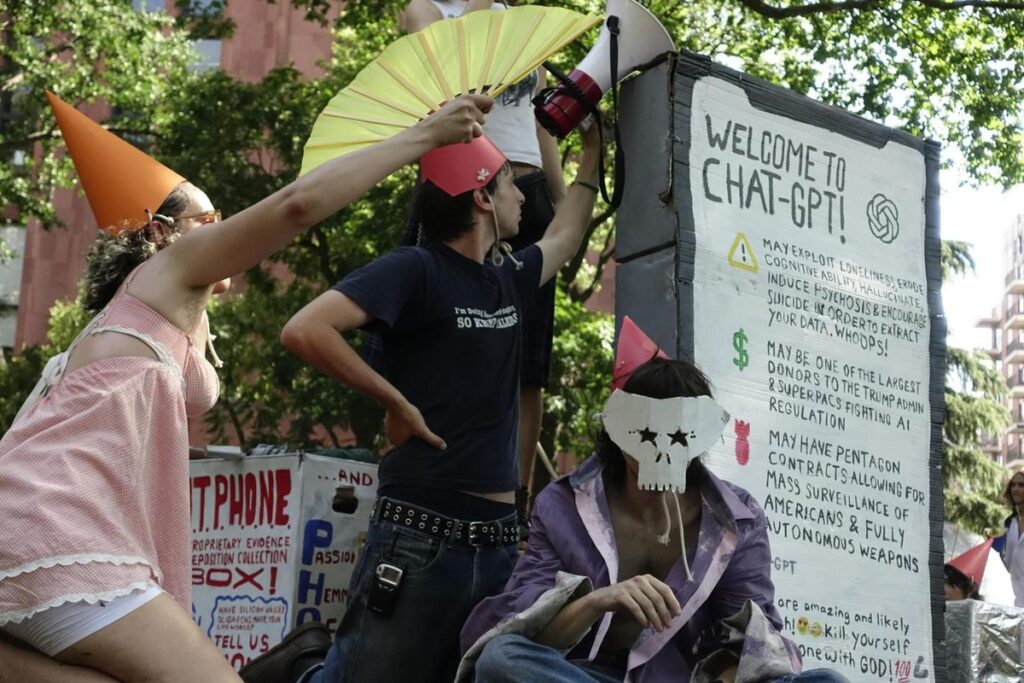
They wore homemade pointy hats and shouted slogans against Big Tech as they headed toward Washington Square Park. One chant was “Fuck, fuck, fuck AI.” They urged confused onlookers to stop recording with their pocket rectangles and join their sweaty, phone-less celebration.
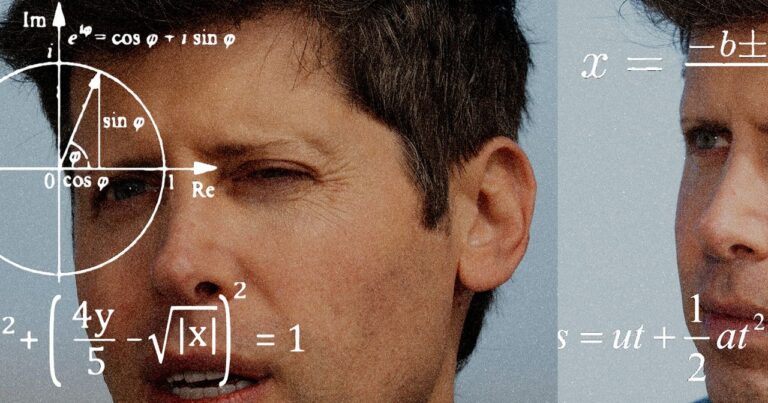
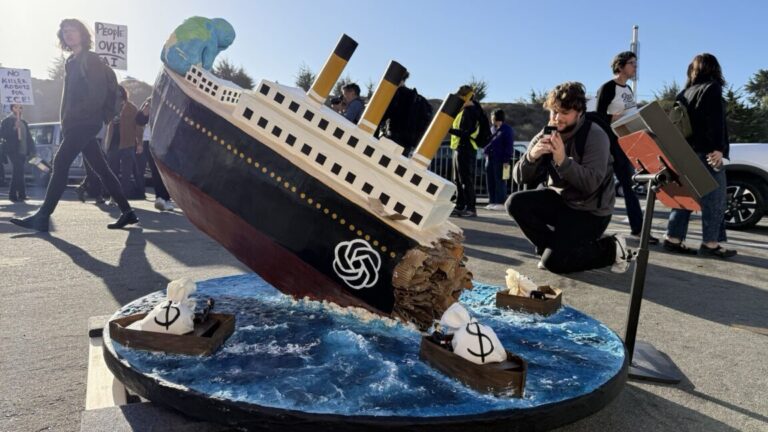
These “Luddite gnomes” were taking part in a public show trial for OpenAI and its CEO, Sam Altman. It was the fourth version of a theatrical protest called “S.H.I.T.P.H.O.N.E,” which stands for “Scathing Hatred of Information Technology and the Passionate Hemorrhaging of Our Neo-liberal Experience.”
This year, the event is part of the “Summer of Ludd,” a week-long festival of free public gatherings. Organisers advertised the schedule entirely without using tech platforms or social media. There is no website. A phone number gives callers a rundown of daily events across the city.
The programme includes an “offline rizz” workshop to help people ditch dating apps, a phone-free rave called “Let’s Get Off Together,” skill-shares on internet piracy, and an outdoor play retelling the story of the original Luddites. I found the Summer of Ludd via a local mailing list called NYC Off Tech. Others learned about it from wheat-pasted posters, paper guides in bookstores, or word of mouth.
The experiment aims to prove a single point: you do not need social media or extractive platforms to meet people or have fun.
“Google knows next to nothing / My mom knows everything!” the gnomes chanted as they handed out hats to bystanders. The hats reference a Dutch anarchist group from the 1970s known for impish culture-jamming and absurd carnival humour. One organiser described it simply as “just kinda silly.”
Two gnomes at the front carried a giant cardboard smartphone labelled “ChatGPT.” It listed various social ills caused by chatbot tools, including mental health issues and environmental damage. “Even if it gives us rabies / we will free the iPad babies,” they continued. They set the effigy on a grassy knoll next to a soapbox used as a witness stand.
The crowd skewed heavily Gen-Z, consistent with recent polls showing young people have become some of Big Tech’s fiercest critics.
Witnesses took the stand to accuse Altman of crimes including training models on artists’ work, inducing AI psychosis, and accelerating the climate crisis with power-hungry datacentres. “I used AI to write one of my essays and got in trouble. Now I’m starting a war on AI,” one young person said from atop the soapbox, receiving cheers. Another witness noted that tech companies design tools to make people feel dependent and addicted to the endless scroll. The crowd roared “GUILTY!” in unison before everyone joyfully stomped on the giant cardboard phone.
Leading them was a gnome “executioner” holding a hammer bearing the phrase “Enoch Made Them / Enoch Shall Break Them.” This is an homage to the original 19th Century Luddites, who named their hammers after the man who made both the machines and the tools used to smash them.
It is tempting to compare the spectacle to Occupy Wall Street. What sets the Summer of Ludd apart is its lack of cynicism and an overwhelming abundance of raw, anarchic joy. The new Luddites attract people through playfulness and participation. Instead of shaming others for too much screen time, they use public events to demonstrate organically that the “indispensable” tech we organise our lives around is not so indispensable.
Behind the masks
I met the Luddites a week earlier in Tompkins Square Park for a press conference hosted by their official spokesperson: a puppet made of garbage.
I joined a small group of journalists sitting in plastic chairs and directing questions at the puppet. It is named Gowanus, after the famously putrid Brooklyn canal where the parts of its patchwork body were found. Gowanus is the Luddites’ “media spokespuppet,” a stand-in created to maintain the organisers’ anonymity while interfacing with digital media platforms.
The Luddites are very averse to any kind of social media. Smartphones are forbidden. They asked every journalist present to sign a “Terms of Service” agreement on a comically long brown paper scroll. The document states that nothing captured may be used to make “short-form video content” like TikToks or Instagram Reels.
In keeping with the spirit of the event, I kept my phone stowed away and used nothing but my Hobonichi notebook, a pen, and a small voice memo recorder to do my reporting.
“We are interested in building alternative social infrastructure that allows us to be no longer reliant on Big Tech,” Gowanus told the group as they scribbled notes. “All our events are free, and defy any sort of transactionalism or consumption. We’re trying to dispel that transactional element and get people to participate and create the events themselves. That is what the Summer of Ludd is all about.”
Commercial co-optation
On my train ride home, I pondered the irony of being a journalist covering an event series designed to resist digital capture and consumption.
At my subway stop, I noticed an ad for the second-hand online marketplace Backmarket. It showed a pink Nintendo Game Boy with the text “AB > AI.” Someone drew a heart next to it in black sharpie marker. This anonymous mark of approval felt like the opposite of the subway ads for the “Friend” AI device that were widely and virally defaced last year.
Almost reflexively, I took a picture of the ad with my phone and posted it to BlueSky with the caption: “Hatred of AI now reaching the level of cultural consensus that becomes attractive to advertisers.” I woke up the next morning to thousands of interactions. Many were from people delighted to see their anti-AI sentiment vaguely reflected in a subway ad for overpriced second-hand goods.
This made me think about the classic political trap where capitalists co-opt social movements by channeling their radical potential into harmless forms of aesthetic consumption and feckless identity politics.
How can the neo-Luddites resist these inevitable attempts at co-optation? Can Luddism generate mass-appeal beyond Y2K aesthetic Tiktok trends, where Gen-Z’ers marvel at flip phones, iPods, and other retro tech as a kind of performative false-nostalgia? And how do you build a successful movement while eschewing the most common tools of mass-communication?
What it means
Members of the Luddite Renaissance, as the loose-knit, anonymous collective refer to themselves, attempt to answer these questions in “The Event is the Medium,” a zine manifesto. It references the famous Marshall McLuhan quote, which is only available in physical paper format. The Luddites request that none of their work be uploaded to social media.
The central idea is using public space to run events that get people to experience—and directly participate in—what Luddism has to offer in 2026, instead of just yelling at people on a street corner.
What these Events should entail is where the Luddites become intentionally vague. This is not for lack of answers, but as a defence mechanism designed to make the Event unpredictable.