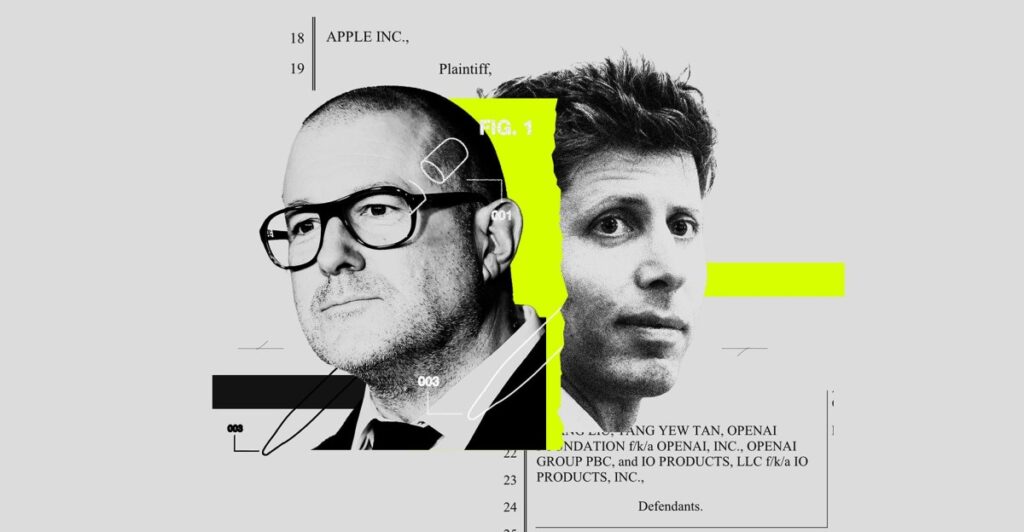
Apple is suing OpenAI for stealing trade secrets, alleging that former employees solicited confidential data during job interviews and downloaded files from Apple servers.
The allegations
OpenAI denies the claims. The company spent $6.5 billion to acquire io Products, the AI hardware startup founded by Apple designer Jony Ive, in 2025. Despite this investment, Apple accuses the firm of targeting its intellectual property.
Hayden Field, senior AI reporter at The Verge, spoke to lawyers specialising in intellectual property law. They said the situation is not entirely positive for OpenAI. While experts have seen individual elements of these accusations before, they have rarely seen them all combined in a single case involving two major tech players.
History of Apple litigation
Apple has a reputation for aggressive legal action. In the 1990s, the company pushed copyright law by suing Microsoft over the design of Windows. In the 2000s and early 2010s, it pursued patent law against Samsung regarding Android and Galaxy phones. Samsung eventually paid roughly $1 billion in damages.
Those cases did not stop Microsoft or Samsung from competing. Android still exists, and Samsung remains a major player. However, Apple may have redefined patent law around 3G and 4G licensing. Now, the company is using trade secret law against OpenAI.
Can OpenAI pay?
The core question is whether OpenAI can afford the settlement. OpenAI is currently burning cash and is strategically adrift as it tries to compete in both enterprise and consumer markets. The company is also turning over executives regularly and is preparing for an initial public offering.
Investors are focused on the bottom line and when the company will turn a profit. Shelling out large sums to Apple at this stage would be difficult. Lawyers suggest the case could drag on for years. Alternatively, OpenAI might gather the necessary funds to pay a settlement if Apple accepts it.
The role of emotion
Tim Cook once explained patent litigation as a matter of licensing fees, but Hayden Field notes that personal grievance often drives these disputes. The OpenAI-Elon Musk lawsuit is a recent example of companies acting out of pettiness rather than pure logic.
Tang Tan, OpenAI’s chief hardware officer, is central to the story. He worked at Apple for 24 years as the VP of the Apple Watch before leaving in 2024. OpenAI hired him to lead hardware efforts after acquiring io Products.
Apple alleges Tang Tan orchestrated the theft of secrets. During interviews, he allegedly asked candidates to bring hardware prototypes to the OpenAI office for a “show and tell.” He reportedly asked why candidates could not share details about code-named projects or bring batteries from past Apple work. The implication is that candidates felt safe sharing information because they believed he was an insider.
What it means
For OpenAI, this lawsuit adds significant distraction and potential financial strain at a critical time. The company is trying to define its hardware future while facing legal challenges that could drain resources. If the case goes to trial, it will occupy management attention for a long period. If it settles, the cost could impact the IPO valuation and investor confidence.