For the creative community, this move signals a troubling trend where synthetic media is being normalised in commercial spaces without clear distinction. When a major retailer decides to flood search results with hallucinated visuals, it sets a precedent that could eventually spill over into the tools artists rely on for inspiration. If shoppers cannot tell a generated image from a real one in a marketplace, why should we assume they can in a portfolio or a stock library?
The new visual search experiment
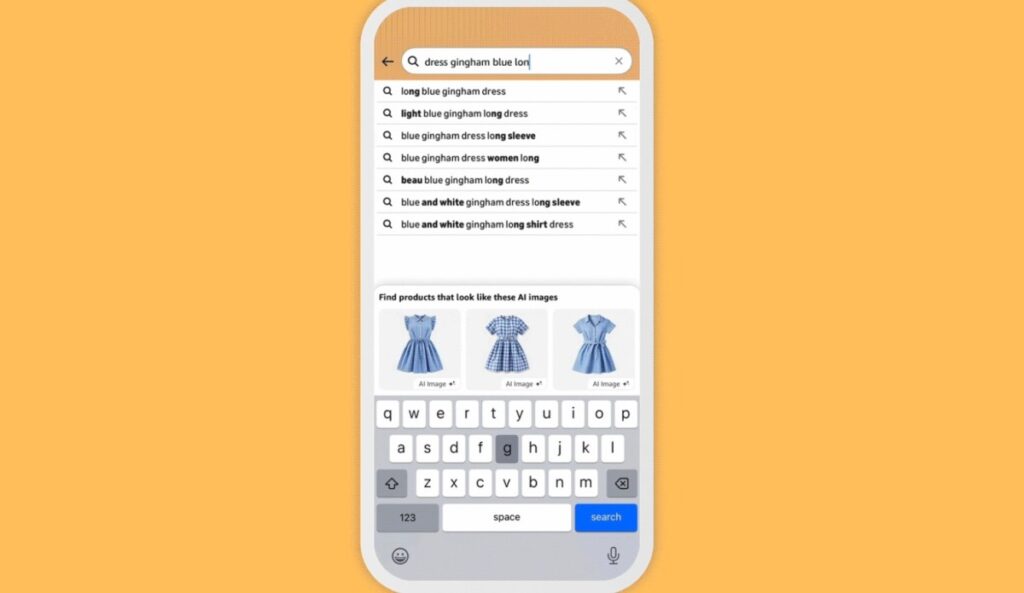
Amazon confirmed on Wednesday that it is rolling out a feature within its shopping application that displays AI-generated images of products directly beneath search queries. The logic provided by the retailer is that these synthetic visuals will assist consumers in finding items they cannot articulate precisely. The company argues that users often struggle to find the correct terminology for specific styles, citing examples such as identifying a “cowl neck” on a shirt or “rattan” furniture.
When a user types a query, the system will present a carousel of AI-created product images alongside standard autocomplete suggestions. Take a search for a “blue gingham dress” as an example: the interface might display variations in sleeve length, hemline, and cut. The intended mechanism is that selecting one of these generated options triggers a visual search powered by Amazon’s technology, which then filters real inventory to match the chosen synthetic style.
Why this feels like a step backward
The approach feels fundamentally flawed for several reasons. Primarily, it risks deceiving the user. A shopper who does not scrutinise the source of the image may believe they are being directed to a specific product page where that exact dress is available. They will inevitably be let down when the item is not in stock, creating a friction point that real photography would have avoided.
Furthermore, the rationale is questionable. Why manufacture fake imagery when the platform already hosts a vast library of authentic photographs from real products? An online shopper typically wants to see what they are actually buying, not a synthetic approximation that might not even correspond to a real SKU.
A pattern of mixed AI integration
This initiative is the latest in a string of attempts by Amazon to embed artificial intelligence into its retail ecosystem, with outcomes ranging from useful to bizarre. On the practical side, the retailer has implemented AI to summarise customer reviews, allowing users to quickly grasp key pros and cons without reading every comment.
However, other experiments have been less successful. Last year, Amazon introduced an audio feature where AI experts described product highlights in a podcast format. More recently, the company replaced its Rufus AI chatbot with “Alexa for Shopping,” aiming to facilitate natural language queries via voice and text. Other recent integrations include “shoppable collages” for curated fashion styles, Amazon Lens Live for scanning physical products, and a Lock Screen widget for visual searches on iOS.
Ultimately, the decision to generate fake product images suggests a confidence in AI capabilities that may outstrip consumer trust. For creators and makers, this serves as a reminder that the line between synthetic and real is becoming increasingly porous in the digital economy.
Key takeaways
- Amazon is launching a feature that displays AI-generated product images below search queries to help users find items they cannot describe accurately.
- The tactic risks misleading shoppers by presenting synthetic visuals as real inventory, potentially causing frustration when the specific item is unavailable.
- This move follows a series of mixed AI experiments at Amazon, ranging from helpful review summaries to the controversial podcast-style product descriptions.