For creators and developers relying on cloud infrastructure, the landscape is shifting. Amazon Web Services (AWS) is now actively exploring a strategy to sell its custom AI chips, Trainium, directly to external enterprises. This move signals a potential pivot from a closed-loop cloud model to an open hardware vendor, challenging the very foundation of how AI workloads are procured.
A shift in strategy from closed to open
Peter DeSantis, Amazon’s head of AI, confirmed to Bloomberg that the company is in preliminary discussions regarding the sale of these chips for deployment in third-party data centres. Specific buyers were not named, but the intent is clear.
This development traces back to a shareholder letter from CEO Andy Jassy in early April. He revealed that demand for Amazon’s proprietary silicon is so intense that the company is considering a standalone chip business. Jassy estimated that if such a business existed, selling current production volumes to AWS and external partners would generate an annual run rate of roughly $50 billion.
“There’s so much demand for our chips that it’s quite possible we’ll sell racks of them to third parties in the future.”
The financial stakes
While a $50 billion revenue stream is significant, it does not immediately threaten Nvidia’s dominance. Nvidia is currently operating on a revenue run rate of $326 billion. However, Amazon’s potential footprint would rival Intel’s annual revenues, marking a substantial entry into the hardware marketplace.
Historically, AWS has resisted selling its silicon outright. The primary driver is the “waterfall effect” of cloud economics. When AWS hosts AI workloads, it charges for the compute tokens processed by the chips, but it also captures revenue from essential supporting services such as storage, security, networking, and monitoring. Selling the bare hardware would bypass this ecosystem of recurring revenue.
Supply constraints and manufacturing hurdles
Furthermore, Amazon has frequently highlighted that its chip capacity sells out faster than it can be manufactured. In the same April letter, Jassy noted that capacity for the existing Trainium chip sold out almost instantly. Demand for the upcoming Trainium4 was equally immediate, with availability not expected for over a year. This demand surge occurred even before AWS formally integrated OpenAI models into its service offerings.
Transitioning to an external sales model would likely force Amazon to leave current customers on waiting lists, unless it can manufacture a surplus. This would require securing additional capacity from manufacturing partners like TSMC. However, TSMC has recently surpassed Apple to become its largest customer, making it difficult for Amazon to elbow Nvidia out of the way to secure extra wafers.
Doron Aronson, an AWS spokesperson who previously hosted a private tour of the chip design facility, acknowledged the possibility. “While we’ve historically declined requests to sell chips directly, Andy noted it’s quite possible we’ll sell racks of them to third parties in the future.”
Competing visions of the chip market
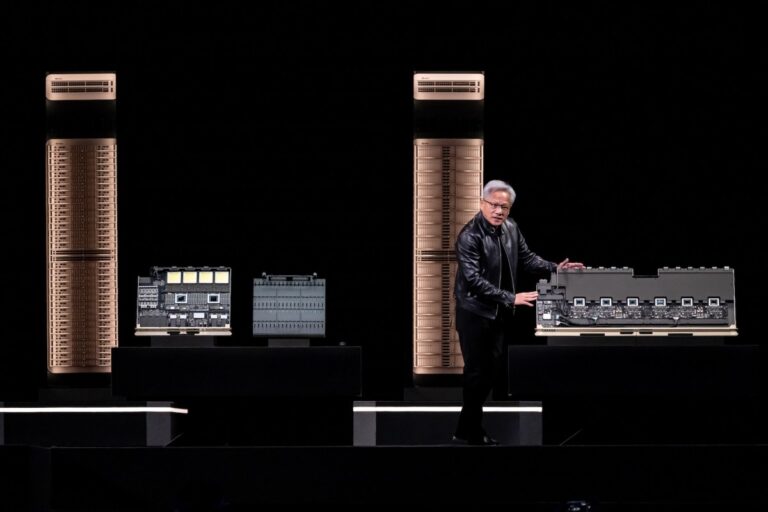
As Nvidia’s founder Jensen Huang recently declared he has discovered a new $200 billion market by selling CPUs for AI workloads-effectively moving into Intel and AMD territory-Jassy is pursuing a parallel ambition. He aims to carve out a $50 billion slice of the market that places direct pressure on Nvidia’s global position.
Key takeaways
- Amazon is in early talks to sell its Trainium AI chips to third-party data centre operators, moving beyond its traditional closed-loop cloud model.
- CEO Andy Jassy projects a potential standalone chip business could generate an annual run rate of approximately $50 billion, rivaling Intel’s revenue.
- Historically, AWS has avoided selling chips to protect the “waterfall effect” of cloud revenue, where compute sales are supplemented by storage, security, and networking fees.
- Supply constraints remain a major hurdle; selling externally could mean leaving current customers on waiting lists or requiring miraculous manufacturing capacity from TSMC.