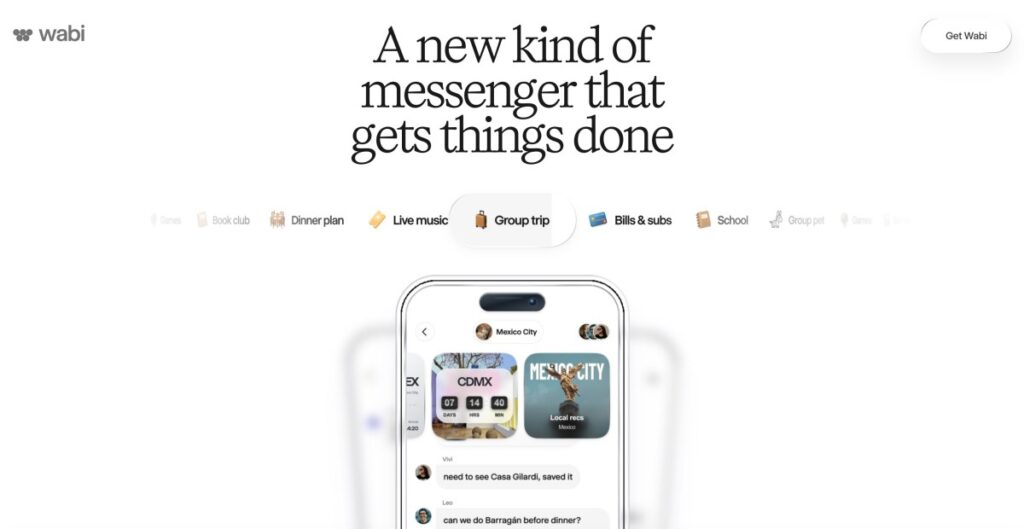
Wabi, the startup that previously let users build applications via prompts, is shifting its focus to become an AI messenger as demand for agents like Meta’s Muse and Instinct grows. The company announced this week that Wabi is now becoming a messaging platform that retains the ability to build apps to help users get things done.
The new model
Eugenia Kuyda, the founder of Wabi and previous creator of the AI companion service Replika, describes Wabi 2.0 as a “personal agent that does stuff for you and builds the interface you need in the moment.”
The value proposition remains similar to the original version of Wabi, but the method of interaction changes. Instead of positioning itself against other vibe-coding tools, Wabi 2.0 aims to compete directly with AI agents that combine conversations and productivity tasks within a single interface.
This move arrives as companies like OpenAI consider how applications will function inside their broader chatbot environments. At its recent Dev Day, OpenAI announced an update to ChatGPT‘s plugins. This change allows apps to offer interactive experiences within ChatGPT, with the app’s name pinned in a more visible spot on the sidebar.
Kuyda explained on X that the new experience makes more sense for consumers who want to do more than simply type to an agent.
“The more you use a chat-only agent, the worse the experience gets. Your history and ongoing tasks end up buried in one endless scroll. People don’t just want to type-type-type; They want to tap-tap-tap, scroll, and look. They love what agents can do, but they also like software,” she wrote. “The most powerful agent will be the one that combines both.”
The concept relies on the agent creating a user interface on demand when a user asks it to perform a task. Kuyda suggested users could build tools such as a calorie tracker, a weightlifting log, and a weight tracker, all accessible within a thread dedicated to health-related topics.
In a separate thread focused on family, users could create a calendar of children’s activities, a language learning application, a tool that tracks local kid-friendly events, and other items relating to parenting, household management, or children’s interests.
“So far, personal agents have been one person, one chat, a stream of one-off tasks. We think the future is your agent, your apps, and your people in one place, running the parts of life that matter most, together,” wrote Kuyda.
The new Wabi 2.0 application is currently available only via invite code, which are being distributed on X.
What it means
For people making things, the shift moves the workflow from a single text stream to a modular environment. Users no longer manage a linear chat history where every command is buried under previous messages. Instead, the agent constructs specific interfaces for specific jobs, then discards them when finished. This reduces clutter and allows the tool to disappear after the task is complete, leaving the conversation thread clean for the next request.