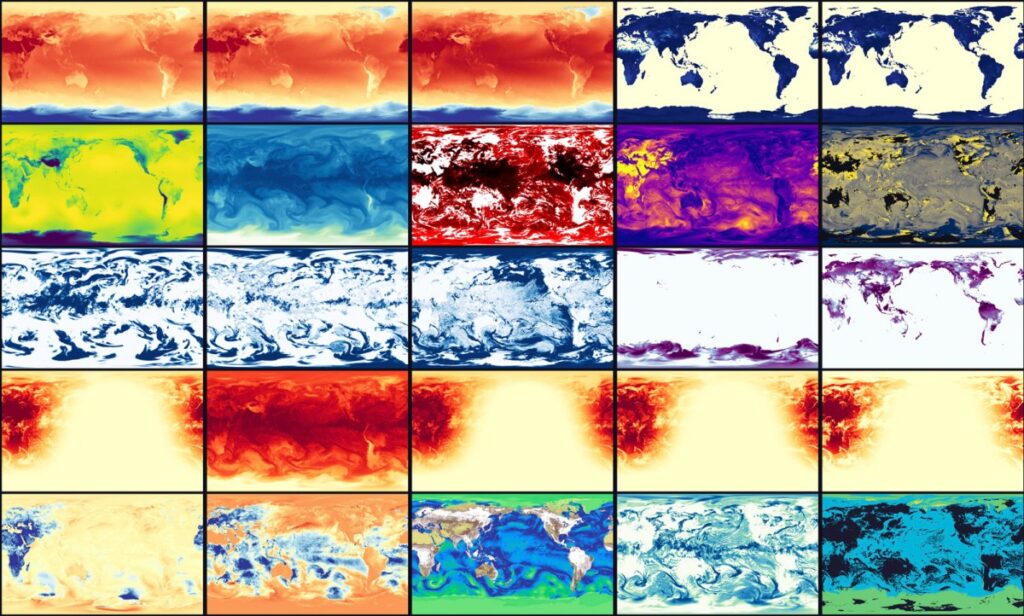
Deep learning models derived from large language architectures now allow weather simulations to run on standard laptops, a shift that has fundamentally altered the hardware requirements for meteorology. The greater hurdle remains helping organisations apply these predictions to real-world operations.
WindBorne raises capital for commercialisation
WindBorne Systems, a startup deploying the world’s longest-enduring weather balloons, has secured $37 million in Series B funding. CEO John Dean told TechCrunch the capital will address the challenge of putting forecasts to practical use.
The round was co-led by Khosla Ventures and Galvanize, with participation from TransLink Capital and Lux Capital, alongside earlier backers. The company now values at $250 million.
Established in 2019, WindBorne originally intended to gather unique atmospheric data using low-cost sensors and long-flying balloons. Recent advances in AI forecasting models have enabled the firm to generate its own predictions, a capability previously reserved for state-funded supercomputing clusters.
The firm currently operates 20 launch sites globally with approximately 600 balloons aloft at any one time. These collect data from inaccessible zones, including the eye of a typhoon. WindBorne is now introducing aerial sensor packages designed to splash into the ocean and function as floating buoys.
This proprietary dataset, which Dean describes as a “planetary nervous system,” creates a competitive advantage for their weather model. The system also ingests data from national government agencies.
“We demonstrated that adding balloons to the forecast yields higher accuracy, and the value per data point is much stronger than satellites,” Dean said. “We’ve also been growing revenue while doing that, so that de-risked the demand signal to VCs.”
Government bodies remain the primary customers. The U.S. National Weather Service purchases WindBorne’s data, while the U.S. Air Force and U.S. Navy fund research partnerships. One project involves developing forecasting models capable of running on ships with intermittent internet connectivity.
The next phase targets commercial clients, specifically investment funds using weather data to forecast commodity prices and business outcomes. Funds from this round will support compute costs, replace the balloon network’s satellite communications with a mesh radio system, and expand the go-to-market team to reach the private sector.
Penetrating this market is not straightforward. Over the last ten years, various startups attempting to scale earth-observing sensing businesses have struggled to move beyond government contracts. Extracting value from such data typically requires established workflows and industry experience.
Existing private weather firms mostly profit by repackaging or refining government forecasts for news outlets, aviation de-icing, maritime routing, or speculation. However, AI tools that simplify data processing could alter this dynamic.
Saloni Multani, a partner at Galvanize who co-led the investment, noted that the private weather market has been constrained by the cost and difficulty of integrating forecasts into business decisions. She stated: “We think AI changes that equation. Better forecasts make the effort worthwhile, and AI makes it much easier to connect those forecasts to the decisions businesses are trying to make.”