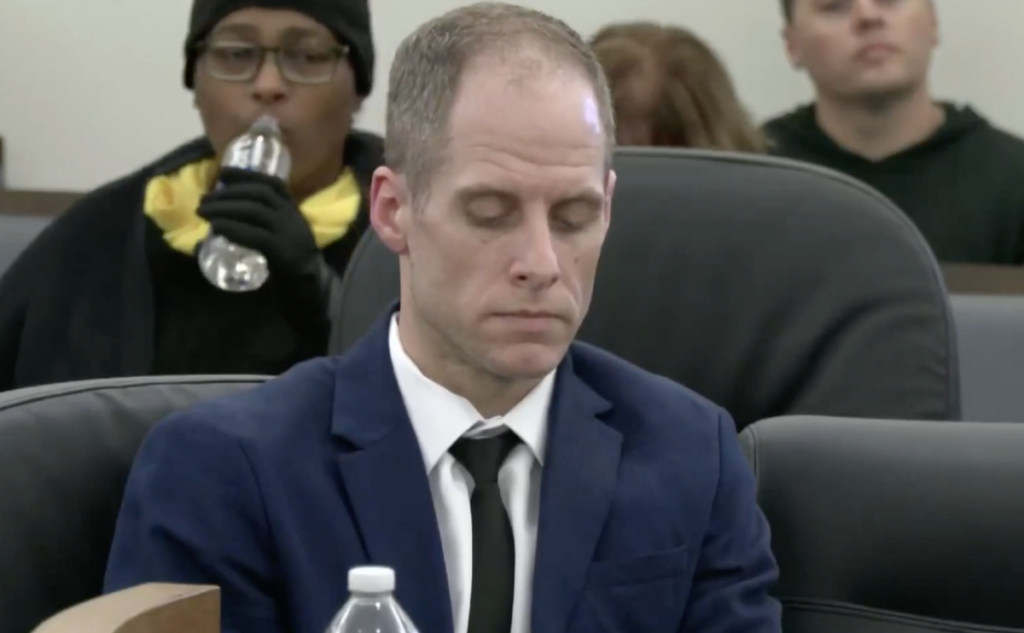
A murder trial in Cleveland featured a generated love song from an accused man’s Notes app as a key piece of evidence. Caleb Flynn, a former American Idol contestant, is charged with killing his wife. Prosecutors played two versions of the track to the jury during proceedings that concluded on Thursday.
The evidence
Investigators discovered the audio files and lyrics on Flynn’s iPhone after using the forensic tool GrayKey to bypass his lock screen. Joseph Wilhelm, a forensic investigator testifying in court, described the discovery.
“We found audio files on Caleb’s iPhone that seem to have been AI generated and related to his relationship with [his mistress],” Wilhelm said. “They’re in two different keys. One’s like a happy or upbeat sad song if that makes any sense, and one’s a sad, sad song. I think one’s in a minor key, one’s in a major key, but I’m not a music professional.”
After asking for permission to play the recordings, the judge granted the request. The court room filled with silence as the prosecution played the tracks. Several people in the gallery tried to suppress laughter during the presentation, which was part of a serious homicide case.
When the songs finished, the court remained quiet for several seconds before the judge announced a recess. “We’re going to break for the day. It’s 10 after 4 [p.m.] We will reconvene tomorrow,” he told the room.
The context
Earlier that day, Flynn’s mistress had read text messages to the public gallery. Flynn wrote that he had spent significant time alone in Cleveland and had finished the lyrics for a song dedicated to her.
“I’ve spent a lot of time on my own and in Cleveland. I finished the lyrics to our song. To your song. Although it may mean nothing to you, I wanted to give them to you,” the text read. “I have the music which is completely different to what you’ve heard to this point and I was going to record it but I know there will be no way I would ever be able to actually sing it again.”
He followed this with a message offering the AI-generated version.
“Do you want to hear the song I wrote for you with an AI voiceover,” Flynn wrote. “I have this software called ElevenLabs where I loaded the song on piano and sent it with my computer microphone to which I can pick an AI voice to sing it better.”
The mistress replied, saying she was not ready to listen yet. “I don’t know if I’m ready to listen to this yet. I’m sorry,” she wrote. “Send me the song and I’ll save it to my phone and I’ll listen when I’m ready, even if it’s a month from now. I don’t want it to be erased.”
She later acknowledged the technical flaws in the track. “Are you sure? It messed up the outro as it’s supposed to be done and the vocals aren’t exactly how I want it, it was a little rock-ier at times but the melody is correct. I tried to sing it with passion and AI took it and went a little extreme.” Flynn added, “It’s OK,” she said.
Technical details
The investigation highlighted the capabilities of modern digital forensics. Wilhelm used Cellebrite and GrayKey to access Flynn’s device. Specifically, he employed GrayKey’s Magnet tool to unlock and examine the phone, resulting in a full file system extraction.
From the device, investigators obtained Flynn’s messages and the AI audio files. They also accessed cell phone location history and sleep data from Flynn’s Oura Ring. Heart rate data from an Apple Watch was recovered, as was information showing Flynn had deleted an app called “AI music song generator” several days before the murder. AirPod connection and disconnection logs were also retrieved.
What it means
This case demonstrates how quickly personal creative tools can become forensic evidence. The generation of the song took place on a consumer-grade device using a specific software package, ElevenLabs. The ability of investigators to extract and play these files in a courtroom shows how digital footprints from everyday applications now carry weight in legal proceedings. The trial underscores how technology used for personal expression can also serve as a tangible record of a defendant’s state of mind and relationships.