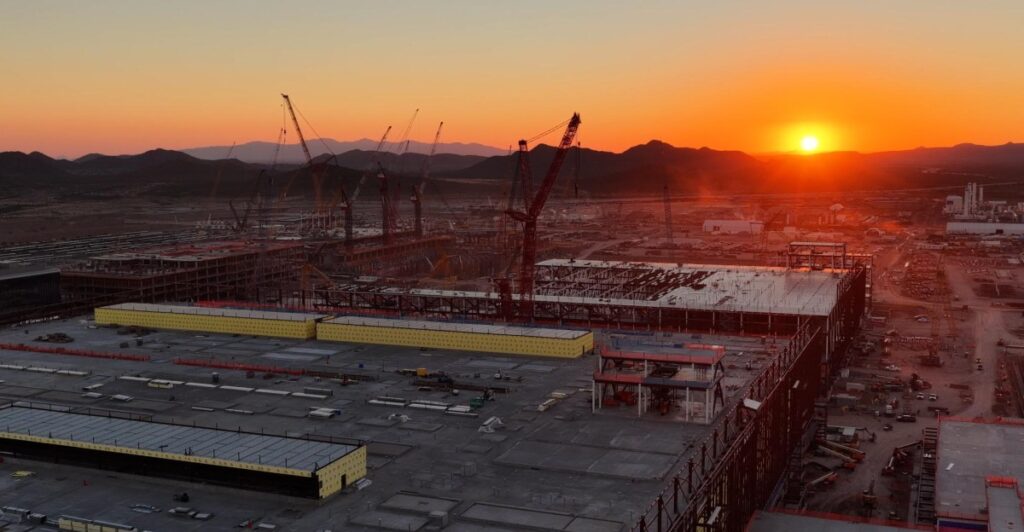
A new data center in Arizona is set to consume nearly 5 million gallons of water every single day, drawn directly from the Phoenix municipal supply.
That volume represents the price of admission for a facility that powers the AI models and streaming services most people use. Construction crews are currently digging the earth for a third building at the site, while parking lots fill with vehicles and food trucks serving thousands of workers.
The site belongs to Taiwan Semiconductor Manufacturing Company, known as TSMC. The company operates the world’s largest chip fabrication plant in the state. This operation is the result of a gamble Phoenix made before the pandemic to revive an economy that had not fully recovered from the Great Recession.
TSMC has become a success story that some local leaders hoped to repeat with hyperscale data centers. The state currently hosts 172 data centers, and the earlier waves of development faced little opposition. New, larger projects proposed between Phoenix and Tucson, however, demand more water, power, and land than residents are willing to provide.
A grassroots, bipartisan coalition has united against these new developments. This stands in contrast to the welcome received by TSMC and the first wave of data centers. Locals on both sides of the argument want a prosperous Arizona, but their visions for achieving it are completely at odds.
Developers have promised jobs, tax revenue, and infrastructure improvements. In exchange, they ask for water, claiming the amount is not nearly as high as people expect. Some hyperscale facilities, such as Google’s site in The Dalles, Oregon, use about 1.5 million gallons a day. That is roughly one-third of the volume consumed by TSMC’s Arizona complex in the same timeframe.
These reassurances do not assuage Arizonans. The state will soon lose access to nearly 30 percent of the water it receives from the Colorado River.
Even as people across the country express concern about AI and fight data centers in their communities, TSMC’s Arizona operation continues without significant opposition. It is impossible to understand the opposition to new data centers without first understanding why Arizonans eagerly welcomed TSMC. Both industries must contend with a problem that has plagued the region since its founding: there is not enough water.
For as long as anyone could remember, business in Arizona revolved around the five C’s: cattle, copper, cotton, citrus, and climate. The last item served as a catchall for the region’s mild winters.
Now the state has a sixth C. Christine Mackay, an Arizona native and head of Phoenix’s economic development office, told me the new category is Chips.
Mackay spearheaded the effort that brought the Taiwanese giant to the Sonoran Desert. In 2020, while the global economy was shut down, TSMC announced it would open an advanced semiconductor foundry in Phoenix. Initially, the company predicted it would pour $12 billion into Arizona’s economy by 2029. Since then, the projected expenditure has ballooned to $265 billion, a figure the company touts as the largest foreign direct investment in US history.
TSMC recently finished its second fab in a formerly desolate part of north Phoenix. A third facility is under construction, with plans for several more underway. The buildout has taken more than a decade. TSMC started shopping for a US location in 2016.
That year, Mackay noted that the company issued a request for proposals under a codename. No one won. Mackay said her office then asked TSMC executives what Arizona was missing and spent three years addressing their concerns.
In 2019, Phoenix sent a delegation to Taiwan to share a new development plan for a science and technology park. The nucleus of the project would be a factory, ideally one of TSMC’s fabs. Mackay recalled that the executives agreed they needed to return and take another look at Phoenix.
Her team showed them two locations: Laveen, a suburb southwest of Phoenix, and an undeveloped area north of the city called Biscuit Flats. Mackay said the name came from the fact that the land is as round and flat as a biscuit.
That very day, the executives said, This could work.
What followed was a flurry of development unlike anything the state had ever seen. TSMC has brought more than 3,500 jobs to the state, and an entire economy has sprung up to support the company’s Arizona operation. Much like in Taiwan, where the company accounts for nearly one-tenth of the gross domestic product, TSMC has become a galaxy unto itself.
The company controls an estimated 70 percent of the global chip market. Its contracts with Apple and Nvidia alone make up more than one-third of its annual revenue. Apple and Nvidia design their own chips but do not produce them. The complex manufacturing process is largely outsourced to TSMC.
TSMC has changed swaths of Phoenix, altering the landscape and industries. It has brought jobs and prosperity. Locals fear that new hyperscale data center developments will do the former but not the latter, consuming resources while contributing little to the community.
Mackay, who has worked as an economic developer for over 30 years, did not experience significant pushback when she helped court data center developments in the past. She noted that the first 10 data centers she handled looked like pretty little office buildings.
The new developments being proposed are neither pretty nor little. Where earlier data centers were inconspicuous, the hyperscale facilities developers want to build in Arizona are often located on rural farm or desert land. These sites are massive and incongruous.
Despite the state’s reputation for sprawl, there are still plenty of places where you can hear a pack of coyotes howl in the middle of the night. There are dark-sky corridors, wild animals, ghost towns, and saguaro forests. Some locals say all of this could be sacrificed for the benefit of an industry that also poses an existential threat to humanity.
There are ethical questions, environmental concerns, and debates over zoning and taxes. The most significant issue remains water. Cities and outlying suburbs keep growing until they are constrained by geography, bureaucracy, or Indigenous sovereignty. Industry keeps arriving, thirstier than ever.
Year-round, and especially in the summers, Arizonans tailor their routines to the elements. Drivers are careful not to get stuck in dust storms or monsoons. Joggers avoid going out in late mornings and early afternoons when the heat is most intense.
On August 1st, at the peak of monsoon season, the No Desert Data Center Coalition holds its annual rally. The group gathers to protest the construction of new facilities that threaten the region’s water supply.