For creators and developers, the latest data from Harvard and Perplexity signals a shift from passive querying to active delegation. The research reveals that AI agents are no longer just summarising information; they are executing complex workflows that previously required human orchestration. This transition fundamentally alters how makers approach knowledge work, moving the focus from finding answers to building outcomes.
The study leverages production data from two Perplexity tools: Search, which functions as a conversational answer engine, and Computer, an agent capable of planning and executing tasks end to end. By observing the same user base interacting with both products, the researchers isolated variables to compare how identical tasks are handled differently.
What the Study Actually Measures
The analysis covers a ninety-day period, running from 27 February to 27 May 2026. Notably, the Computer tool was released just two days before this window began.
The methodology relies on matching near-identical query pairs across the two platforms. The team identified 10,000 session pairs with a cosine similarity score exceeding 0.99, ensuring each pair represents effectively the same task attempted in two different ways.
For the Computer analysis, sessions were filtered to include only those invoking an execution tool. These ‘do’ tools encompass code execution, browser actions, file writes, and connector calls. This filtering ensures that every Computer session measured involves genuine autonomous work.
User adoption grew steadily throughout the observation period. Cumulative Computer queries surged to 84 times their first-week total. A matched analysis revealed that this shift also increased users’ daily Search queries by 1.05, suggesting the tools complement rather than replace one another.

The Cost-Structure Framework
The research is grounded in a straightforward task-based model. Every task has a step count, and longer tasks generally carry higher value.
Agents fundamentally alter the cost structure. They impose a higher fixed cost per task, covering delegation and review. However, they charge a lower marginal cost per step because the system executes the work rather than the user.
This dynamic creates a breakeven step count. Tasks below this threshold are cheaper in conversational mode, while those above it are more efficient as agents. Consequently, short lookups remain manual, whereas long workflows migrate to the agent.
Autonomy: 26 Minutes vs 33 Seconds
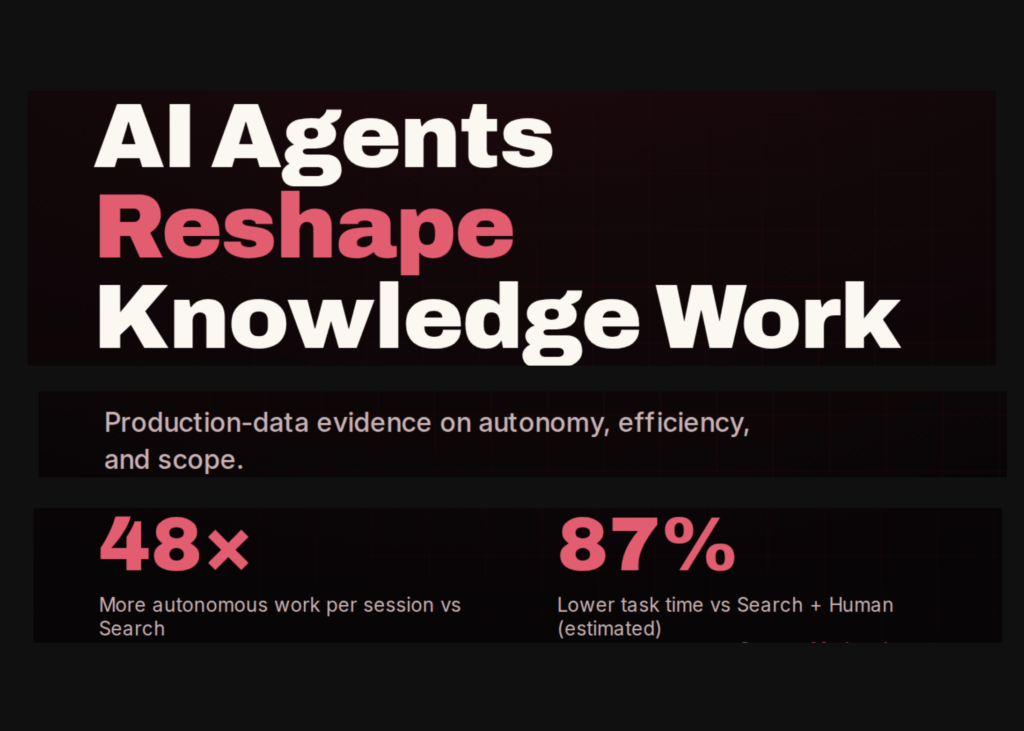
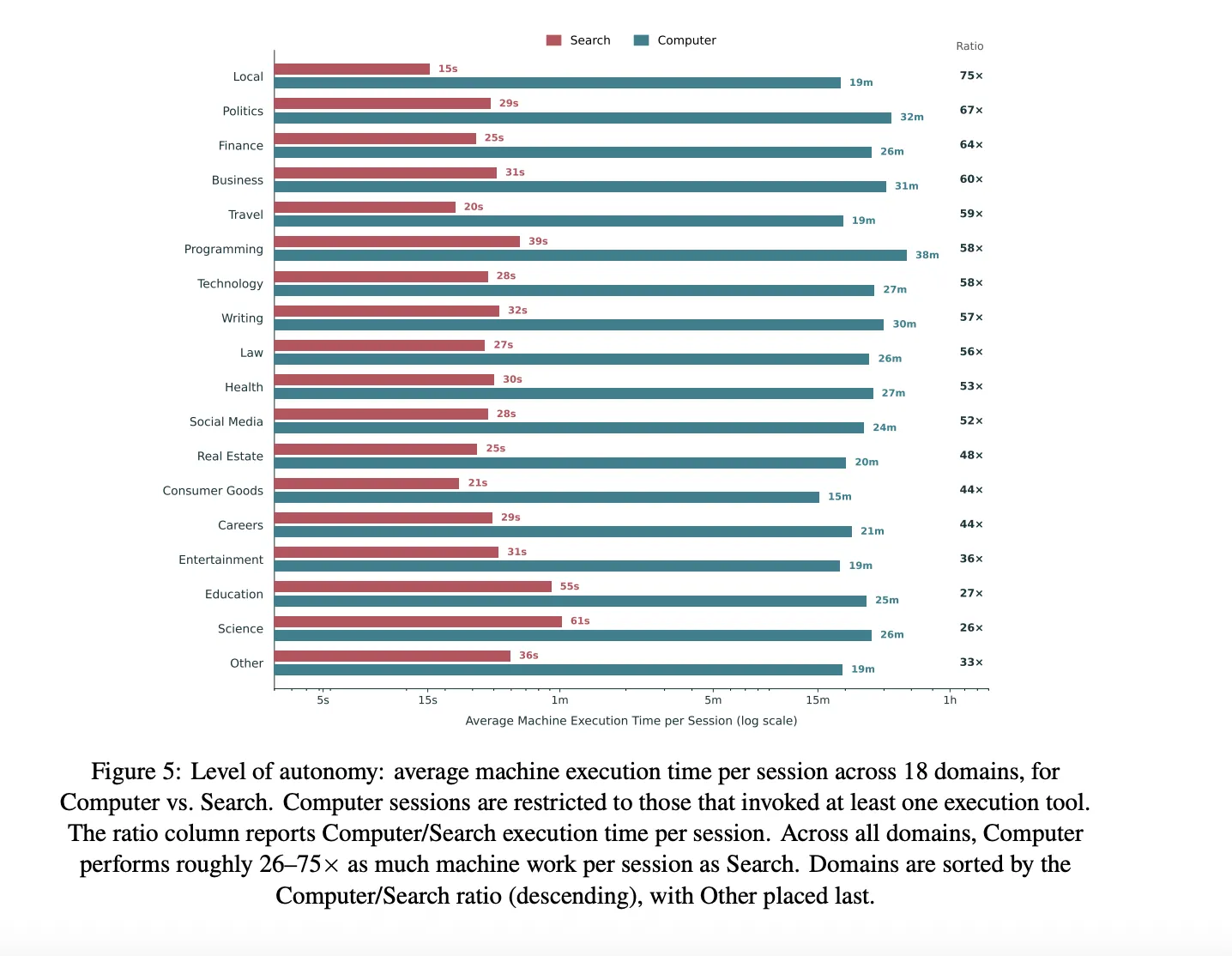
The primary measure of autonomy is execution time. Computer performs 26 minutes of machine work per session, compared to just 33 seconds for Search. This represents a forty-eight-fold gap.
Median figures show the same trend: nine minutes versus fourteen seconds. The disparity varies by domain. Local tasks display a seventy-five-fold difference, whereas Science shows a twenty-six-fold gap, as plain answers often suffice in that field.
Increased autonomy did not compromise quality in this study. The team measured next-turn dissatisfaction based on user actions. Computer’s meaningful dissatisfaction rate stood at 1.3%, against 2.9% for Search, marking a fifty-five percent reduction.
Follow-up turns on Computer shifted slightly toward review and extension, though the changes were minor. Connector usage rose more distinctly. Computer invoked at least one connector in 7.9% of sessions, versus 1.8% for Search, chaining external tools that Search users would otherwise run manually.
Efficiency: Where the Savings Come From
The efficiency section estimates a Search plus Human counterfactual. A human using Search alone requires 269 minutes per matched task. Using Computer plus Human drops this to 36 minutes.
This equates to 87% less time and 94% less cost overall. Cost savings exceed time savings because domain wages amplify the effect. Computer’s model cost runs between $4 and $10 per task, while Search runs about $0.05.
The marginal numbers support the framework. Computer plus Human costs $0.16 per step, versus $2.05 for Search plus Human. Matched Computer sessions also ran longer prompts, with a median of 652 characters against 448 for Search, supporting the assumption of higher fixed costs for agents.
Breakeven analysis indicates a professional must finish all manual steps in under twenty minutes to match Computer. The team cross-checked this with an independent LLM estimate and user interviews. The LLM method found 84% time and 93% cost savings. Interviewees reported speedups ranging from five to three hundred times.
Horizontal and Vertical Expansion
Scope is where this research extends beyond prior work. Autonomy does not merely accelerate tasks; it changes which tasks users attempt.
Horizontally, Computer queries cross occupational lines more frequently. Cross-occupation share averaged 59% on Computer, versus 50% on Search. Management and Entrepreneurship showed the largest gap, at nineteen points.
Vertically, Computer queries are more demanding. On Bloom’s Revised Taxonomy, 76% required higher-order cognition, versus 55% for Search. Create-level work constituted 50% of Computer queries, against 26%.
Computer tasks also span more knowledge domains. Each query touched 2.40 O*NET Knowledge domains on average, versus 1.74. It was nearly three times as likely to need three or more domains.
Composability increases as the O*NET hierarchy gets finer. At the Task Statement level, Computer engaged 60% more activities. Approximately 23% of Computer queries hit a Task Statement that the same users never sent to Search.
Comparison Table: Search vs Computer
| Dimension | Perplexity Search | Perplexity Computer |
|---|---|---|
| Mode in the framework | Conversational answer engine | Agent orchestrator |
| Machine time per session | 33 seconds (median 14s) | 26 minutes (median 9m) |
| Queries per session | 2.8 | 5.3 |
| Meaningful (mid+high) dissatisfaction | 2.9% | 1.3% |
| Sessions with a connector call | 1.8% | 7.9% |
| Counterfactual task time | 269 min (Search + Human) | 36 min (Computer + Human) |
| Cost per step | $2.05 | $0.16 |
| Model cost per task | ~$0.05 | $4–10 |
| Cross-occupation query share | 50% | 59% |
| Higher-order Bloom cognition | 55% | 76% |
| O*NET Knowledge domains per query | 1.74 | 2.40 |
Key takeaways
- Computer executes 26 minutes of autonomous work per session versus 33 seconds for Search, creating a forty-eight-fold gap.
- On matched tasks, Computer plus Human cuts estimated time by 87% and cost by 94% compared to Search plus Human.
- Computer’s meaningful dissatisfaction rate is 1.3% versus 2.9% for Search, representing a fifty-five percent reduction.
- Computer queries cross occupations more frequently (59% versus 50%) and demand significantly more higher-order cognition (76% versus 55%).
- Approximately 23% of Computer queries hit a Task Statement that the same users never sent to Search.