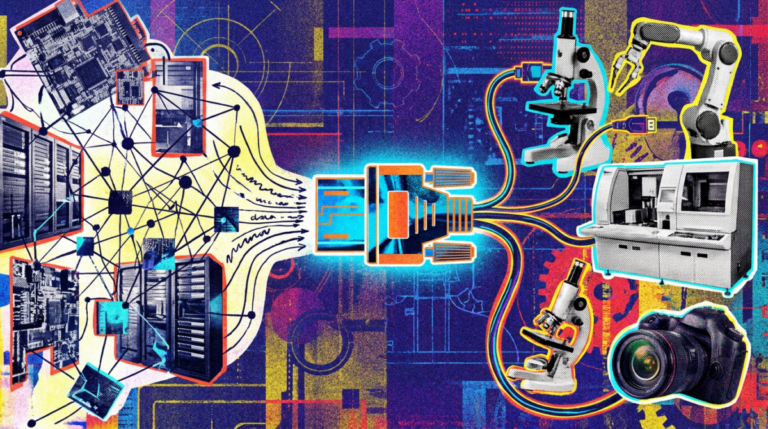
Model Context Protocol is the most significant thing to happen to AI tools in 2025, and it’s still not well understood outside of developer circles. This is the plain-English explanation of what MCP is, why it matters, and what it means for how you use AI day-to-day.
The Problem MCP Solves
Before MCP, if you wanted Claude to access your files, your database, your GitHub, or any external service, you had two options: copy-paste the information into the chat manually, or have a developer build a custom integration.
Every AI tool solved this problem differently, which created chaos. A plugin built for ChatGPT wouldn’t work with Claude. An integration built for one version of an AI API would break when the API changed. There was no standard.
MCP is the standard. It’s the equivalent of USB for AI tools, a common protocol that any tool can speak, any AI can understand, and any developer can build for.
What MCP Actually Is
MCP is an open-source protocol developed by Anthropic and released in November 2024. It defines a structured way for AI models to communicate with external tools called “MCP servers.”
An MCP server is a small program that runs on your computer (or a server you control) and exposes a set of capabilities, called “tools”, that an AI can call. The filesystem MCP server exposes tools like “read_file,” “write_file,” and “list_directory.” The GitHub MCP server exposes “get_repository,” “create_issue,” and “list_pull_requests.” The Postgres MCP server exposes “query” and “describe_table.”
Claude (or any MCP-compatible AI) can discover what tools a server has, decide which one to use for a given task, call it with the right parameters, and use the result, all automatically, without you needing to know anything about how the tool works underneath.
The Architecture in Plain English
Here’s what happens when you ask Claude to “read my project files and write a summary of the architecture”:
- Claude receives your request in the chat
- It checks what MCP servers are connected and what tools they provide
- It decides to use the filesystem server’s “list_directory” tool to see what files exist
- It calls that tool, gets the file list back
- It decides to read several key files using the “read_file” tool
- Each read returns the file contents to Claude
- Claude synthesises all of it and writes your architecture summary
You saw: one request, one response. What happened underneath: Claude autonomously called several external tools, got structured data back, and used it to answer your question.
Why This Is Different From Old-Style Plugins
ChatGPT had plugins before MCP. OpenAI had function calling. These were all proprietary systems, they only worked with specific AI providers.
MCP is provider-agnostic. Anthropic built the spec and open-sourced it. Now other AI providers are adopting it. An MCP server built today for Claude will likely work with other MCP-compatible AI systems in the future. The ecosystem develops once, benefits everyone.
MCP also runs locally. Unlike cloud-based plugin systems, MCP servers run on your machine. Your files never leave your computer to be processed by a third-party plugin service, Claude reads them locally through the MCP server running on your machine.
What MCP Means for Non-Developers
You don’t need to understand the protocol to benefit from it. The practical upshot:
Claude can now connect to things. Files on your computer, your calendar, your email, your code, your databases, your services, any of these can be connected to Claude through MCP servers. The setup is usually a five-minute configuration change.
AI assistants can take actions, not just answer questions. An MCP-connected Claude doesn’t just tell you how to update a file, it can update the file. It doesn’t just explain how to create a GitHub issue, it creates the issue.
Privacy improves, not deteriorates. Because MCP servers run locally, connecting Claude to your files through MCP is actually more private than uploading those files to a cloud service. The data stays on your machine.
The Ecosystem Right Now
As of 2026, there are hundreds of MCP servers available covering:
- File systems and code editors
- Databases (Postgres, MySQL, SQLite, MongoDB)
- Version control (GitHub, GitLab)
- Communication tools (Slack, email)
- Web browsers (Playwright, Puppeteer)
- Web search (Brave, Exa)
- Cloud services (AWS, Google Cloud)
- Productivity tools (Notion, Linear, Jira)
- Custom business tools (increasingly common)
The quality varies significantly, some are production-grade and well-maintained, others are weekend projects. The servers maintained directly by Anthropic (the official @modelcontextprotocol packages) are the most reliable starting point.
Key Takeaways
- MCP is an open standard, like USB, but for connecting AI to tools, developed by Anthropic and released in late 2024
- MCP servers run locally on your machine; your data doesn’t pass through third-party cloud services
- Any MCP-compatible AI can use any MCP server, it’s not locked to Claude
- Non-developers benefit too: connecting Claude to your files, calendar, or notes is a 5-minute setup, not a coding project
- MCP is the foundation that turns AI chatbots into AI agents, the difference between answering questions and actually doing things
AI Maestro covers Claude, MCPs, and the practical AI tools that are actually worth your time.